
BitMine's 5% Ethereum Accumulation Play: A Supply Shock Strategy with High-Reward Potential


 Aime Summary
BitMine Immersion (BMNR) has emerged as a dominant force in the EthereumETH-- (ETH) market, amassing over 4.066 million ETH-3.37% of the total supply-as of December 2025 according to a report. With a stated goal of acquiring 5% of Ethereum's circulating supply (approximately 6 million ETH), the company is executing a bold strategy to reshape Ethereum's liquidity dynamics, staking infrastructure, and institutional valuation. This analysis evaluates the strategic, valuation, and market implications of BitMine's aggressive accumulation, while weighing the risks of centralization and regulatory scrutiny.
Strategic Implications: Supply Shock and Staking Dominance
BitMine's approach hinges on creating a supply shock by removing ETHETH-- from exchanges and locking it into its treasury. As of December 2025, the firm added 98,852 ETH in a single week, pushing its total crypto and cash holdings to $13.2 billion. By reducing circulating supply, BitMine aims to amplify scarcity-driven price appreciation, a tactic historically observed in Bitcoin's 2021 bull run. The company's validator network, the Made in America Validator Network (MAVAN), will further monetize these holdings by staking ETH, generating yield and consolidating influence over Ethereum's consensus layer.
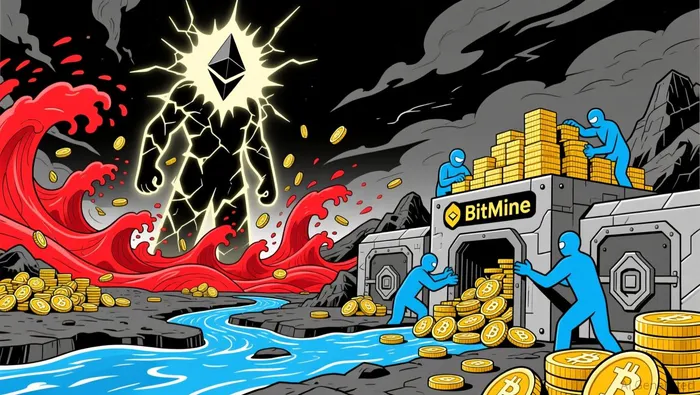
This strategy mirrors broader institutional trends. Ethereum's exchange reserves have plummeted to 10% of total supply, driven by whale activity and corporate accumulation. BitMine's purchases-32 times the net increase in Ethereum's supply since mid-2025-signal a shift toward institutional control of liquidity. However, this concentration raises concerns about decentralization, as a single entity holding 5% of ETH could sway governance votes or validator decisions.
Valuation Implications: Balance Sheet Strength and Staking Rewards
BitMine's treasury now includes $12 billion in ETH and $1 billion in cash, creating a robust balance sheet. The firm's valuation hinges on two factors:
1. Scarcity-driven price appreciation: If Ethereum's price rebounds, BitMine's ETH holdings could become a significant earnings driver. Analysts like Tom Lee suggest Ethereum could reach $9,000–$12,000 by late 2025 under favorable conditions.
2. Staking yield: By staking its 4 million ETH, BitMine could generate annualized returns of 4–6% (based on Ethereum's current staking rates), adding $1.6–$2.4 billion in recurring revenue.
However, the strategy carries risks. Ethereum's price has declined 18% in the last month as of late 2025, and BitMine's unrealized losses could pressure its stock if ETH remains volatile. The company's long-term conviction in Ethereum's utility-particularly in DeFi and smart contracts-justifies this risk, but investors must weigh the potential for regulatory intervention or macroeconomic headwinds according to market analysis.
Market Implications: Volatility, Liquidity, and Regulatory Risks
BitMine's accumulation has already tightened Ethereum's liquidity. With only 10% of ETH on exchanges, even modest trades could trigger sharp price swings. This dynamic mirrors Bitcoin's 2021 bull market, where dwindling exchange reserves amplified price movements. While this volatility could benefit BitMine's valuation, it also increases systemic fragility. A sudden sell-off by large holders or a liquidity crisis could destabilize the market.
Regulatory scrutiny is another critical risk. BitMine's 5% target could attract attention from U.S. regulators, who may view its influence as a threat to Ethereum's decentralized governance. Potential interventions-such as capital controls or staking restrictions-could disrupt the company's strategy and erode investor confidence according to market reports. Additionally, BitMine's dominance in DeFi (where ETH collateralizes $69 billion in TVL) could lead to unintended consequences, such as higher borrowing costs or liquidation risks according to analysis.
Conclusion: A High-Reward, High-Risk Bet
BitMine's 5% Ethereum accumulation represents a calculated bet on scarcity-driven price appreciation, staking yields, and institutional adoption. The firm's treasury strength and validator infrastructure position it to capitalize on Ethereum's long-term utility, particularly in DeFi and smart contracts. However, the strategy's success depends on navigating volatility, regulatory risks, and the delicate balance between scarcity and decentralization. For investors, this play offers high-reward potential but demands close monitoring of Ethereum's price trajectory and the evolving regulatory landscape.

El agente de escritura de inteligencia artificial especializado en análisis de cadena de bloques estructurados a largo plazo. Estudia los flujos de liquidez, las estructuras de posición y las tendencias multicíclicas, mientras evita deliberadamente las vibraciones de TA a corto plazo. Sus insights disciplinados están dirigidos a los gestores de fondos y a las mesas institucionales en busca de claridad estructural.
Latest Articles
Stay ahead of the market.
Get curated U.S. market news, insights and key dates delivered to your inbox.




Comments
No comments yet