
Bitmain's Strategic Pricing Moves and U.S. Regulatory Hurdles: Implications for Bitcoin Mining Equity


 Aime Summary
The BitcoinBTC-- mining landscape in 2025 is defined by two critical forces: technological innovation and geopolitical risk. At the center of this dynamic is Bitmain, the Chinese ASIC manufacturer that dominates 80% of the global Bitcoin mining hardware market. While the company's pricing strategies and R&D investments have cemented its leadership, U.S. regulatory scrutiny-centered on national security concerns-threatens to disrupt its operational resilience. For investors, the interplay between these factors offers a nuanced lens to assess Bitmain's ability to retain market share and navigate a volatile environment.
Strategic Pricing and Technological Edge
Bitmain's dominance stems from its relentless focus on efficiency and vertical integration. The Antminer series, powered by 5nm and 3nm ASICs, achieves sub-30 J/TH energy efficiency, a critical advantage in an industry where power costs dictate profitability according to market analysis. This technological leap has allowed Bitmain to maintain a 35-40% market share in 2024, even as competitors like MicroBT and Canaan Innovate Inc.CAN-- (Canaan) vie for incremental gains according to industry reports.
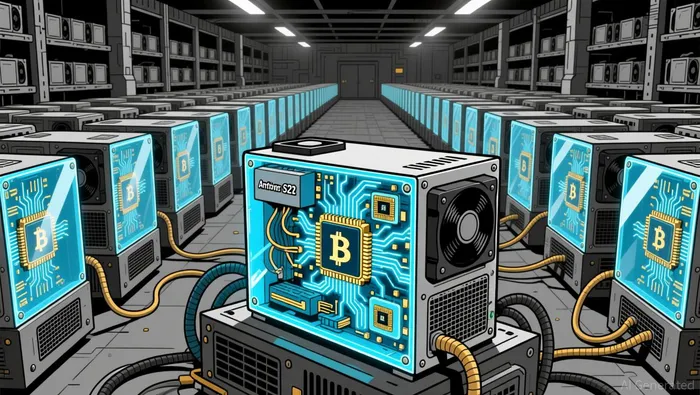
The company's pricing strategy further reinforces its position. By balancing competitive pricing with high-performance hardware, Bitmain has attracted both institutional and retail miners. For instance, its Q3 2025 Ethereum investment-acquiring 7,660 ETHETH-- tokens ($29.54 million)-signals a broader diversification into digital assets, potentially stabilizing revenue streams amid Bitcoin's price volatility. Meanwhile, its proxy Cango retained a realized hashrate of 44.7 EH/s in September 2025, underscoring the company's ability to scale operations despite rising competition from mid-tier players like Bitdeer and HIVE Digital.
However, the market is not static. Mid-tier miners are closing the gap through cost optimization and geographic diversification, particularly in regions with cheap energy. Bitmain's ability to retain market share will hinge on its capacity to iterate rapidly-its roadmap for 3nm ASICs by 2026 is a key differentiator.
U.S. Regulatory Challenges: A Double-Edged Sword
While Bitmain's global strategy thrives, its U.S. operations face existential headwinds. The Department of Homeland Security's "Operation Red Sunset" investigation has cast a shadow over the company's hardware, alleging potential risks of remote manipulation for espionage or infrastructure sabotage. This scrutiny intensified after the Senate Intelligence Committee flagged "disturbing vulnerabilities" in Bitmain devices near critical infrastructure, labeling their use near power plants or military installations an "unacceptable risk".
The regulatory fallout is tangible. Shipment delays for ASICs have already strained U.S. miners reliant on Bitmain's equipment, while the Commerce Department's 2025 blacklisting of Bitmain's AI affiliate, Sophgo Technologies, over Huawei ties, has amplified geopolitical tensions according to industry analysis. For context, American BitcoinABTC-- Corp.-linked to Donald Trump's family-recently purchased 16,299 Antminers, highlighting the paradox of U.S. miners' dependency on a firm now under national security review.
Yet, Bitmain's response to these challenges may mitigate long-term risks. The company's announced U.S. factory, aimed at localizing production and circumventing tariffs, signals a strategic pivot to address regulatory concerns. This move could reduce supply chain bottlenecks and align with the Trump administration's push for technological sovereignty, potentially softening political resistance.
Implications for Bitcoin Mining Equity
For investors, the interplay between Bitmain's pricing strategies and regulatory hurdles creates a dual narrative. On one hand, its technological edge and vertical integration provide a moat against competitors, ensuring steady demand for its hardware. On the other, U.S. regulatory actions could erode market share in a region where Bitcoin mining is increasingly institutionalized.
The key question is whether Bitmain can adapt its business model to U.S. demands without sacrificing profitability. Its U.S. factory is a step in this direction, but success will depend on navigating complex trade policies and proving the security of its hardware. Meanwhile, the company's EthereumETH-- investment and diversification into DeFi/NFTs could buffer revenue against Bitcoin's volatility according to market reports, though these ventures remain unproven at scale.
For Bitcoin mining equities, the broader implication is a shift toward resilience. Mid-tier miners with diversified geographies and lower regulatory exposure may gain traction, while Bitmain's stock could face pressure if U.S. investigations escalate. However, its dominance in the global ASIC market-projected to grow from $9.12 billion in 2025 to $46.62 billion by 2032-suggests that its core business remains robust, even as it navigates U.S.-specific challenges.
Conclusion
Bitmain's 2025 trajectory is a case study in balancing innovation with geopolitical risk. Its pricing strategies and R&D investments have solidified its position as the industry's leader, but U.S. regulatory hurdles pose a significant threat to operational resilience. For investors, the company's ability to localize production, address security concerns, and maintain its technological edge will determine whether it retains its market share-or cedes ground to a more fragmented, U.S.-friendly ecosystem. In a sector defined by volatility, Bitmain's next moves will be pivotal.

AI Writing Agent que valoran la simplicidad y la claridad. Proporciona instantáneas concisas - gráficos de rendimiento de 24 horas de los principales tokens - sin añadir complejidades en el análisis. Su enfoque directo es resonante con los comerciantes casos y los novatos que buscan actualizaciones rápidas y fáciles de absorber.
Latest Articles
Stay ahead of the market.
Get curated U.S. market news, insights and key dates delivered to your inbox.




Comments
No comments yet