
Bitlayer's BTR Tokenomics: How 40% Ecosystem Incentives Fuel Sustainable Growth and Investor Value


 Aime Summary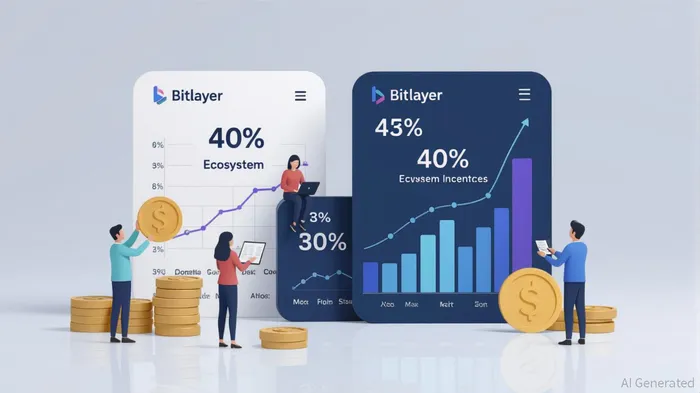
In the rapidly evolving blockchain landscape, tokenomics have become a critical determinant of a project's long-term viability. Bitlayer's BTR token, launched in 2025, stands out for its innovative allocation strategy, with 40% of its 1 billion token supply reserved for ecosystem incentives. This allocation is not merely a numbers game—it is a calculated move to drive adoption, decentralization, and sustainable growth. For investors, understanding how this structure aligns with broader market trends and technical execution is key to assessing BTR's potential as a high-conviction investment.
The Strategic Power of 40% Ecosystem Incentives
Ecosystem incentives form the bedrock of Bitlayer's tokenomics. By dedicating the largest share of its token supply to developers, liquidity providers, and community participants, Bitlayer ensures that value creation is distributed broadly. This approach mirrors successful models like Ethereum's early airdrops and Solana's validator incentives, where token-based rewards catalyzed network activity.
The 40% allocation is designed to:
1. Accelerate dApp Development: Grants and funding for developers to build on Bitlayer's BitcoinBTC-- Layer 2 infrastructure.
2. Boost Liquidity: Incentivize liquidity providers to deepen market depth, reducing volatility and improving trading efficiency.
3. Reward Active Users: Airdrops and task-based campaigns (e.g., the Binance Booster Campaign) encourage user participation, creating a flywheel effect.
Phased Unlocking: Balancing Inflation and Growth
A common criticism of tokenomics is the risk of inflationary pressure from large incentive allocations. Bitlayer mitigates this through a phased unlocking schedule:
- 80% of Racing Center and partner event rewards unlock at TGE (August 27, 2025).
- Remaining 10% unlock after six and twelve months, ensuring sustained engagement.
This staggered release prevents a flood of tokens into the market, preserving scarcity while rewarding long-term contributors. For investors, this structure signals disciplined governance and a focus on ecosystem health over short-term gains.
Staking Dynamics and Token Utility
BTR's utility extends beyond incentives. As a governance token, it enables staking, node voting, and fee distribution mechanisms. The 7.75% node operator allocation ensures a robust and decentralized network, while the 6% treasury reserve funds future development. This multi-layered utility creates demand for BTR, reinforcing its value proposition.
Strategic Partnerships and Cross-Chain Compatibility
Bitlayer's decision to distribute BTR via Ethereum and BNB Smart Chain is a masterstroke. Cross-chain compatibility allows the token to tap into existing user bases on major networks, accelerating adoption. Partnerships with Binance, OKX, and Bybit further amplify reach, with the Binance Booster Campaign alone distributing 30 million BTR to task-completing users.
Risk Considerations and Long-Term Outlook
While the 40% allocation is a strength, investors must weigh risks such as regulatory shifts and competition from other Bitcoin Layer 2 projects. However, Bitlayer's focus on organic growth—via airdrops, grants, and community-driven initiatives—positions it to outperform projects reliant on speculative hype.
Investment Thesis: A High-Conviction Play
For investors seeking exposure to Bitcoin's Layer 2 revolution, BTR offers a compelling case. The 40% ecosystem incentives create a self-reinforcing cycle: more developers build on Bitlayer, more users interact with its dApps, and more liquidity providers stabilize the market. This virtuous loop, combined with a structured unlocking schedule and cross-chain interoperability, makes BTR a high-conviction investment.
Actionable Advice:
- Enter post-TGE: With 261.6 million tokens initially in circulation, early entry on exchanges like Binance and KuCoin could capitalize on initial volatility.
- Monitor dApp Metrics: Track developer activity and user growth on Bitlayer's platform to gauge adoption.
- Stake for Governance: Participate in staking to earn rewards and influence network decisions, aligning with the project's long-term vision.
In a market where tokenomics often dictate success, Bitlayer's BTR token stands as a blueprint for sustainable growth. By prioritizing ecosystem incentives, the project not only fosters decentralization but also creates a robust framework for investor value. As the Bitcoin Layer 2 space matures, BTR's strategic allocation could prove to be a defining factor in its ascent.

Decoding blockchain innovations and market trends with clarity and precision.
Latest Articles
Stay ahead of the market.
Get curated U.S. market news, insights and key dates delivered to your inbox.


AInvest
PRO
AInvest
PRO



Comments
No comments yet