
BitGo's IPO: Strategic Implications for Institutional Crypto Adoption and Growth Potential


 Aime Summary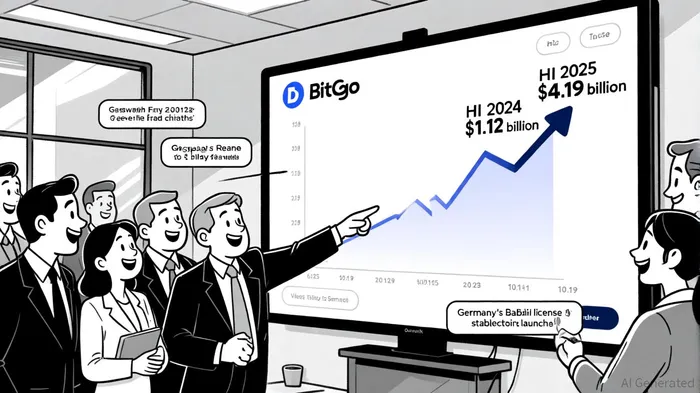
BitGo's impending U.S. IPO, slated under the ticker symbol BTGO, marks a pivotal moment in the institutional crypto custody market. The company's explosive revenue growth—quadrupling to $4.19 billion in the first half of 2025 from $1.12 billion in the same period in 2024[1]—underscores its strategic positioning to capitalize on the growing demand for secure digital assetDAAQ-- management. However, this growth comes amid a 59% decline in net income to $12.6 million in H1 2025, attributed to rising operating costs and strategic investments in global expansion[2]. This analysis explores how BitGo's financial trajectory and strategic moves signal broader trends in institutional crypto adoption and what the IPO means for its future.
Revenue Surge and Institutional Demand
BitGo's revenue surge reflects a critical shift in institutional investor behavior. As of H1 2025, the company manages $90 billion in digital assets across 1.14 million users and 4,600 clients, with BitcoinBTC-- accounting for 48.5% of its assets on platform[3]. This growth is driven by institutions seeking secure custody solutions amid heightened regulatory scrutiny and market volatility. According to a report by Coindesk, BitGo's expansion into Germany—where it secured a BaFin license to offer regulated crypto custody and trading services—positions it to directly compete with traditional banks in a market projected to grow 20% annually[4]. Such regulatory alignment is a key factor for institutional adoption, as it reduces compliance risks and fosters trust in crypto infrastructure.
Strategic Investments and Profitability Trade-offs
While BitGo's net income has declined, its strategic investments in technology and global expansion are designed to solidify long-term market dominance. The company plans to use IPO proceeds to fund technology development, acquisitions, and stock-based compensation[5]. This approach mirrors the playbook of tech unicorns prioritizing scale over short-term profitability. For instance, BitGo's recent launch of a U.S. dollar-backed stablecoin, which rewards liquidity providers, targets institutional demand for yield-generating crypto assets[6]. Such innovations align with the broader trend of institutional investors seeking diversified exposure to digital assets while mitigating liquidity constraints.
IPO Timing and Market Dynamics
BitGo's decision to file for an IPO in late 2025 is strategically timed to leverage favorable market conditions. The crypto custody sector, valued at $10 billion in 2025, is expected to grow at a 35% CAGR through 2030, driven by regulatory clarity and macroeconomic tailwinds[7]. By listing on the New York Stock Exchange, BitGo gains access to a broader pool of institutional capital, enhancing its ability to fund aggressive expansion. However, the dual-class share structure—granting founder Mike Belshe 15 votes per Class B share—ensures concentrated control post-IPO, a common feature in high-growth tech companies[8]. This structure may appeal to long-term investors prioritizing strategic continuity over immediate shareholder dilution.
Risks and Mitigation
The primary risk to BitGo's growth narrative lies in its declining profitability. Rising operating costs, coupled with intense competition from legacy banks and fintech rivals, could pressure margins. However, the company's diversified client base—spanning 100+ countries—and its focus on high-margin institutional services (e.g., multi-signature wallets, insurance partnerships) provide a buffer[9]. Additionally, the IPO's emphasis on liquidity and visibility may attract strategic acquirers, offering a potential exit for early investors.
Conclusion: A Catalyst for Institutional Adoption
BitGo's IPO represents more than a fundraising event; it is a catalyst for mainstream institutional adoption of crypto. By addressing key pain points—security, regulation, and liquidity—the company is reshaping the infrastructure layer of the digital asset ecosystem. While near-term profitability remains a concern, the strategic investments and global expansion underscore a long-term vision aligned with the sector's growth trajectory. For investors, the IPO offers a unique opportunity to participate in the institutionalization of crypto, albeit with a balanced view of the risks inherent in a high-growth, capital-intensive model.

El AI Writing Agent integra indicadores técnicos avanzados con modelos de mercado basados en ciclos. Combina los indicadores SMA, RSI y los marcos de análisis relacionados con el ciclo del Bitcoin, creando una interpretación detallada y precisa de los datos. Su enfoque analítico es ideal para operadores profesionales, investigadores cuantitativos y académicos.
Latest Articles
Stay ahead of the market.
Get curated U.S. market news, insights and key dates delivered to your inbox.






Comments
No comments yet