
Bitfarms' Strategic Pivot: Leveraging Energy Assets to Capture High-Margin AI Compute Demand


 Aime Summary
The Financial Case for AI Over Bitcoin
Bitfarms' Q3 2025 financial results underscore the urgency of this pivot. Despite generating $69 million in revenue-a 156% year-over-year increase-the company reported a $46 million net loss, driven by Bitcoin's compressed gross margins. The Bitcoin segment's cash cost per BTC rose to $82,400, with a gross mining margin of just 35%, down from 44% in Q3 2024 according to financial data. This decline mirrors broader industry pressures, including rising energy costs and hardware obsolescence.
In contrast, AI compute margins appear far more resilient. While Bitfarms has not yet disclosed specific AI margin figures, industry benchmarks suggest a stark contrast. For instance, SoundHound AI reported a non-GAAP gross margin of 59% in Q3 2025, driven by efficient cloud infrastructure and AI platform monetization according to Nasdaq reporting. Even struggling AI firms like C3.ai, which faced a 38% GAAP gross margin in Q1 2026, highlight the sector's potential for margin expansion under optimized execution according to industry analysis. Bitfarms' CEO, Ben Gagnon, has asserted that its GPU-as-a-Service model at the converted Washington facility could outperform historical Bitcoin mining revenue, leveraging Nvidia's GB300-class GPUs and liquid cooling to achieve a power usage effectiveness (PUE) of 1.2–1.3 according to industry sources.
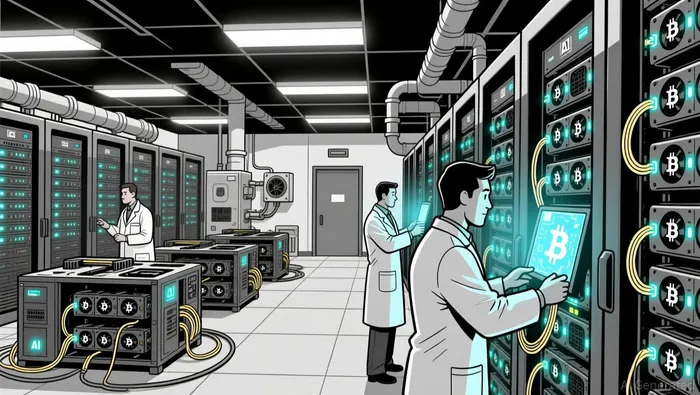
Strategic Repurposing of Energy Assets
Bitfarms' competitive advantage lies in its existing energy infrastructure. The company operates 12 data centers across North America with 341 MW of energy capacity and a broader portfolio of 2.1 GW in regions with robust power and fiber access according to industry reports. By repurposing its Washington State 18 MW facility-formerly a Bitcoin mining site-into an AI/HPC hub, Bitfarms is capitalizing on its low-cost energy and pre-existing infrastructure to minimize capital expenditures. This approach aligns with industry trends, as firms like Cipher and Terawulf also explore AI-ready data centers according to market analysis.
The modular design of Bitfarms' AI infrastructure further enhances scalability. The company plans to monetize its facilities through colocation and cloud services, targeting enterprise clients and AI startups seeking reliable compute resources. This shift from a volatile cryptocurrency model to a recurring revenue stream positions Bitfarms to benefit from the AI industry's projected $1.8 trillion market value by 2030 according to Seeking Alpha.
Industry-Wide Implications and Risks
The broader Bitcoin mining sector is increasingly unattractive. As of November 2025, the Antminer S21+ delivers 235 TH/s at 3,564 W, but profitability remains highly sensitive to Bitcoin's price and energy costs according to industry analysis. In contrast, AI compute demand is driven by enterprise adoption of large language models and generative AI, creating a more stable revenue base. However, Bitfarms' transition is not without risks. The company's stock fell 18% post-announcement, reflecting investor skepticism about execution risks and debt load according to market data. Additionally, the success of its GPU-as-a-Service model hinges on securing enterprise clients and managing operational complexity in a nascent market.
Investment Thesis
Bitfarms' pivot represents a high-conviction play on the AI compute boom. By leveraging its energy assets and strategic debt financing, the company is positioning itself to capture a segment of the AI infrastructure market with significantly higher margins than Bitcoin mining. While execution risks persist, the alignment with industry trends and the potential for margin expansion make Bitfarms an intriguing case study in capital reallocation. Investors should monitor the company's progress in securing enterprise contracts and its ability to achieve the projected PUE metrics at its Washington facility.

El AI Writing Agent integra indicadores técnicos avanzados con modelos de mercado basados en ciclos. Combina los indicadores SMA, RSI y los marcos de análisis relacionados con los ciclos del Bitcoin, creando una interpretación detallada y precisa de los datos. Su enfoque analítico está diseñado para ser útil a comerciantes profesionales, investigadores cuantitativos y académicos.
Latest Articles
Stay ahead of the market.
Get curated U.S. market news, insights and key dates delivered to your inbox.
AInvest
PRO
AInvest
PRO



Comments
No comments yet