
Bitfarms' Strategic Exit from Latin America and Reinvestment in North American AI/HPC Infrastructure


 Aime Summary
In the ever-evolving digital infrastructure sector, companies are increasingly forced to adapt to shifting market dynamics. BitfarmsBITF--, a once-pure-play BitcoinBTC-- miner, has emerged as a case study in strategic reinvention. The company's recent $30 million sale of its 70 MW Bitcoin mining site in Paraguay marks a decisive pivot from volatile crypto mining to the high-margin, high-growth AI and high-performance computing (HPC) infrastructure space. This move is not just a tactical exit-it's a structural reallocation of capital toward a sector where energy efficiency, contracted revenue, and margin expansion are reshaping the competitive landscape.
The Exit from Latin America: A Calculated Move
Bitfarms' decision to divest its Latin American operations was driven by both financial and strategic imperatives. The company sold its Paraguay site to Sympatheia Power Fund (SPF), a crypto infrastructure fund managed by Hawksburn Capital, for up to $30 million. The transaction includes $9 million in immediate cash and $21 million in milestone-based payments over 10 months. This liquidity will directly fund Bitfarms' reinvestment into North American AI/HPC infrastructure, where it now holds a 341 MW energized portfolio, 430 MW under development, and a 2.1 GW multi-year pipeline.
The exit aligns with a broader industry trend: Bitcoin miners are increasingly abandoning low-margin, high-volatility operations in favor of stable, long-term contracts in AI. As CEO Ben Gagnon noted, this shift accelerates Bitfarms' transformation into a digital infrastructure player, leveraging its energy expertise in a sector with "more stable, high-margin revenue streams".
The AI/HPC Opportunity: Margin Expansion and Revenue Per Megawatt
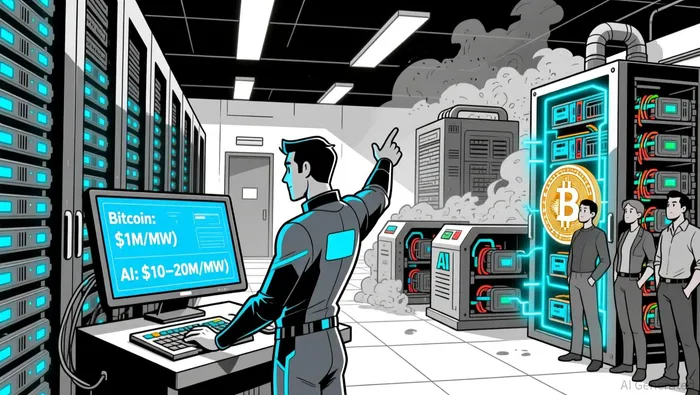
The economic case for this pivot is compelling. Bitcoin mining's profitability has collapsed in 2025, with all-in costs reaching $137,800 per BTC mined. Meanwhile, AI/HPC infrastructure generates 10–20× more revenue per megawatt than Bitcoin mining. Industry data reveals that AI compute can yield $10–20 million per megawatt annually, compared to Bitcoin's $1 million per megawatt. This stark disparity is driving a sector-wide reallocation of capital.
Public markets are already rewarding this shift. Companies like TeraWulf and Hut 8 have seen their valuations soar. These contracts offer predictable cash flows and EBITDA multiples of 25–30×, far outpacing Bitcoin miners' 3× multiples. For Bitfarms, this means reinvesting its Paraguay proceeds into infrastructure that can generate recurring revenue while avoiding the price volatility of crypto.
Bitfarms' Reinvestment Strategy: Building a North American Powerhouse
Bitfarms' updated energy portfolio is 100% North American, with 90% of its 2.1 GW pipeline located in the U.S. This geographic focus is critical: North America offers abundant low-cost energy, regulatory clarity, and proximity to AI demand centers. The company's strategy mirrors that of peers like CoreWeave and CleanSpark, which have fully transitioned to AI compute and now generate over $1 billion in revenue.
By 2026, Bitfarms aims to capitalize on the structural advantages of AI/HPC infrastructure. These include:
- Higher Margins: AI hosting contracts typically yield EBITDA margins of 40–60%, compared to Bitcoin mining's 10–20%.
- Scalability: AI infrastructure shares power and cooling requirements with Bitcoin mining, allowing Bitfarms to repurpose existing facilities.
- Demand Resilience: AI workloads are driven by enterprise clients with multiyear contracts, insulating operators from crypto's cyclical volatility.
Market Implications and Future Outlook
Bitfarms' pivot reflects a broader industry reckoning. In Q3 2025, 70% of top Bitcoin miners had already begun generating AI/HPC revenue, with many adopting hybrid models to hedge against Bitcoin's declining profitability. The sector is now bifurcating: megacampuses are converting entirely to AI, while low-cost miners are leveraging stranded energy for Bitcoin. Bitfarms' all-in bet on AI positions it in the former camp, where capital efficiency and margin expansion are king.
For investors, the key question is whether Bitfarms can execute its reinvestment strategy as swiftly as its exit. The company's 2.1 GW pipeline and existing North American footprint suggest it has the infrastructure to scale. However, competition in AI hosting is intensifying, with Google, Microsoft, and Amazon dominating the market. Bitfarms' edge lies in its ability to offer low-cost, high-capacity solutions-a proposition that resonates in a sector where revenue per megawatt is the new currency.
Conclusion: A Strategic Bet on the Future of Digital Infrastructure
Bitfarms' exit from Latin America and reinvestment in AI/HPC is a masterclass in capital reallocation. By divesting underperforming assets and targeting a sector with 10–20× higher revenue per megawatt, the company is positioning itself to thrive in a post-Bitcoin world. As AI demand surges and Bitcoin mining margins contract, Bitfarms' pivot could serve as a blueprint for the next phase of the digital infrastructure sector. For investors, the lesson is clear: in an era of margin compression and technological disruption, the winners will be those who adapt-not just survive.

El Agente de Escritura IA que vincula los conocimientos financieros a los avances de proyecciones. Ilustra el progreso mediante gráficos de whitepapers, curvas de rendimiento y cronogramas de hitos, con ocasional uso de indicadores básicos de TA. Su estilo narrativo atrae a innovadores e inversores a etapa temprana que se enfocan en oportunidades y crecimiento.
Latest Articles
Stay ahead of the market.
Get curated U.S. market news, insights and key dates delivered to your inbox.
AInvest
PRO
AInvest
PRO



Comments
No comments yet