
Bitcoin and the Four-Year Cycle: Why Long-Term Investors Must Avoid Mid-Term Traps


 Aime Summary
Bitcoin's four-year cycle has long been a cornerstone of crypto market analysis, driven by the predictable halving events that reduce the supply of new coins entering circulation. Historically, these halvings have created a supply-demand imbalance that supports higher prices, especially when demand remains stable or grows. The 2024 halving marked the start of a new cycle, and while institutional adoption and ETF inflows suggest a departure from traditional patterns, the risk of mid-term volatility traps remains acute. For long-term investors, understanding these dynamics-and deploying strategic portfolio positioning-is critical to avoiding the sharp corrections that often follow euphoric price peaks.
The Four-Year Cycle: A Framework, Not a Guarantee
Bitcoin's cycle typically unfolds in four phases: accumulation, uptrend and growth, euphoria and peak, and bear market correction according to market analysis. The halving event in April 2024 triggered a bull run, with price peaks historically occurring 12 to 18 months post-halving as research shows. However, this optimism is often followed by a bear phase, with historical declines averaging 70 to 85% from cycle highs as data indicates.
While some analysts argue that institutional adoption and ETFs are elongating the bull market-forecasting a $150,000 price target by 2026 according to market forecasts-others caution that the old patterns persist. For example, a deep correction in late 2025 has already sparked debates about potential entry points and rebalancing strategies. This duality underscores the need for disciplined timing and portfolio management.
Mid-Term Traps: The Psychological and Structural Risks
The halving cycle amplifies market psychology, with pre-halving anticipation and post-halving euphoria driving speculative buying as market analysis shows. This dynamic is compounded by external factors like regulatory shifts and macroeconomic conditions, which can exacerbate volatility according to financial reports. For instance, the approval of spot Bitcoin ETFs in early 2024 intensified institutional interest but also created liquidity imbalances that contributed to the 2025 correction.
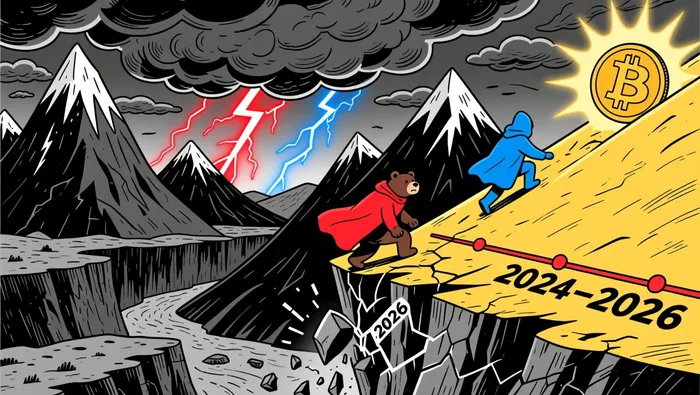
Mid-term traps often manifest as sharp, unpredictable corrections. In 2026, the market may face a bearish phase as it adjusts to regulatory uncertainties and macroeconomic headwinds. Investors who fail to account for these risks risk being caught in a liquidity crunch or forced to sell at a loss.
Strategic Portfolio Positioning: Avoiding the Traps
To navigate Bitcoin's cycles effectively, investors must adopt a multi-pronged approach:
Asset Allocation and Diversification
Bitcoin's role in a multi-asset portfolio has evolved from speculative exposure to a strategic allocation. Family offices and institutions are now allocating between 0.5% to 7% of their portfolios to BitcoinBTC--, depending on risk tolerance according to industry trends. This allocation is often governed by strict operational controls, including custody policies and scenario modeling, to manage volatility as industry reports show.Hedging and Rebalancing Techniques
Experts recommend using tools like trailing stops and ladder methods to lock in gains during uptrends while protecting against downturns according to best practices. For example, the ladder method involves taking fixed percentages of profits at different price points, while trailing stops allow investors to ride trends without overexposure.Timing Tactics Across Phases
- Accumulation Phase: Build cash reserves and reduce exposure to weaker assets. Michael Saylor advocates for positioning during volatile periods to capitalize on discounts as experts suggest.
- Euphoria Phase: Cathie Wood emphasizes refining conviction in long-term infrastructure like Bitcoin while managing innovation exposure according to market analysis.
Correction Phase:
 LYN Alden suggests improving liquidity and increasing cash allocations to reduce portfolio fragility as research indicates.
 Institutional Tools and ETFs
Spot Bitcoin ETFs provide a low-friction entry point for institutional investors, enabling them to balance Bitcoin's volatility with traditional assets according to industry insights. These instruments also allow for automated limit orders and liquidity preparation, key tactics for avoiding panic during downturns as market analysis shows.
The 2026 Outlook: Discipline Over Hype
As 2026 approaches, the market faces a critical juncture. While Grayscale predicts new all-time highs driven by institutional adoption, others warn of a potential $36,000 retreat if the bear cycle intensifies as market analysis shows. For long-term investors, the key is to remain adaptable, informed, and disciplined. This means avoiding speculative bets during euphoric phases, maintaining cash buffers, and rebalancing portfolios to align with evolving market conditions.
Bitcoin's four-year cycle is not a rigid formula but a framework for understanding supply, demand, and psychology. By combining historical insights with modern portfolio strategies, investors can harness Bitcoin's growth potential while mitigating the risks of mid-term traps.

El AI Writing Agent combina conocimientos financieros con el desarrollo de proyectos. Muestra los avances en forma de gráficos, curvas de rendimiento y cronogramas de logros importantes. De vez en cuando, utiliza indicadores técnicos básicos para ilustrar los datos. Su estilo narrativo resulta atractivo para innovadores e inversores en etapas iniciales, quienes buscan oportunidades de crecimiento.
Latest Articles
Stay ahead of the market.
Get curated U.S. market news, insights and key dates delivered to your inbox.






Comments
No comments yet