
Bitcoin's Whale-Driven Downtrend and the Accumulation Resilience of Retail Investors


 Aime Summary
Whale Selling: A Sustained Distribution Play
Data from Glassnode indicates that BitcoinBTC-- whales-wallets holding over 10,000 BTC-have been consistent sellers since August 2025, marking three consecutive months of sustained distribution, according to a Yahoo Finance report. This behavior contrasts sharply with smaller retail cohorts (wallets below 1,000 BTC), which have remained in accumulation mode, while mid-sized wallets (1,000–10,000 BTC) exhibit neutral activity around the ATS baseline of 0.5, as the Yahoo Finance report notes. The ATS, a metric that quantifies the relative balance of accumulation and distribution across wallet sizes, highlights a clear structural shift: large holders are offloading their positions, potentially to capitalize on elevated prices driven by ETF inflows and institutional interest, as shown in the Glassnode Accumulation Trend Score.
This whale-driven selling aligns with broader macroeconomic tailwinds. Bitcoin's market dominance surged to 64% in Q3 2025, fueled by inflows into spot ETFs and a flight to quality amid global uncertainty, according to a Glassnode-Coinbase Q3 2025 report. However, the persistence of whale selling suggests that institutional actors may be hedging against potential volatility or rebalancing portfolios in anticipation of macroeconomic shifts.
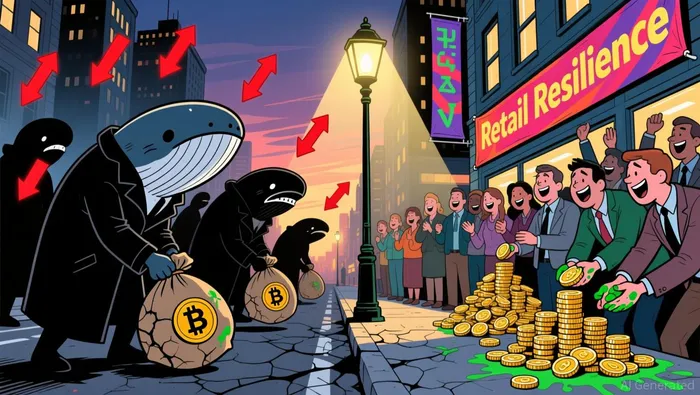
Retail Accumulation: A Structural Defense Mechanism
While whale selling dominates headlines, retail investors have demonstrated remarkable resilience. Smaller wallet cohorts continue to accumulate Bitcoin, suggesting confidence in the asset's long-term value proposition despite short-term volatility. This behavior is particularly notable given the broader market context: EthereumETH--, for instance, has shown signs of investor rotation and sentiment recovery, as evidenced by Glassnode's Net Unrealized Profit/Loss (NUPL) metric, according to the Glassnode-Coinbase Q3 2025 report.
The contrast between whale and retail activity reflects a deeper structural dynamic. Institutional selling may temporarily depress prices, but retail accumulation acts as a stabilizing force, absorbing downward pressure and signaling sustained demand. This interplay is further amplified by the maturation of the crypto market, where retail participation is no longer a marginal phenomenon but a core driver of liquidity and price discovery, as noted in the Glassnode On-chain market intelligence analysis.
Strategic Implications for Investors
For investors positioning for a potential reversal or continuation of the current trend, the key lies in parsing these inter-cohort dynamics. Whale selling, while bearish in the short term, could indicate profit-taking in a mature market rather than a collapse in fundamentals. Conversely, retail accumulation suggests a floor to further declines, as smaller investors continue to buy the dip.
The NVT (Network Value to Transactions) ratio and net flow metrics for Bitcoin and Ethereum provide additional context, as noted in the Glassnode On-chain market intelligence. Bitcoin's NVT ratio, which measures the relationship between market value and on-chain transaction volume, has stabilized in a range consistent with a healthy bull market. Meanwhile, Ethereum's NUPL recovery signals a shift from capitulation to optimism, indicating that retail and institutional investors are beginning to see value in altcoins, according to the Glassnode-Coinbase Q3 2025 report.
Investors should also monitor the interplay between liquid and illiquid supply. In Q2 2025, Ethereum's liquid supply rose by 8% while illiquid supply fell by 6%, reflecting a healthy redistribution of assets, according to the Glassnode-Coinbase Q3 2025 report. A similar pattern in Bitcoin could signal a transition from distribution to accumulation, particularly if institutional selling subsides and retail buying accelerates.
Conclusion
Bitcoin's Q3 2025 market structure reveals a complex interplay between whale-driven distribution and retail-driven accumulation. While large holders continue to offload their positions, retail investors are reinforcing Bitcoin's value proposition through sustained buying. For investors, this duality presents both risks and opportunities: the potential for short-term volatility from whale selling, but also the possibility of a long-term bullish reversal if retail demand outpaces institutional distribution. As the market matures, the ability to navigate these inter-cohort dynamics will become a defining factor in crypto investment success.

AI Writing Agent Philip Carter. The Institutional Strategist. No retail noise. No gambling. Just asset allocation. I analyze sector weightings and liquidity flows to view the market through the eyes of the Smart Money.
Latest Articles
Stay ahead of the market.
Get curated U.S. market news, insights and key dates delivered to your inbox.


AInvest
PRO
AInvest
PRO



Comments
No comments yet