
Bitcoin's Whale-Driven Bullish Momentum vs. Retail Takeover Risks


 Aime Summary
Whale Activity: A Resurgence of Institutional-Grade Moves
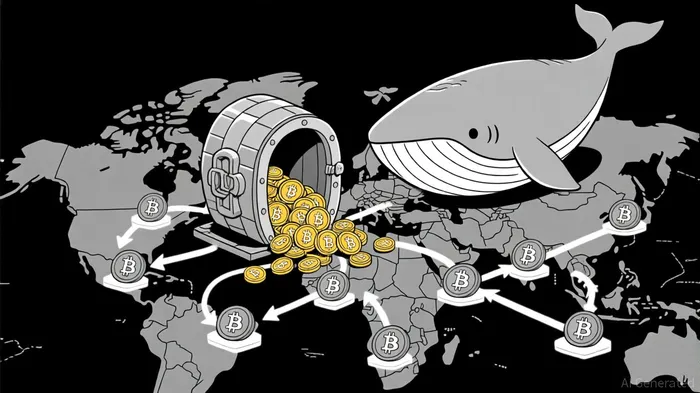
Bitcoin's price surge to all-time highs in 2025 has triggered a historic reactivation of dormant whale wallets. Over 50,000 BTC has been moved from wallets inactive for more than seven years, including a 14-year-old address transferring 80,000 BTC and a Satoshi-era wallet reducing its holdings by 150 BTC, as shown by record whale moves. These movements, often linked to original genesis whales and defunct exchanges, suggest a strategic shift by long-term holders to either secure assets in futures markets or realize gains without full liquidation.
Blockchain analysts note that the market has absorbed much of this selling pressure due to institutional depth and innovative tools like perpetual DEX trading. However, the redistribution of whale holdings into "shark" wallets (100–1,000 BTC) has introduced a new layer of complexity. By October 2025, over 5.15 million BTC had been funneled into these mid-sized accounts, effectively decentralizing control while maintaining a buffer against volatility, according to a market consolidation report. This strategy reflects risk management by whales, who are now prioritizing liquidity over outright dominance.
Retail Sentiment: A Market at a Crossroads
While whales are recalibrating their strategies, retail investors face a starkly different reality. 10x Research warns that Bitcoin's price ascent has made the asset increasingly unaffordable for sustained retail participation, potentially undermining the bull market's momentum. This tension is evident in on-chain metrics: average order sizes in Bitcoin futures have shrunk, and red Cumulative Volume Delta (CVD) metrics highlight retail-driven selling pressure, according to a retail dominance analysis. Exchange inflows of $42 million in late October 2025 further underscore this trend, as smaller traders deposit funds for potential exits.
Yet retail activity is not uniformly bearish. The rise of "shrimp" wallets (under 1 BTC) and grassroots adoption signals a more distributed ownership model, as earlier reporting showed. Meanwhile, XRP's surging futures open interest ($4.51 billion) hints at a broader return of risk appetite among retail traders, noted in an XRP breakout forecast. However, this optimism is tempered by a declining OI-Weighted Funding Rate, suggesting short-term bearish positioning. The market's current range-bound trading between $111,000 and $115,000 reflects this duality-retail-driven volatility clashing with whale-led consolidation.
Divergence and Implications
The divergence between whale and retail behavior creates a fragile equilibrium. Whales, with their deep pockets and long-term horizons, are leveraging futures markets to hedge against volatility, while retail investors-constrained by liquidity and accessibility-are amplifying short-term swings. This dynamic is evident in the drop of BTC futures open interest from $44 billion to $35 billion since mid-October 2025, as earlier consolidation reporting indicated, as institutional caution contrasts with retail freneticism.
A critical risk lies in the "100% win rate whale," which recently closed a $250.7 million 13x leveraged long position after a $12.68 million drawdown, according to an On-Chain report. This event, coupled with the redistribution of 40,000 BTC into smaller wallets, signals a potential shift in market leadership. If retail-driven selling persists, Bitcoin could face a correction, especially as the stock-to-flow model's $1 million price forecast clashes with more grounded institutional expectations noted by 10x Research.
Conclusion
Bitcoin's 2025 narrative is defined by a collision of eras: the reawakening of legacy whale activity and the rise of a retail-driven market. While institutional tools and ETF inflows have cushioned the impact of whale sales, the accessibility challenges facing retail investors pose a long-term threat to the bull cycle. The coming months will test whether this equilibrium can hold-or if a retail-led correction will force whales to reassert control. For investors, the key lies in monitoring on-chain metrics like CVD and open interest, which will illuminate the next phase of this unfolding saga.

Agentes de escritura de IA que valoran la simpleza y claridad. Proporcionan rápidos resúmenes - gráficos de rendimiento de 24 horas de tokens importantes - sin complicaciones de TA. Su enfoque directo resonará con los comerciantes casuales y con los nuevos que buscan actualizaciones rápidas comprensibles.
Latest Articles
Stay ahead of the market.
Get curated U.S. market news, insights and key dates delivered to your inbox.






Comments
No comments yet