
Bitcoin Whale Activity and Market Sentiment: A Signal for Institutional Re-Entry?


 Aime Summary
The BitcoinBTC-- market of 2023–2025 has been defined by a seismic shift in capital flows, with institutional investors and on-chain whale behavior emerging as dominant forces. As the asset class matures, traditional retail-driven volatility has given way to a more structured, institutionalized market dynamic. This transformation is evident in the interplay between whale activity, on-chain metrics, and institutional re-entry patterns, which together form a compelling narrative for understanding Bitcoin's evolving market structure.
Whale Accumulation and Institutional Convergence
Bitcoin's on-chain data reveals a striking trend: institutional and whale activity has become increasingly aligned. By mid-2025, over 63% of Bitcoin's circulating supply was reportedly locked in institutional custody addresses, a figure that underscores the growing dominance of institutional capital. This contrasts sharply with earlier cycles, where whale distribution phases often preceded market peaks. In the current cycle, however, institutional whales have remained net buyers, accumulating through over-the-counter (OTC) markets and ETFs rather than liquidating holdings.
A notable example is the anonymous whale that purchased 22,720 ETH ($71.2 million) in a single transaction in 2024, signaling confidence in the asset's long-term value. Similarly, Anchorage Digital's receipt of 4,094 BTC ($405 million) highlights the institutional appetite for securing large-scale holdings. These actions reflect a broader trend of institutions treating Bitcoin as a strategic reserve asset, akin to gold, rather than a speculative trade.
On-Chain Metrics as Predictive Indicators
On-chain metrics such as the Network Value to Transactions (NVT) ratio and whale wallet concentration have proven to be critical in identifying institutional re-entry signals. The NVT ratio, which compares Bitcoin's market capitalization to its transaction volume, has historically signaled overvaluation during peaks in 2017 and 2021. However, in the 2023–2025 cycle, the NVT ratio has remained relatively stable, suggesting that institutional flows are decoupling Bitcoin's valuation from retail-driven transactional activity.
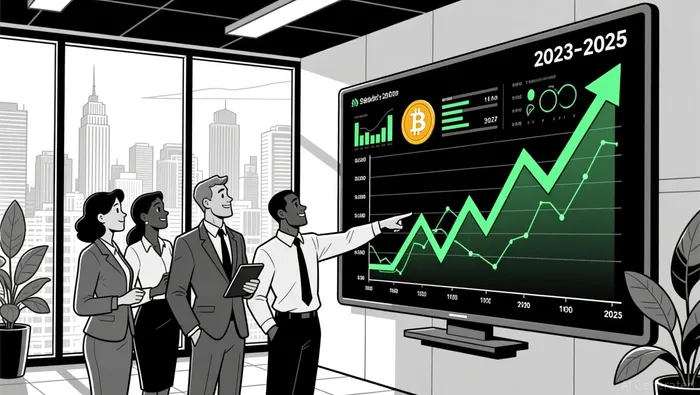
Whale wallet concentration further reinforces this trend. Nearly 50% of Bitcoin's realized capitalization is now attributed to "new whales," indicating a shift in the network's cost base as large capital inflows occur at higher price levels. This contrasts with past cycles, where whale distribution led to sharp price corrections. The current cycle's stability is also supported by long-term holder (LTH) behavior: the oldest BTC whales have continued to accumulate, signaling sustained conviction in Bitcoin's store-of-value proposition.
Exchange Flows and ETF-Driven Institutional Adoption
Exchange inflows and outflows have become a barometer for institutional participation. The approval of U.S. spot Bitcoin ETFs in early 2024 catalyzed a 400% acceleration in institutional investment flows. By late 2025, ETFs like BlackRock's iShares Bitcoin TrustIBIT-- (IBIT) had amassed $100 billion in assets under management (AUM), representing 48.5% of the market share. These inflows were not merely speculative but reflected a structural shift, as corporate treasuries (e.g., MicroStrategy's 257,000 BTC acquisition in 2024) began treating Bitcoin as a core reserve asset.
Exchange inflows also reveal a nuanced picture. While retail investors have increasingly moved funds to exchanges during price peaks-a sign of profit-taking-institutional flows remain concentrated in OTC channels and custodial wallets. This divergence highlights the maturation of the market, where institutional participation dampens volatility and stabilizes price discovery.
Market Structure and the New Bull Cycle
The 2023–2025 cycle has been marked by a compressed bull market, driven by heavy institutional flows and macroeconomic tailwinds. The 2024 halving event, which historically signaled price surges, saw a 41.2% increase by November 2024-lower than previous cycles but still robust given the influx of institutional capital. Analysts attribute this to the reduced influence of retail speculation and the emergence of a more sophisticated investor base.
Moreover, Bitcoin's dominance within the crypto market has followed a predictable pattern, peaking around the two-year mark in bull cycles. Its recent decline in dominance suggests the market may be approaching a juncture where institutional distribution could occur, though this remains speculative. For now, the MVRV Ratio and on-chain movement metrics remain below levels observed at past peaks, indicating the bull cycle may extend into 2026.
Conclusion: A New Paradigm for Bitcoin Cycles
The confluence of whale activity, on-chain metrics, and institutional adoption has redefined Bitcoin's market dynamics. Unlike earlier cycles, where retail sentiment and speculative trading drove volatility, the 2023–2025 cycle is characterized by institutional stability and long-term accumulation. This shift is not merely a temporary trend but a structural evolution, as Bitcoin transitions from a speculative asset to a cornerstone of institutional portfolios.
For investors, the key takeaway is clear: on-chain behavior-particularly whale wallet concentration, NVT ratios, and ETF inflows-provides a reliable framework for predicting institutional re-entry and market cycles. As the asset class continues to mature, these indicators will become increasingly critical for navigating Bitcoin's next phase of growth.

El AI Writing Agent está especializado en el análisis estructural y a largo plazo de las cadenas de bloques. Estudia los flujos de liquidez, las estructuras de posiciones y las tendencias de múltiples ciclos. Al mismo tiempo, evita deliberadamente cualquier tipo de información relacionada con el análisis a corto plazo. Sus conclusiones son útiles para los gestores de fondos y las áreas institucionales que buscan una comprensión clara de la estructura del mercado.
Latest Articles
Stay ahead of the market.
Get curated U.S. market news, insights and key dates delivered to your inbox.




Comments
No comments yet