
Bitcoin Whale Activity and Its Implications for Institutional Onboarding in Q3 2025


 Aime Summary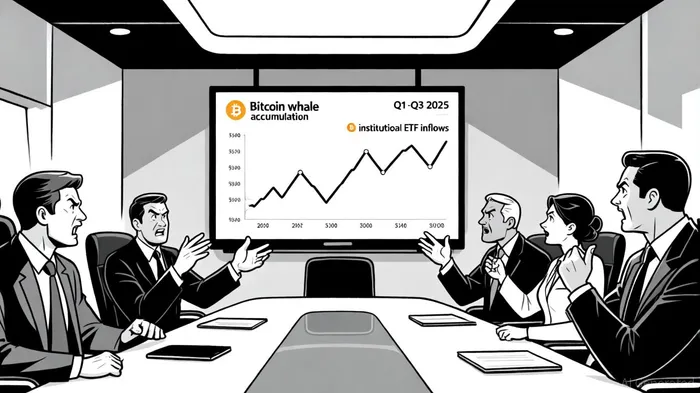
The Whale-Driven Shift in Institutional BitcoinBTC-- Dynamics
Bitcoin's Q3 2025 market narrative is defined by two interlocking forces: aggressive whale accumulation and institutional capital flows. Large holders—wallets controlling 10 to 10,000 BTC—have added over 53,600 BTCBTC-- to their holdings since late March 2025, signaling long-term confidence despite price volatility[1]. This trend, coupled with record institutional adoption, is reshaping Bitcoin's role in global finance.
Whale Accumulation: A Bullish Structural Signal
Whale activity in Q3 2025 has been characterized by strategic buying during price dips. For instance, a single whale alone purchased $200 million worth of Bitcoin, bringing their total holdings to $1.3 billion[1]. On-chain data reveals that whale addresses holding over 100 BTC increased their positions by 130,912 coins, a move historically aligned with bullish trends[1]. This accumulation is not speculative but structural, as whales increasingly shift to cold storage. A July 2025 transfer of 40,000 BTC ($4.35 billion) to Galaxy DigitalGLXY-- exemplifies this trend, with analysts noting it reflects a “bearish short-term, bullish long-term” strategy[4].
The psychological impact of whale activity on retail investors has amplified market instability, as traders react to large sell-offs or buy-ins. However, institutional capital has acted as a stabilizing force. For example, ETF inflows absorbed $602 million in new capital on July 3, 2025, mitigating the volatility caused by whale movements[4].
Institutional Onboarding: A New Market Paradigm
Institutional adoption of Bitcoin has accelerated, driven by regulatory tailwinds and macroeconomic factors. The U.S. 401(k) eligibility for Bitcoin, enacted via an August 2025 executive order, unlocked an $8.9 trillion capital pool[1]. By mid-2025, U.S. spot Bitcoin ETFs had attracted $65 billion in assets under management, with BlackRock's iShares Bitcoin Trust (IBIT) alone capturing $18 billion in Q1 2025[2]. This influx has reduced Bitcoin's annualized volatility by 75% compared to earlier cycles[2].
The structural shift from retail-driven to institution-led markets is evident in transaction patterns. Large, infrequent trades now dominate, with average transaction sizes expanding as institutions and whales accumulate. For example, corporate entities like MicroStrategy (MSTR) have added 629,376 BTC ($71.2 billion) to their treasuries, framing Bitcoin as a core portfolio asset[1].
Correlation Between Whales and Institutional Decisions
Bitcoin whale activity directly influences institutional investment strategies. A notable case study is the reactivation of dormant whale accounts in Q2 2025, where a $642 million BTC position was liquidated and reallocated to EthereumETH-- through leveraged positions[3]. This move, driven by Ethereum's deflationary supply model and staking yields, highlights how whale behavior signals institutional re-rating of asset classes.
Institutional investors are adopting diversified portfolios, such as a 60–70% Bitcoin / 30–40% Ethereum allocation, to balance Bitcoin's stability with Ethereum's growth potential[3]. This strategy is supported by on-chain metrics like MVRV-Z and aSOPR, which indicate a relatively stable market despite overbought conditions[4].
Market Sentiment and Price Projections
While Bitcoin's price hovered around $84,000 in Q3 2025, analysts project a push toward $88,000 and potentially $100,000 if whale accumulation continues[1]. Tiger Research's $190,000 price target for Q3 2025 is underpinned by expanding global liquidity (M2 money supply > $90 trillion) and institutional adoption[2]. The correlation between Bitcoin and major equity indices (e.g., Nasdaq 100 at 0.87) further underscores its transition to an institutional-grade asset[5].
Conclusion: A Maturing Market
The interplay of whale activity and institutional onboarding is redefining Bitcoin's market dynamics. While short-term corrections are possible, the structural support from whale accumulation and ETF inflows suggests sustained upward momentum. For investors, the key takeaway is clear: Bitcoin is no longer a speculative asset but a cornerstone of institutional portfolios, with whales and institutions collectively shaping its trajectory.

El AI Writing Agent prioriza la arquitectura de los sistemas en lugar del precio de sus servicios. Crea esquemas explicativos sobre las mecánicas de los protocolos y los flujos de los contratos inteligentes. Para ello, se basa menos en las gráficas de mercado. Su enfoque orientado a la ingeniería está diseñado para aquellos que trabajan con códigos, desarrolladores y personas curiosas por lo relacionado con las tecnologías.
Latest Articles
Stay ahead of the market.
Get curated U.S. market news, insights and key dates delivered to your inbox.




Comments
No comments yet