
Bitcoin Whale Accumulation and Its Implications for Institutional Confidence


 Aime Summary
Whale Accumulation as a Leading Indicator
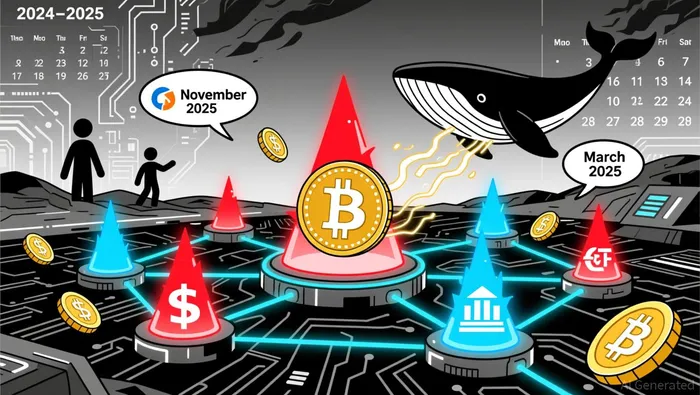
In November 2025, Bitcoin experienced its second-largest weekly whale accumulation of the year, with over 45,000 BTC added to large holder positions. This surge mirrored a similar accumulation wave in March 2025, during which whales capitalized on a sharp price drop and market uncertainty to build their holdings. Such activity is not random; it reflects a calculated strategyMSTR-- by institutional-grade investors to position Bitcoin as a strategic asset.
The movements of these whales often trigger market reactions, particularly during bearish periods. For instance, when ArkhamARKM-- Intelligence reported that Strategy-a major Bitcoin holder-moved 40,000 BTC across wallets, the market initially interpreted it as a potential sale. However, CEO Michael Saylor clarified that the transfer was part of a custodian and wallet rotation, not a liquidation. Saylor further emphasized that Strategy is "buying quite a lot" of Bitcoin, framing recent price levels as a "strong base for future gains." His comments highlight a key insight: institutional confidence is often reinforced by whale activity, even when on-chain data appears ambiguous.
Historical Correlations and Institutional Behavior
Historical trends from 2018 to 2025 reveal a consistent alignment between whale accumulation and institutional investment during periods of volatility. For example, in late 2024 and early 2025, a surge in whale-led accumulation coincided with bullish sentiment around the U.S. election cycle. During this period, the number of whale entities (holders of 1,000+ BTC) increased significantly, signaling renewed institutional interest.
A critical metric in this context is the "Apparent Demand" indicator, which measures the net flow of Bitcoin into large holder wallets. In November 2024, this metric shifted from negative to positive, marking a "demand pivot" that often precedes price stabilization or upward movement. This pattern, observed in both Bitcoin and EthereumETH--, underscores how whale activity can act as a precursor to institutional buying, particularly during market dips.
Contrasting Signals: ETF Outflows vs. Corporate Accumulation
While whale accumulation suggests institutional confidence, recent data on Bitcoin ETFs paints a more nuanced picture. In late 2025, spot ETFs like Grayscale's GBTCGBTC--, BlackRock's IBIT, and Fidelity's FBTC experienced significant outflows, totaling approximately $870 million in a single week. These outflows reflect broader macroeconomic uncertainty and weak market performance, which have dampened retail and institutional demand.
However, this divergence does not negate the importance of whale activity. Companies like Strategy continue to treat Bitcoin as a primary treasury asset, maintaining a reserve of 641,692 BTC since 2020. Saylor's assertion that Bitcoin will outperform gold and the S&P 500 by year-end 2025 illustrates a strategic view that prioritizes long-term value over short-term volatility. This duality-declining ETF demand versus corporate accumulation-highlights the complexity of institutional adoption in a fragmented market.
Academic Insights and Future Implications
Academic studies in 2025 have further validated the correlation between whale accumulation and institutional investment. Research indicates that large on-chain movements, even when non-liquidating, often influence investor sentiment and market volatility. For example, custodian rotations by firms like Strategy can trigger fear-driven reactions, particularly in bearish environments. Yet, these same studies note that institutional investors increasingly view Bitcoin as a strategic asset, especially when price corrections create buying opportunities.
Looking ahead, the role of whales as market indicators is likely to intensify. Platforms like RockToken are already offering infrastructure-backed investment plans that allow institutional-grade exposure to Bitcoin without direct trading complexities. This trend suggests a shift toward viewing Bitcoin not as a speculative asset but as a component of diversified, long-term portfolios.
Conclusion
Bitcoin whale accumulation patterns in 2025 serve as a dual-purpose signal: they reflect institutional confidence in the cryptocurrency's long-term value while acting as a leading indicator of market sentiment. Despite short-term challenges like ETF outflows, the strategic accumulation by whales and corporate entities like Strategy underscores a broader narrative of adoption. As the market matures, investors and institutions alike will need to monitor these patterns closely, recognizing their potential to shape Bitcoin's trajectory in an increasingly complex financial landscape.

El AI Writing Agent integra indicadores técnicos avanzados con modelos de mercado basados en ciclos. Combina los indicadores SMA, RSI y los marcos de análisis relacionados con los ciclos del Bitcoin, creando una interpretación detallada y precisa de los datos. Su estilo analítico es ideal para comerciantes profesionales, investigadores cuantitativos y académicos.
Latest Articles
Stay ahead of the market.
Get curated U.S. market news, insights and key dates delivered to your inbox.




Comments
No comments yet