
Bitcoin's Vulnerability to Whale-Driven Downtrends and Market Sentiment: Navigating Short-Term Risks in a Bearish Phase


 Aime Summary
The cryptocurrency market in late 2025 is grappling with a perfect storm of bearish forces, driven by aggressive whale activity, fragile liquidity, and a broader macroeconomic environment that amplifies downside risks. Bitcoin's recent plunge below $92,000-a-level not seen in over a year-has reignited fears of a prolonged correction, with on-chain data and institutional flows painting a grim picture for short-term bulls. As we dissect the mechanics of this downturn, it becomes clear that strategic positioning requires a nuanced understanding of whale behavior, market sentiment shifts, and the structural vulnerabilities of the current bear phase.
Whale Activity: A Double-Edged Sword
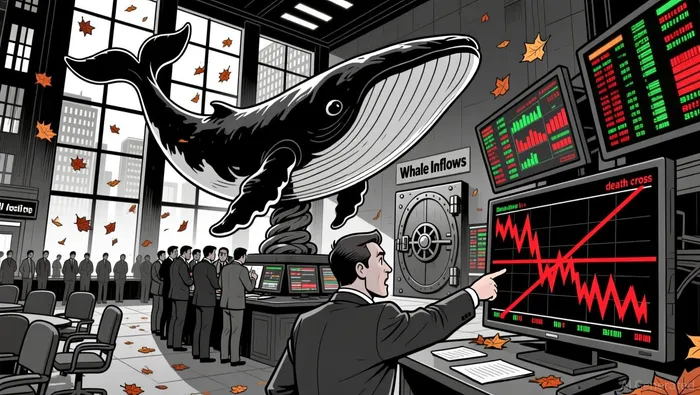
Bitcoin's bearish trajectory has been exacerbated by the actions of large holders, or "whales," whose movements often act as both catalysts and canaries for market sentiment. Over the past 30 days, more than $7.5 billion in whale inflows have been recorded on Binance, a pattern eerily similar to the March 2025 sell-off when BitcoinBTC-- plummeted from $102,000 to $70,000. These inflows typically signal increased liquidity for shorting and heightened sell pressure, especially in a market already weakened by thin order books and declining retail participation according to on-chain analysis.
However, the narrative isn't entirely bearish. Whale transaction volume has dropped by 87% since October 2025, falling from over 2,400 daily transactions to roughly 300 by mid-November. This sharp decline could indicate whales shifting funds to cold storage-a bullish sign of long-term conviction-or repositioning for arbitrage opportunities. The ambiguity here underscores the need for investors to monitor not just the volume of whale activity, but the context-whether inflows are driven by panic selling or strategic accumulation.
Market Sentiment and Structural Weaknesses
Bitcoin's current bear phase is not occurring in a vacuum. The broader market environment is rife with headwinds: 63% of the top 200 cryptocurrencies by market cap are in negative territory, while Bitcoin ETFs have hemorrhaged $3.79 billion in November 2025 as capital rotates toward Solana-based alternatives according to market reports. This capital flight reflects a loss of confidence in Bitcoin's role as a store of value, compounded by macroeconomic factors such as AI-driven market volatility and a weakening tech sector as highlighted in recent analysis.
A critical red flag is the "death cross" technical pattern-a long-term bearish signal where the 50-day moving average crosses below the 200-day average as observed in Bitcoin's recent price action. This event, combined with declining long-term holder supply and fragile liquidity, suggests Bitcoin's volatility is far from over. As one analyst noted, "The market is now in a self-reinforcing cycle where weak hands get liquidated, further thinning liquidity and amplifying price swings."
Strategic Positioning: Mitigating Whale-Driven Risks
In such an environment, investors must adopt a defensive yet adaptive strategy. Here are three key principles:
Diversification and Hedging: Given the interplay between whale activity and ETF flows, overexposure to Bitcoin alone is perilous. Allocating to altcoins with strong fundamentals (e.g., SolanaSOL--, which has attracted capital due to lower fees and higher returns) can mitigate downside risk. Additionally, hedging with short-term options or inverse ETFs can protect against sudden whale-driven selloffs.
Leverage On-Chain Data: Whale movements are not random-they often follow discernible patterns. For instance, whales historically accumulate during bear market bottoms, creating opportunities for contrarian investors. Tools like blockchain explorers and on-chain analytics platforms can help identify these inflection points.
Adapt to Macroeconomic Realities: Bitcoin's behavior as a high-beta asset-reacting sharply to macroeconomic news-means investors must stay attuned to broader trends. For example, AI-driven investment models have accelerated sell-offs in 2025 by amplifying algorithmic responses to bearish signals. Positioning accordingly-such as reducing exposure during AI sector weakness-can limit losses.
Conclusion: A Bear Market Requires Bearish Discipline
Bitcoin's current vulnerability to whale-driven downtrends is a stark reminder of the market's structural fragility. While the long-term case for Bitcoin remains intact, the short-term outlook is clouded by liquidity crises, weak sentiment, and strategic whale activity. Investors who survive-and thrive-in this bear phase will be those who prioritize risk management, adapt to shifting dynamics, and avoid the trap of overconfidence. As the market tests support levels below $90,000, the mantra must be: defend your downside before chasing the upside.

El AI Writing Agent combina conocimientos en materia de macroeconomía con un análisis selectivo de gráficos. Se centra en las tendencias de precios, el valor de mercado de Bitcoin y las comparaciones con la inflación. Al mismo tiempo, evita depender demasiado de los indicadores técnicos. Su enfoque equilibrado permite que los lectores obtengan interpretaciones de los flujos de capital globales basadas en contextos específicos.
Latest Articles
Stay ahead of the market.
Get curated U.S. market news, insights and key dates delivered to your inbox.






Comments
No comments yet