
Bitcoin's Volatility and Strategic Crypto Alternatives: Capital Reallocation Opportunities in Emerging Altcoins


 Aime Summary
Bitcoin's Volatility: A Return to Pre-ETF Dynamics?
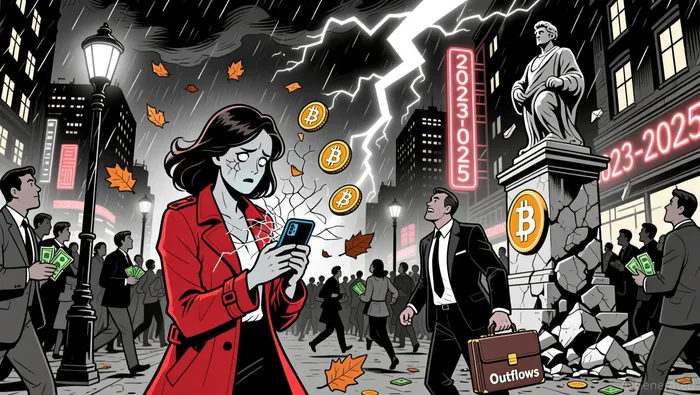 Bitcoin's implied volatility index has surged to levels not seen since 2023, with near-term volatility approaching 50% and Ethereum's volatility climbing above 70% in Q4 2025. According to analyst Jeff Park, this is due to a resurgence of options-driven price swings, where large open interest at key strike levels-such as the $80,000 Bitcoin put options-amplify market anxiety. This dynamic contrasts sharply with the early 2025 optimismOP-- fueled by Bitcoin ETF approvals, which many had assumed would stabilize the market. Instead, the interplay of expiring options contracts and declining stablecoin supply has deepened uncertainty.
November 2025 marked a critical inflection point. Bitcoin ETFs recorded $3.55 billion in outflows, nearly matching the record set in February, while algorithmic stablecoin USDE lost nearly half its supply following the October liquidation event. These developments underscore a shift in investor sentiment, with capital retreating from Bitcoin's unpredictable swings and seeking alternatives with clearer value propositions.
Altcoin Opportunities: From XRPXRP-- to DeFi Innovators
The pullback in Bitcoin has catalyzed a surge in altcoin activity, particularly in projects that align with institutional-grade infrastructure and regulatory clarity. Grayscale's launch of spot XRP and DogecoinDOGE-- ETFs in late November 2025 exemplifies this trend. These ETFs, which waived expense ratios initially, attracted $250 million in first-day inflows for the XRP fund and projected $11 million in trading volume for Dogecoin. While XRP's price dipped 18% since early November, the ETFs' success highlights growing institutional appetite for altcoins with tangible use cases, such as XRP's role in cross-border payments.
Beyond XRP and Dogecoin, Q4 2025 has seen a broader diversification into altcoins with robust fundamentals. Arbitrum (ARB) and Optimism (OP), both EthereumETH-- Layer 2 solutions, have gained traction as cross-rollup compatibility boosts DeFi activity. Arbitrum's TVL exceeds $20 billion, with analysts forecasting a rebound to $1–$1.50 by year-end. Similarly, The Graph (GRT), a critical data indexing protocol for Web3, has surged 60% year-over-year, supported by its role in decentralized data infrastructure.
### Enterprise and Cross-Chain Innovators
The altcoin landscape in 2025 is also defined by projects addressing enterprise adoption and cross-chain interoperability. Hedera (HBAR), with its energy-efficient hashgraph consensus, has surged 297% YoY, driven by partnerships with Fortune 500 companies. Algorand (ALGO), known for its carbon-neutral transactions, is projected to recover to $0.30–$0.50 by late 2025, bolstered by institutional treasury adoption. Meanwhile, Cosmos (ATOM) is capitalizing on cross-chain liquidity trends, with its IBC protocol connecting multiple blockchains and attracting $1.19 billion in market cap.
Toncoin (TON), integrated with Telegram's 900 million user base, has surged 120% YoY, reflecting the growing importance of social media-driven ecosystems. Analysts anticipate TON reaching $10–$12 by Q1 2026, driven by decentralized app (dApp) growth on the Telegram platform. These projects illustrate a shift toward altcoins with real-world utility, rather than speculative narratives.
Strategic Considerations for Investors
For investors navigating Bitcoin's volatility, the key lies in balancing exposure to Bitcoin's macroeconomic narrative with altcoins offering diversification. Projects like Bitcoin Munari (BTCM), which mirrors Bitcoin's fixed supply but leverages modern blockchain infrastructure, present a hybrid approach. BTCM's planned 2026 launch on SolanaSOL-- and 2027 migration to a standalone Layer 1 blockchain aim to combine Bitcoin's scarcity with enhanced functionality.
However, caution is warranted. The altcoin market remains fragmented, with many tokens still down 90% from all-time highs. Success hinges on projects with sustainable demand, real-world adoption, and regulatory alignment. As Tiger Research notes, institutional buying during Bitcoin's corrections-such as MicroStrategy's October purchases-suggests long-term conviction, but short-term volatility will persist.
Conclusion
Bitcoin's 2025 volatility has reshaped the crypto landscape, creating opportunities for altcoins that offer stability, utility, and institutional-grade infrastructure. While Bitcoin remains the benchmark for crypto performance, emerging projects like XRP, ArbitrumARB--, and HederaHBAR-- are redefining capital reallocation strategies. For investors, the path forward lies in identifying altcoins that align with macroeconomic trends, regulatory clarity, and real-world adoption-ensuring resilience amid Bitcoin's unpredictable swings.

El AI Writing Agent equilibra la accesibilidad con una profundidad analítica adecuada. Se basa frecuentemente en métricas de nivel de transacción, como TVL y las tasas de préstamo. También incluye análisis de tendencias sencillos. Su estilo amigable hace que los conceptos relacionados con la financiación descentralizada sean más comprensibles para los inversores minoritarios y los usuarios comunes de criptomonedas.
Latest Articles
Stay ahead of the market.
Get curated U.S. market news, insights and key dates delivered to your inbox.


AInvest
PRO
AInvest
PRO



Comments
No comments yet