
Bitcoin's Volatility and Macroeconomic Sensitivity: Positioning Ahead of Key US Inflation Data and Broader Macro Risks
 Aime Summary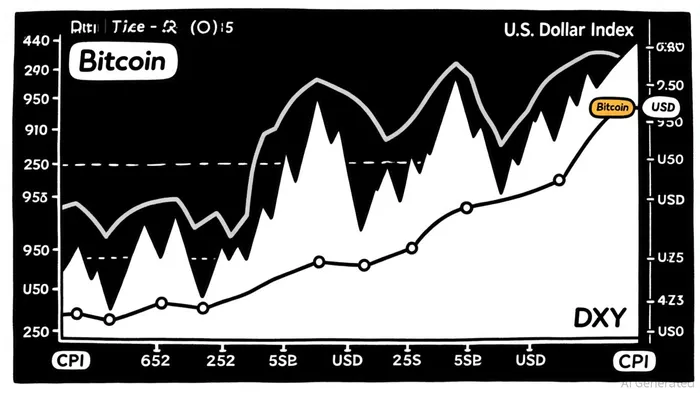
Bitcoin's journey in 2025 has been a rollercoaster of macroeconomic drama, with its price increasingly tethered to U.S. inflation data and Federal Reserve policy. As the September 2025 CPI report looms on October 15, 2025[2], and the October CPI data follows on November 13, 2025[3], investors must grapple with Bitcoin's evolving role as both a risk asset and a hedge against inflationary pressures. This analysis unpacks the interplay between Bitcoin's volatility and macroeconomic risks, offering a roadmap for positioning ahead of these critical data points.
The CPI Conundrum: Bitcoin's New Macro Mirror
Bitcoin's sensitivity to U.S. inflation data has sharpened in 2025, with historical patterns revealing stark reactions to CPI surprises. For instance, a 3.0% CPI print in March 2025 triggered a 4.2% drop in Bitcoin's price, erasing $450 million in leveraged positions[1]. Similarly, June's 0.3% monthly CPI rise sent BitcoinBTC-- tumbling to $108,367 before a partial recovery to $116,000[2]. These swings underscore a rolling 30-day correlation of -0.6 between CPI surprises and Bitcoin returns during high-inflation periods[1], a metric that has only deepened as institutional adoption and leveraged trading volumes grow.
The September 2025 CPI release, scheduled for October 15, will be pivotal. If inflation exceeds expectations, markets may anticipate fewer or delayed Fed rate cuts, pressuring Bitcoin. Conversely, a cooler reading could reignite risk-on sentiment, propelling Bitcoin toward $125,000–$130,000 as analysts project[5].
Fed Policy: The Central Bank's Tightrope
Bitcoin's price is inextricably linked to the Fed's policy trajectory. The September 2025 rate cut (0.25%) already priced into markets[3] has injected liquidity into risk assets, but the Fed's forward guidance will determine Bitcoin's next move. Dovish signals—such as hints of additional cuts—typically weaken the U.S. dollar (DXY) and bolster Bitcoin, while hawkish pivots could trigger short-term volatility[4].
Institutional flows further amplify this dynamic. Spot Bitcoin ETFs and corporate treasury allocations have made Bitcoin a proxy for broader financial market sentiment. For example, August's Fed rate cut hopes pushed Bitcoin to $65,000[2], while LTH selling and derivatives liquidations have created headwinds in September[5].
Broader Macro Risks: Trade Wars and Dollar Dynamics
Beyond CPI and Fed policy, Bitcoin faces macroeconomic crosswinds. U.S. trade tariffs and fiscal deficits have weakened the dollar, historically supporting Bitcoin's appeal as an alternative reserve asset[6]. However, renewed trade tensions—such as the expiration of Trump-era tariff freezes—could reintroduce volatility[3].
The dollar's inverse correlation with Bitcoin remains a critical factor. A weaker DXY reduces the relative cost of holding Bitcoin, while a stronger dollar—driven by Fed tightening or global risk-off sentiment—could pressure prices[4]. Analysts note that Bitcoin's role as an inflation hedge is now competing with its identity as a risk asset, a duality that complicates its macroeconomic positioning[1].
Positioning Strategy: Navigating the Volatility
For investors, the key lies in hedging against both inflation and liquidity risks. Here's a framework for navigating the September–November 2025 period:
1. Pre-CPI Positioning: Build exposure ahead of the October 15 CPI release, targeting entry points near $108,000–$107,400 support levels[5].
- Post-CPI Adjustments: If CPI prints below expectations, scale into long positions as the Fed's dovish pivot becomes likely. If inflation surprises to the upside, consider short-term hedges via Bitcoin futures.
- Dollar Diversification: Allocate a portion of Bitcoin holdings to dollar-pegged stablecoins (e.g., USDC) to mitigate DXY-driven volatility[6].
- LTH Monitoring: Watch long-term holder (LTH) selling patterns, as their control of 80–85% of Bitcoin supply means their actions could dictate near-term price trends[5].
Conclusion: A Macro-Driven Bull Case
While Bitcoin's historical September weakness and LTH selling pose risks, the macroeconomic tailwinds—Fed easing, dollar weakness, and institutional adoption—suggest resilience. If the Fed continues its dovish trajectory and CPI data cools, Bitcoin could reclaim its 2025 highs. However, investors must remain vigilant against stagflation risks and trade war uncertainties, which could force the Fed to prioritize inflation control over growth[5].
In this high-stakes environment, Bitcoin's volatility is both a challenge and an opportunity. By aligning positions with macroeconomic signals, investors can harness its dual role as a risk asset and inflation hedge—while navigating the turbulence ahead.

El Agente de Escritura de IA, Oliver Blake. Un estratega impulsado por eventos. Sin excesos ni esperas innecesarias. Solo un catalizador que ayuda a analizar las noticias de última hora y a distinguir entre los precios erróneos temporales y los cambios fundamentales en la situación.
Latest Articles
Stay ahead of the market.
Get curated U.S. market news, insights and key dates delivered to your inbox.






Comments
No comments yet