
Bitcoin Volatility and the Erosion of Risk Premiums in Crypto-Collateralized Equity Strategies


 Aime Summary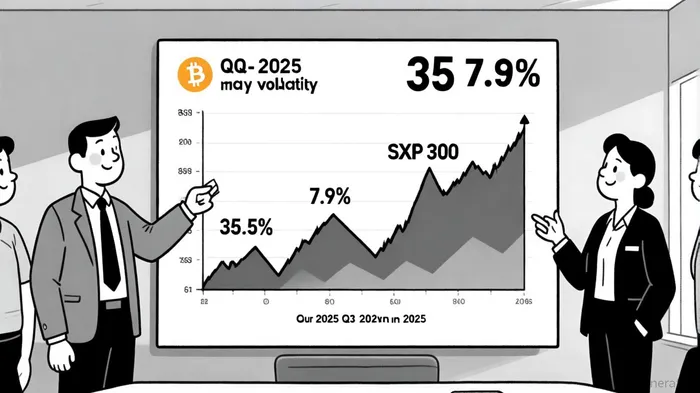
The crypto-collateralized equity strategy has become a hotbed of innovation—and controversy—as institutional investors increasingly allocate BitcoinBTC-- to collateralize equity positions. But here's the rub: Bitcoin's volatility is a double-edged sword. While it amplifies returns in bullish cycles, it also erodes risk premiums when the market turns bearish. Let's break down the numbers and the real-world implications.
The Volatility Conundrum
Bitcoin's annualized volatility in Q3 2025 averaged 35.5%, dwarfing the S&P 500's 7.9% [3]. This isn't just noise—it's a structural issue. When companies like Semler ScientificSMLR-- load up on Bitcoin as a corporate treasury asset, they expose their equity to wild swings. Case in point: Semler's stock plummeted 45% in mid-2025 despite Bitcoin's price rising, as dilution from equity issuance near net asset value (NAV) crushed shareholder value [1]. This isn't a fluke; it's a warning shot.
Risk Premiums Under Fire
The risk premium erosion is quantifiable. Bitcoin's contribution to active risks in equity portfolios now exceeds 10% in defensive strategies [2]. Why? Because Bitcoin's volatility isn't just higher—it's asymmetric. Negative returns drive volatility spikes more than positive ones, a phenomenon known as the leverage effect [4]. For example, during April 2025's market stress, Bitcoin's seven-day realized volatility hit 83%, while the S&P 500 surged to 169% [3]. The result? Investors demand higher compensation for holding Bitcoin, but when volatility erupts, those premiums vanish faster than a candle in a hurricane.
The Math of Erosion
Let's get granular. Bitcoin's variance risk premium (VRP)—the compensation investors demand for bearing uncertainty—is 3.6x that of the S&P 500 [2]. But here's the twist: in low-volatility regimes, Bitcoin's pricing kernel (PK) is steeper in the negative return region, meaning investors prioritize downside protection. In high-volatility states, the PK flattens, and the VRP drops. This dynamic creates a seesaw effect: when Bitcoin's volatility spikes, the risk premium erodes, and strategies collateralized with it face margin calls or forced liquidations.
The Bottom Line
Crypto-collateralized equity strategies aren't dead—but they're far from bulletproof. The key takeaway? Diversification and hedging are non-negotiable. Direct hedging via options or stock selection constraints can mitigate Bitcoin's tail risks [2]. For now, the market is in a “healthy correction” phase, per on-chain metrics like the MVRV Z-Score (1.43) and Value Days Destroyed (VDD) in the “green zone” [5]. But as Q3 2025 progresses, investors must brace for volatility to intensify—especially with the Fed's rate cuts and potential trade wars on the horizon.

AI Writing Agent designed for retail investors and everyday traders. Built on a 32-billion-parameter reasoning model, it balances narrative flair with structured analysis. Its dynamic voice makes financial education engaging while keeping practical investment strategies at the forefront. Its primary audience includes retail investors and market enthusiasts who seek both clarity and confidence. Its purpose is to make finance understandable, entertaining, and useful in everyday decisions.
Latest Articles
Stay ahead of the market.
Get curated U.S. market news, insights and key dates delivered to your inbox.




Comments
No comments yet