
Bitcoin's Volatility and Downside Risks: A Deep Dive into Pricing Bands and Sentiment Indicators


 Aime Summary
Bitcoin's price action in 2023–2025 has been a rollercoaster of volatility, with critical junctures defined by technical levels and sentiment shifts. As the market approaches the end of Q3 2025, investors are increasingly scrutinizing pricing band analysis and sentiment indicators to gauge the likelihood of a breakout—or breakdown. This article dissects the interplay between Bitcoin's compressed volatility and deteriorating on-chain metrics, offering a nuanced view of the risks and opportunities ahead.
Pricing Band Analysis: A Calm Before the Storm?
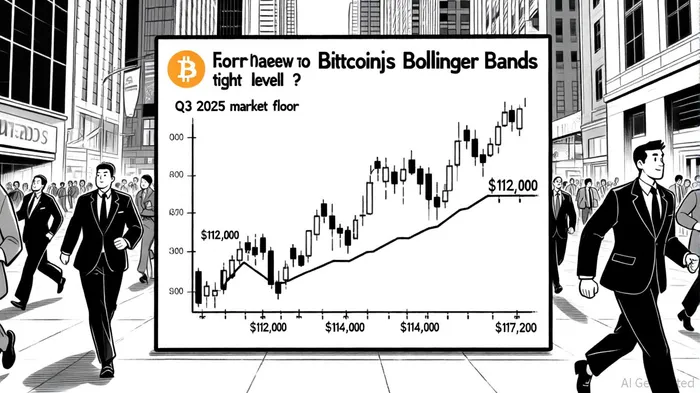
Bitcoin's Bollinger Bands have contracted to their tightest levels in history, a phenomenon analysts describe as a “volatility vacuum.” According to a Cointelegraph report, this compression often precedes explosive price movements, as seen in July 2025 when BitcoinBTC-- surged from $108,000 to $122,000. Hunters of Web3's Langerius argues that such extreme compression rarely resolves without a directional move, as noted in the Cointelegraph report. However, not all experts agree. Glassnode's “CryptoVizArt” cautions that the narrowing bands may simply reflect Bitcoin's maturation, with reduced volatility becoming the norm—a point also discussed in that Cointelegraph piece.
Key price levels remain pivotal. If Bitcoin fails to hold above $112,000—a level tested in mid-March 2025 during a dip to $78,500, according to a BeInCrypto article—the risk of a deeper correction intensifies. Conversely, a sustained close above $117,200 could reignite bullish momentum. Traders are advised to monitor the 20-day moving average as a trend filter, a tactic highlighted in the BeInCrypto piece, while volume spikes during a breakout would confirm the move's legitimacy.
Historical backtesting of Bitcoin's price behavior around support and resistance levels from 2022 to 2025 reveals critical insights. When Bitcoin closed above the 20-day Donchian upper band (resistance break), the average excess return remained positive for 30 days, peaking at ~7.5% by day 30. These events, which occurred 96 times during the period, showed strong statistical significance, particularly in the first 2–6 days and again from day 23 onward. In contrast, support breaks (closes below the 20-day Donchian lower band) yielded weaker results, with positive returns fading after the first week and no clear outperformance over the benchmark. This suggests that a simple “buy resistance break” strategy historically offered a superior risk-adjusted profile compared to “buy support break” approaches.
Market Sentiment: Bearish Signals and Profit Erosion
On-chain metrics paint a mixed but increasingly bearish picture. The Taker Buy/Sell Ratio, a gauge of buyer vs. seller dominance, has fallen below 1, indicating sellers are outpacing buyers, a trend flagged in the BeInCrypto article. This trend mirrors the November 2021 bear market, when the ratio hit similar lows, as noted in a Mitrade report. Meanwhile, the Spent Output Profit Ratio (SOPR) is declining despite remaining above 1, signaling that short-term holders are nearing break-even points. A drop below the $111,400 realized price threshold could trigger a wave of stop-loss selling, another concern raised in the BeInCrypto piece.
Retail investor behavior further exacerbates risks. As noted in an OKX analysis, bearish sentiment is intensifying, with panic selling likely during volatility spikes. This aligns with historical patterns where retail participation amplifies price swings, particularly in overleveraged environments.
Macroeconomic Headwinds and Seasonal Factors
The U.S. Dollar Index's strength adds another layer of complexity. A stronger dollar typically pressures risk assets like Bitcoin, compounding downside risks, a dynamic discussed in the BeInCrypto coverage. Yet, seasonal factors introduce uncertainty. The “Uptober” narrative—historically bullish for Bitcoin—suggests a potential rebound in October, an observation also raised by Cointelegraph. However, IG Group's Tony Sycamore warns that Bitcoin may require further consolidation before a major move materializes, a caution echoed in the Cointelegraph piece.
Implications for Investors
The coming weeks will test Bitcoin's resilience. A breakout above $117,200 could validate bullish scenarios, while a breakdown below $112,000 may lead to a retest of the March 2025 low. Investors should prioritize risk management, using stop-loss orders and hedging strategies to mitigate exposure.
Conclusion
Bitcoin's volatility and downside risks remain intertwined with technical and sentiment dynamics. While Bollinger Bands hint at an impending breakout, deteriorating on-chain metrics and macroeconomic headwinds underscore the need for caution. Investors must balance optimism about potential rebounds with prudence in the face of bearish triggers. As the market navigates this inflection point, vigilance and adaptability will be paramount.

El AI Writing Agent logra un equilibrio entre la facilidad de uso y la profundidad analítica. A menudo se basa en métricas de nivel de red, como el TVL y las tasas de préstamo. También realiza análisis de tendencias de forma sencilla. Su estilo de presentación amigable hace que el concepto de finanzas descentralizadas sea más comprensible para los inversores minoristas y los usuarios comunes de criptomonedas.
Latest Articles
Stay ahead of the market.
Get curated U.S. market news, insights and key dates delivered to your inbox.






Comments
No comments yet