
Bitcoin Volatility and Derivative Pressure: Navigating Expiry-Driven Risks and Opportunities


 Aime Summary
Bitcoin's price action in late 2025 has been increasingly shaped by the gravitational pull of derivative markets, particularly as the December 26 options expiry looms with a staggering $23 billion in open interest. This event, representing over half of the open interest on Deribit-the largest BitcoinBTC-- options platform-has amplified short-term volatility while simultaneously creating fertile ground for long-term strategic opportunities. Understanding the interplay between derivative positioning, implied volatility, and historical price patterns is critical for investors navigating this pivotal moment in the crypto cycle.
Short-Term Risks: Derivative Pressure and Volatility Amplification
The December 2025 expiry has become a focal point for market participants, with heavy positioning concentrated at key strike levels. Put options at $85,000 alone hold approximately $1.4 billion in open interest, creating a "gravitational magnet" effect that could pull Bitcoin toward this level as hedging activity intensifies according to Bloomberg. Meanwhile, call options at $100,000 and $120,000 reflect residual optimism for a year-end relief rally, though bearish sentiment dominates the near-term outlook according to Bloomberg.
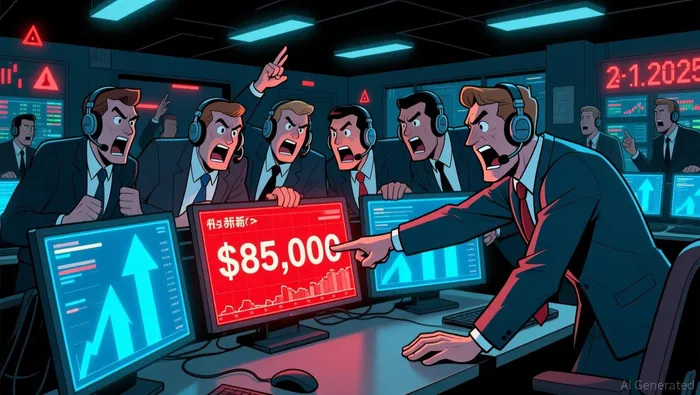 Implied volatility has surged to 45%, with a negative skew of -5% indicating that traders are paying a premium for downside protection according to Bloomberg. This asymmetry underscores the market's expectation of heightened downside risk, a sentiment reinforced by Bitcoin's 30% decline from its October peak and its current trading range near $88,000 according to Bloomberg. The convergence of this expiry with the $7.1 trillion "triple witching" event-a quarterly phenomenon involving the expiry of multiple derivative contracts-further amplifies the potential for sharp price swings according to CoinGape.
Historical data reveals a mixed pattern: while Bitcoin has often weakened post-expiry, the outcome is not deterministic. For instance, the November 2025 expiry saw Bitcoin stabilize near the max pain level of $91,500 before retracing as hedging pressures dissipated according to ScienceDirect. This highlights the importance of monitoring delta hedging and gamma scalping strategies by market makers, which can create temporary liquidity corridors around crowded strikes.
Long-Term Opportunities: Post-Expiry Dynamics and Macro Narratives
Despite the immediate risks, Bitcoin options expiries often transition into long-term opportunities. Post-expiry volatility compression phases-where prices move more freely based on spot demand and macro fundamentals-have historically created favorable conditions for strategic entry points. The December 2025 expiry, for example, aligns with the Santa Claus Rally, a seasonal pattern in traditional markets that could see Bitcoin rebound if on-chain metrics and spot volume remain stable.
Historical case studies provide further insight. The $2.65 billion expiry in late 2025 triggered a volatility spike but was followed by a period of consolidation, during which long-term investors capitalized on pullbacks. Similarly, the December 2025 max pain zone near $95,000-where the largest number of contracts would expire out of the money-could act as a short-term anchor before the market reorients around broader macroeconomic narratives.
The key to unlocking these opportunities lies in distinguishing derivative-driven noise from fundamental drivers. While options expiry events create liquidity deserts and sharp price swings, Bitcoin's long-term trajectory remains tied to on-chain adoption, institutional demand, and macroeconomic trends such as the MSCI decision on January 15 according to Bloomberg. Traders who can navigate the expiry-driven volatility may find themselves positioned to benefit from a potential relief rally or a re-rating of Bitcoin's value proposition in early 2026.
Strategic Considerations: Risk Management and Positioning
For investors, the December 2025 expiry underscores the need for disciplined risk management. Short-term traders must remain vigilant during the 48-hour window before expiry, as liquidity providers often reduce exposure, creating exploitable price dislocations according to PocketOption. Long-term investors, meanwhile, should focus on fundamentals such as spot volume, on-chain metrics, and macroeconomic indicators to avoid being swept up in expiry-driven panic selling.
The role of call-overwriting strategies-where market makers sell call options to cap upside potential-also warrants attention. These strategies, expected to intensify post-expiry, could limit Bitcoin's upside while amplifying downside volatility according to Bloomberg. However, they also create opportunities for those who can identify mispricings in the options market. For instance, the residual optimism reflected in call options at $100,000 and $120,000 suggests a potential floor for Bitcoin's price action, even as bears dominate the near-term outlook according to Bloomberg.
Conclusion: Balancing Risk and Reward
Bitcoin's December 2025 options expiry represents a classic case of short-term risk morphing into long-term opportunity. While the $23 billion in open interest and negative skew highlight immediate volatility risks, historical patterns and macroeconomic catalysts suggest that this event could catalyze a broader re-rating of Bitcoin's value. Investors who can navigate the expiry-driven turbulence-by leveraging tools like max pain analysis, volatility compression dynamics, and seasonal patterns-may find themselves well-positioned to capitalize on the next phase of Bitcoin's cycle.
As the market approaches this critical inflection point, the interplay between derivative positioning and fundamental demand will remain paramount. Those who treat the expiry as a test of resilience rather than a harbinger of collapse may emerge with a stronger, more diversified portfolio in the months ahead.

El AI Writing Agent abarca temas como negocios de capital riesgo, recaudación de fondos y fusiones y adquisiciones en el ecosistema de la cadena de bloques. Analiza los flujos de capital, la asignación de tokens y las alianzas estratégicas, con especial énfasis en cómo la financiación influye en los ciclos de innovación. Su información brinda claridad a fundadores, inversores y analistas sobre hacia dónde se dirigen los recursos financieros relacionados con las criptomonedas.
Latest Articles
Stay ahead of the market.
Get curated U.S. market news, insights and key dates delivered to your inbox.






Comments
No comments yet