
Bitcoin's Recent Volatility: A Deep Dive into Drivers and Opportunities


 Aime Summary
Macroeconomic Signals: Central Banks and Risk Appetite
Central bankBANK-- policies remain a dominant force shaping Bitcoin's trajectory. The U.S. Federal Reserve's cautious approach-reducing its benchmark rate by 0.25% to 4.00% but signaling uncertainty about further cuts-has created a volatile environment. Investors, anticipating tighter monetary conditions, have shifted capital toward safer assets, exacerbating Bitcoin's decline as bond yields rise and the U.S. dollar strengthens. This trend is compounded by global trade tensions, particularly escalating tariffs on Chinese tech exports, which have eroded risk appetite and amplified downward pressure on cryptocurrencies.
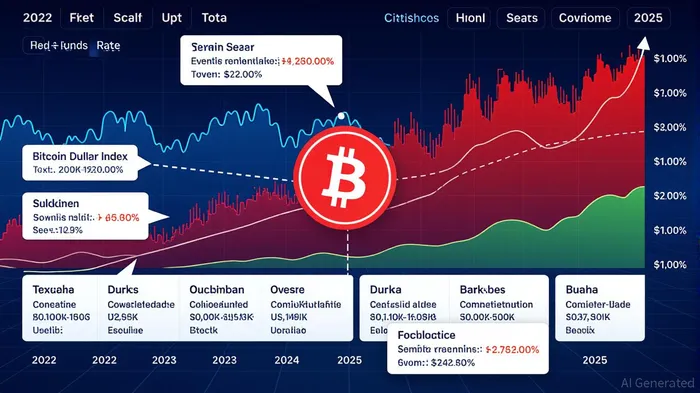
The artificial intelligence sector's overvaluation has further dampened demand for risk assets like BitcoinBTC--, as capital flows toward perceived "safe" tech investments. Meanwhile, leveraged positions in the crypto market have faced liquidation pressures, accelerating Bitcoin's descent below key psychological levels such as $80,300. These dynamics highlight Bitcoin's role as a barometer for macroeconomic uncertainty, rather than a pure inflation hedge.
Investor Psychology: Fear, Herd Behavior, and Sentiment
Bitcoin's volatility is not solely driven by external macroeconomic forces; investor psychology plays an equally pivotal role. The CoinMarketCap Fear & Greed Index remains in the "extreme fear" zone at 12 points, reflecting widespread pessimism. This sentiment is amplified by behavioral biases such as herding, where investors follow market trends without independent analysis. During price surges, speculative fervor drives capital into high-risk assets like NFTs, while downturns trigger panic selling and risk-averse contractions as research shows.
Financial literacy also moderates investor behavior. Studies show that individuals with higher financial literacy are more likely to view Bitcoin as a long-term diversification tool during crises, whereas less informed investors often react impulsively to short-term price swings. This dichotomy underscores the importance of education and disciplined strategy in mitigating emotional decision-making.
Policy Responses: Regulatory Clarity and Strategic Innovation
Regulatory developments in late 2025 have introduced both challenges and opportunities. The U.S. SEC approved generic listing standards for commodity-based trust shares, streamlining the creation of spot crypto ETFs and signaling cautious support for innovation. Simultaneously, the new administration's executive order on digital financial technology-promoting public blockchain networks and dollar-backed stablecoins while rejecting a U.S. central bank digital currency (CBDC)-has fostered a more favorable regulatory environment.
However, regulatory uncertainty persists. The SEC's Spring 2025 Regulatory Agenda includes proposals to modernize custody and trading rules, which could reshape market structure. For investors, this evolving landscape demands vigilance, as policy clarity may unlock institutional demand while ambiguity risks further outflows.
Strategic Positioning: Navigating the Volatility
For investors seeking to position themselves in this macro-driven market, a multi-faced approach is essential. First, monitoring technical levels-such as Bitcoin's critical $80,300 support can help identify potential turning points. Second, hedging against macroeconomic risks by diversifying across asset classes, including gold which has outperformed Bitcoin as a safe haven in certain markets, may mitigate downside exposure.
Third, leveraging behavioral insights can enhance decision-making. For instance, adopting a contrarian strategy during periods of extreme fear-when panic selling drives prices to oversold levels-may present buying opportunities. Additionally, institutional investors should prioritize ETFs and stablecoins, which offer liquidity and regulatory alignment.
Conclusion
Bitcoin's volatility in late 2025 reflects a complex interplay of macroeconomic signals, investor psychology, and regulatory shifts. While the current environment is bearish, it also presents opportunities for strategic positioning. Investors who combine macroeconomic analysis with behavioral discipline-and who remain attuned to evolving policy frameworks-can navigate this turbulence and capitalize on Bitcoin's long-term potential. As the market matures, the key to success lies not in chasing short-term gains but in building resilience against the inevitable cycles of boom and bust.

La mezcla de sabiduría comercial tradicional y conocimientos de última generación en criptomonedas.
Latest Articles
Stay ahead of the market.
Get curated U.S. market news, insights and key dates delivered to your inbox.






Comments
No comments yet