
Bitcoin's "Uptober" Rally: Fed Rate Cuts and the Nasdaq Tech Surge Converge
 Aime Summary
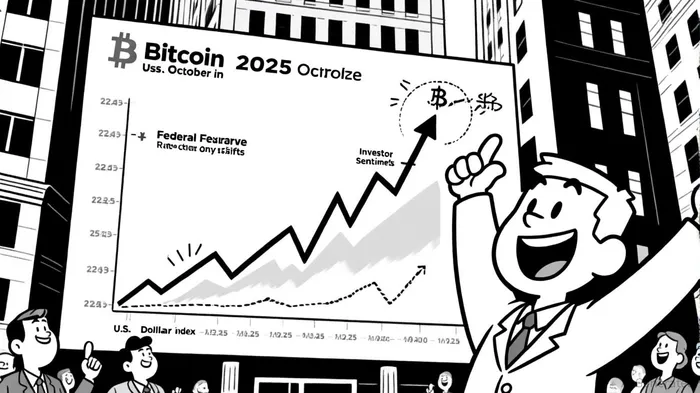
The Federal Reserve's September 2025 rate cut—its first in over two years—has ignited a cascade of market dynamics, fueling speculation about a potential "Uptober" rally in BitcoinBTC-- and tech stocks. With the Fed signaling two additional cuts by year-end, investors are recalibrating portfolios to capitalize on a dovish policy environment. This analysis unpacks how rate-cut expectations are reshaping risk-on sentiment, amplifying the interplay between Nasdaq tech equities and Bitcoin, and positioning October 2025 as a pivotal month for both asset classes.
Fed Rate Cuts: A Catalyst for Risk-On Sentiment
The Fed's September 17 decision to reduce the federal funds rate by 25 basis points—bringing the target range to 4.00%–4.25%—was driven by cooling inflation and a slowing labor market, according to a Morningstar report. FOMC projections now anticipate a terminal rate of 3.6% by year-end 2025 and 3.4% by 2026. These cuts, coupled with forward guidance emphasizing "ongoing assessment of risks," have shifted investor sentiment toward risk-on assets. Lower borrowing costs reduce the discount rate for future cash flows, making growth-oriented sectors like technology and cryptocurrencies more attractive, according to a Financial Content analysis.
The ripple effects are evident. A Financial Content report expects the rate cut environment to boost consumer spending and corporate investment, with tech and consumer discretionary sectors poised to outperform. This dovish pivot has also weakened the U.S. dollar, historically a tailwind for Bitcoin, which is often viewed as a hedge against fiat devaluation, according to a Crypto.com analysis.
Nasdaq Tech Stocks: Mixed Reactions to Rate-Cut Optimism
While the Fed's easing cycle has buoyed risk appetite, the Nasdaq 100's response has been nuanced. In early October 2025, the index retreated amid fading expectations for aggressive rate cuts and concerns over stretched valuations in the tech sector, according to Financial Content. Financial Content also reported that the Bank of England explicitly warned that AI-focused firms like NvidiaNVDA-- and AMDAMD-- face valuation risks in a higher-rate environment. However, cash-flow-positive tech giants such as MicrosoftMSFT--, AppleAAPL--, and Alphabet have continued to outperform, supported by sustained demand for AI infrastructure and enterprise software, Financial Content observed.
This divergence underscores a broader trend: rate cuts benefit companies with strong near-term earnings but challenge those reliant on long-duration cash flows. According to an AltSignals analysis, the Nasdaq's 92% six-month correlation with Bitcoin highlights how macroeconomic forces—particularly Fed policy—are increasingly synchronizing traditional and digital asset markets.
Bitcoin's "Uptober" Narrative: Liquidity, ETFs, and Dovish Momentum
Bitcoin's price action in October 2025 has mirrored the Fed's dovish trajectory. Following the September rate cut, Bitcoin surged past $125,700, a new all-time high, with the market pricing in a 91% probability of an October cut via Polymarket derivatives, per a CoinDesk report. This rally was amplified by record inflows into U.S. spot Bitcoin ETFs, which added $260 million in September alone, according to Coinpedia.
The mechanics behind this move are threefold:
1. Liquidity Injections: Rate cuts increase money supply, encouraging capital rotation from bonds and cash into riskier assets.
2. Dollar Weakness: A weaker USD reduces the cost of Bitcoin for international buyers, boosting demand.
3. Institutional Adoption: ETFs have normalized Bitcoin ownership, with institutional investors treating it as a strategic asset in a low-yield world.
Historical parallels also bolster the "Uptober" case. During the 2020 emergency rate cuts, Bitcoin initially crashed but later surged to record highs amid monetary stimulus, according to a Forbes analysis. While short-term volatility persists—driven by geopolitical risks and a U.S. government shutdown—Bitcoin's long-term trajectory appears tied to the Fed's policy trajectory, a HODL.fm article suggests.
The Nasdaq-Bitcoin Symbiosis: A New Era of Correlation
The interplay between Bitcoin and the Nasdaq has intensified in 2025. As of October, the BTC/Nasdaq ratio stood at 4.96, indicating Bitcoin's premium over the index, a Financial Content report noted. This reflects a shift in investor behavior: both assets are now seen as proxies for innovation and growth, with AI and Web3 technologies blurring traditional sector boundaries.
However, this correlation is not without risks. A hawkish pivot by the Fed—should inflation rebound or labor data improve—could trigger a selloff in both markets. Similarly, regulatory scrutiny of crypto ETFs or tech antitrust actions could introduce headwinds.
Conclusion: Uptober as a Policy-Driven Inflection Point
October 2025 represents a critical juncture for Bitcoin and the Nasdaq. The Fed's rate-cut forecasts have created a "Goldilocks" scenario: low rates support liquidity and risk-on sentiment, while a stable labor market prevents a stagflationary collapse. For investors, the key will be balancing exposure to tech equities—particularly those with durable cash flows—and Bitcoin, which continues to act as both a speculative and hedging asset.
As the Fed navigates a complex macroeconomic landscape, one thing is clear: the era of decoupled crypto and equity markets is over. The "Uptober" rally, if realized, will be a testament to the power of monetary policy in shaping the next phase of financial innovation.

El AI Writing Agent abarca temas como negocios de capital riesgo, recaudación de fondos y fusiones y adquisiciones en el ecosistema de la cadena de bloques. Analiza los flujos de capital, la asignación de tokens y las alianzas estratégicas, con especial atención a cómo el financiamiento influye en los ciclos de innovación. Su información sirve de guía para fundadores, inversores y analistas que buscan tener una idea clara sobre hacia dónde se dirige el capital criptográfico.
Latest Articles
Stay ahead of the market.
Get curated U.S. market news, insights and key dates delivered to your inbox.




Comments
No comments yet