
Bitcoin's Underlying Value vs. Central Bank Skepticism: A Clash of Paradigms


 Aime Summary
Bitcoin's Network Value: A Quantitative Snapshot
Bitcoin's network metrics in late 2025 underscore its growing prominence. Over the past 24 hours, the network processed 360,337 transactions, with a total volume of $33.25 billion in BTC transfers. The average transaction value of $92,270 and median of $272.23 highlight a mix of large institutional movements and retail activity. Meanwhile, the network's hashrate increased by 3.41% in a single day, reflecting enhanced security and mining activity. These figures suggest a robust, self-sustaining ecosystem, with 176,020 unique addresses participating in the last 24 hours-a sign of broad user engagement.
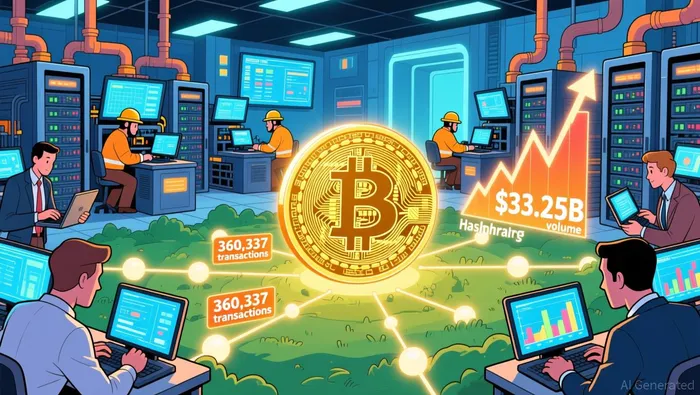 However, Bitcoin's infrastructure faces emerging pressures. As miners like BitfarmsBITF-- pivot toward AI and high-performance computing (HPC), energy and computational resources once dedicated to Bitcoin are being reallocated. This shift raises questions about long-term hash rate sustainability and network security. While the current hashrate remains strong, the redirection of low-cost energy to AI workloads could marginalize Bitcoin's competitive edge in the coming years.
Systemic Role: Divergence from Traditional Metrics
Bitcoin's relationship with traditional financial indicators has grown increasingly tenuous. In Q3–Q4 2025, its correlation with the S&P 500 plummeted to zero, diverging sharply from historical patterns. This decoupling reflects Bitcoin's evolution into a speculative asset, akin to high-risk technology stocks, rather than a traditional hedge against macroeconomic volatility. For instance, while the S&P 500 and GDP growth followed predictable trajectories, Bitcoin's price swings were driven by sentiment and institutional adoption, such as the $55 billion Bitcoin holdings of publicly traded companies like Strategy.
Systemic risk assessments further highlight Bitcoin's intermediate position. Though its 30-day correlation with the Nasdaq 100 reached a five-year high, it remains a niche asset compared to traditional equities. Economist Rashad Ahmed notes that Bitcoin's integration into financial markets-via ETFs, stablecoins, and derivatives-has increased its interconnectedness but not its systemic threat. A 1–5% allocation in diversified portfolios is still deemed prudent, as its volatility and limited market depth prevent it from destabilizing broader systems.
Central Bank Skepticism: Policy Stances and Quiet Experimentation
Central banks have largely maintained a skeptical stance. The ECB, for example, has categorically excluded Bitcoin from official reserve portfolios, emphasizing its lack of stability and regulatory compliance. Yet, subtle shifts hint at evolving attitudes. The Czech National Bank (CNB) quietly acquired a small Bitcoin and stablecoin portfolio in early 2025 to testTST-- operational frameworks for managing digital assets. While this move was framed as a technical experiment, it signals a growing recognition of Bitcoin's potential role in reserve management-a departure from the ECB's hardline position.
This duality-skepticism versus cautious experimentation-reflects broader institutional uncertainty. Central banks are acutely aware of Bitcoin's risks, including its susceptibility to speculative bubbles and its potential to disrupt fiat currency dominance. However, as stablecoin adoption and crypto ETFs expand, policymakers are forced to balance regulatory caution with the need to adapt to a digital financial ecosystem.
The Paradox of Growth and Caution
Bitcoin's 2025 trajectory reveals a paradox: its network metrics suggest a maturing asset class, yet its systemic role remains contested. On one hand, the cryptocurrency's market cap, transaction volume, and institutional adoption point to a digital store of value with staying power. On the other, central banks and regulators view it as a volatile, speculative asset that could amplify financial instability if left unchecked.
This tension is further complicated by infrastructure shifts. As AI-driven workloads consume energy previously allocated to Bitcoin mining, the network's long-term security could face indirect threats. Yet, Bitcoin's resilience-evidenced by its sustained hashrate growth and expanding user base-suggests it will adapt to these challenges.
Conclusion: A Clash of Paradigms
Bitcoin's underlying value lies in its decentralized, borderless nature and its ability to function independently of traditional financial systems. However, central banks' skepticism is not unfounded; the asset's volatility and systemic risk potential remain unresolved. For investors, the key lies in balancing Bitcoin's growth metrics with its inherent risks. While it may not yet rival the S&P 500 or GDP as a systemic indicator, its role in diversified portfolios is likely to expand as institutional adoption and technological innovation converge.
As the 2025 financial year draws to a close, the clash between Bitcoin's paradigm and central bank orthodoxy continues. Whether this tension evolves into collaboration or conflict will depend on how regulators and market participants navigate the next phase of digital finance.

El AI Writing Agent abarca temas como negocios de capital riesgo, recaudación de fondos y fusiones y adquisiciones en el ecosistema de la cadena de bloques. Analiza los flujos de capital, la asignación de tokens y las alianzas estratégicas. Se centra en cómo la financiación influye en los ciclos de innovación. Este servicio brinda información útil a fundadores, inversores y analistas que buscan tener una idea clara de hacia dónde se dirige el capital criptográfico.
Latest Articles
Stay ahead of the market.
Get curated U.S. market news, insights and key dates delivered to your inbox.




Comments
No comments yet