
Bitcoin’s Transformation: From Speculative Asset to Institutional Yield Engine


 Aime Summary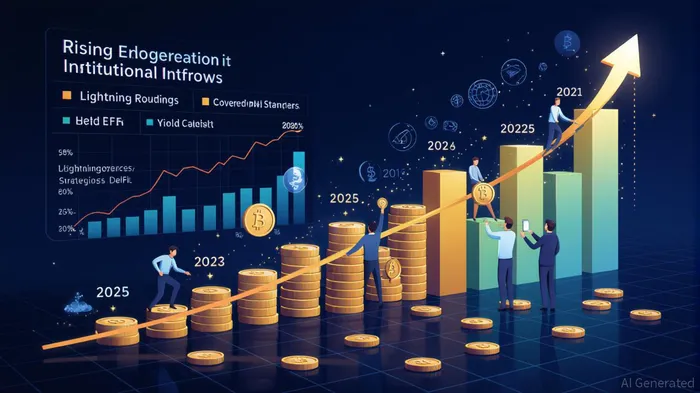
Bitcoin’s journey from a niche speculative asset to a cornerstone of institutional portfolios has been nothing short of revolutionary. By 2025, over 180 publicly traded companies hold BitcoinBTC-- as a strategic reserve, with 59% of institutional portfolios incorporating BTC [1]. This shift is driven by a confluence of regulatory clarity, macroeconomic tailwinds, and innovative yield strategies that position Bitcoin as a productive capital asset rather than a static store of value.
The Institutionalization of Bitcoin
The U.S. BITCOIN Act and the approval of spot ETFs like BlackRock’s IBIT and Fidelity’s FBTC have normalized institutional access to Bitcoin, unlocking over $43 trillion in addressable capital through retirement accounts [1]. Bitcoin’s post-halving inflation rate of 0.83% and its 375.5% return from 2023 to 2025 outperformed traditional assets like gold and the S&P 500 [1]. Meanwhile, the Federal Reserve’s rate cuts and declining 10-year yields have reduced the opportunity cost of holding Bitcoin, accelerating capital reallocation to crypto [2].
MicroStrategy, rebranded as StrategyMSTR--, exemplifies this trend. Its leveraged BTC accumulation strategy generated a 25% year-to-date yield as of July 2025, supported by a $112 billion equity buffer and 20–30% leverage [4]. This success underscores the maturation of Digital AssetDAAQ-- Treasury Strategies (DATS), with 126 publicly traded companies now holding ~4% of the total Bitcoin supply [2].
Yield Generation: Beyond HODLing
Institutional investors are no longer passively holding Bitcoin; they are actively deploying it to generate yield through sophisticated strategies.
- Lightning Network Routing: BlockXYZ-- Inc. operates a Lightning node that generates 9.7% annual returns on invested liquidity through routing fees [4]. This “non-custodial yield” model allows operators to monetize Bitcoin’s utility without surrendering control.
- Covered Calls: Investors sell call options on Bitcoin to collect premiums, capping upside potential but generating steady income. The Purpose Bitcoin Yield ETF and Ether Yield ETF utilize this strategy, leveraging Bitcoin’s volatility to enhance returns [3].
- DeFi Integration: Institutional-grade wallets now account for 41% of total value locked (TVL) in DeFi protocols, up from 17% in 2023 [3]. Platforms like Babylon and Morpho enable Bitcoin holders to earn real yield through fee-sharing mechanisms and liquid staking derivatives [3].
These strategies reflect a broader shift toward “real yield”—sustainable returns from protocol revenue rather than inflationary token emissions [3]. For instance, Bitcoin-secured DeFi protocols like Babylon have locked ~$4.6 billion in TVL, signaling a 300× growth potential for Bitcoin DeFi [1].
Macroeconomic and Regulatory Tailwinds
Bitcoin’s institutional adoption is further bolstered by its role as a hedge against inflation and geopolitical instability. With a weakening correlation to traditional assets, Bitcoin’s market capitalization has surpassed $1.5 trillion, cementing its status as “digital gold” [2]. The DEC Institute’s whitepaper highlights nine institutional-grade strategies, including futures arbitrage and smart contract-based inheritance models, to secure and grow Bitcoin wealth [4].
The Future of Bitcoin as Productive Capital
As Bitcoin’s utility expands, so does its appeal to institutional investors. The integration of Bitcoin into corporate treasuries and retirement accounts reflects a paradigm shift: investors are advised to allocate 1–5% of holdings to Bitcoin, particularly in high-risk markets [1]. With innovations like programmable money and collateralized lending, Bitcoin is redefining the future of finance.
For investors, the message is clear: Bitcoin is no longer a speculative bet but a strategic asset capable of generating real, institutional-grade returns. As the crypto market matures, those who embrace Bitcoin’s productive potential will be best positioned to capitalize on the next phase of its evolution.
Source:
[1] The Rise of BTC Treasuries: How Institutional Adoption Reshaping the Global Economy [https://www.ainvest.com/news/rise-btc-treasuries-institutional-adoption-macroeconomic-forces-reshaping-bitcoin-role-portfolios-2508/]
[2] Bitcoin's Institutionalization and Macroeconomic Tailwinds: A Self-Sustaining Bullish Cycle for 2025 [https://www.ainvest.com/news/bitcoin-institutionalization-macroeconomic-tailwinds-sustaining-bullish-cycle-2025-2508/]
[3] DeFi Yield Strategies Generating 8%+ for Smart Money [https://www.linkedin.com/pulse/defi-yield-strategies-generating-8-smart-money-while-risk-trucco-xtywc]
[4] Strategy Announces Second Quarter 2025 Financial Results [https://www.strategy.com/press/strategy-announces-second-quarter-2025-financial-results_07-31-2025]

Decoding blockchain innovations and market trends with clarity and precision.
Latest Articles
Stay ahead of the market.
Get curated U.S. market news, insights and key dates delivered to your inbox.




Comments
No comments yet