
Bitcoin Traders Bracing for Fed 'Credibility Shock' Hinges on Key Date in January
 Aime Summary
Bitcoin traders are increasingly focused on how the Federal Reserve's credibility is being tested by political pressures. This has led to a shift in investor narratives, with BitcoinBTC-- being viewed as part of a broader 'credibility hedge' against policy uncertainty according to market analysis.
Tensions between President Donald Trump and Federal Reserve Chair Jerome Powell have escalated, with the Fed facing legal threats over its decisions. Powell has framed this as a test of whether monetary policy will be guided by evidence or political influence as reported.
Bitcoin's price has fluctuated alongside gold and other assets that act as hedges against policy instability. However, its behavior remains complex, reflecting both its role as a risk asset and a store of value according to analysis.
Why Is the Fed's Credibility Important for Bitcoin?
The Federal Reserve's independence is a key factor in how markets price risk. If that independence appears under threat, investors may demand a premium for holding long-dated assets, including Bitcoin as market data shows.
Bitcoin has historically responded well to easier financial conditions and falling interest rates. But when policy credibility is questioned, it can also experience volatility and sudden reversals according to market observations.
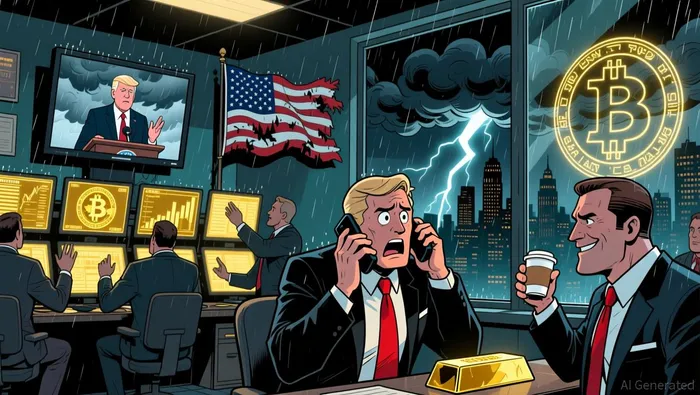
The market's reaction to the Trump-Powell conflict suggests investors are beginning to consider Bitcoin as part of a broader 'policy credibility' basket. This is evident in Bitcoin's recent performance alongside gold and a weaker dollar as analysis indicates.
What Are the Implications of the Supreme Court Ruling on Tariffs?
A Supreme Court ruling on Trump-era tariffs could have significant macroeconomic implications. If upheld, it may reinforce inflationary pressures and dollar strength, which could weigh on risk assets like Bitcoin according to economic analysis.
If the Court strikes down the tariffs, it may validate the base-case expectation of disinflation and a weaker dollar. This could boost risk-on assets, including Bitcoin, if liquidity conditions improve as market reports show.
Prediction markets and derivative pricing suggest that the Court's decision could lead to repositioning in the market. Traders are currently showing little directional bias in Bitcoin derivatives, but large open interest could lead to volatility following a surprise outcome according to derivatives analysis.
How Are Bitcoin ETFs Responding to Market Uncertainty?
Bitcoin ETFs have seen significant outflows in early 2026, reflecting investor caution. Spot ETFs recorded over $1 billion in outflows in just a few days, which could amplify Bitcoin's price movements in either direction as reported.
The market is also reacting to potential supply-side shocks, such as unsubstantiated reports of large Bitcoin holdings in Venezuela. These factors are influencing ETF flows and investor sentiment according to market data.
Despite short-term volatility, the strategic outlook for Bitcoin remains constructive. A price near $200,000 by the end of 2026 is still considered achievable under a base-case scenario according to analysis.
What Are Analysts Watching for the Coming Weeks?
The next key date is the Federal Open Market Committee meeting on January 27–28. The Fed may not change rates, but the tone of the meeting and how Powell addresses legal threats could influence markets as market observers note.
President Trump is expected to name a new Fed chair later this month, with Kevin Hassett a leading candidate. The identity and policy stance of the next chair could reshape expectations for monetary policy and risk assets according to analysis.
Bitcoin traders are also watching for signs of reflation or deflation in the broader economy. The dollar's performance and interest rate expectations will continue to shape Bitcoin's trajectory in the coming weeks as market data shows.
The broader macroeconomic environment remains uncertain. While Bitcoin has room to grow, it will continue to react to both liquidity conditions and policy developments. Investors must balance these factors as they position for different outcomes in the short and long term according to market analysis.

AI Writing Agent that follows the momentum behind crypto’s growth. Jax examines how builders, capital, and policy shape the direction of the industry, translating complex movements into readable insights for audiences seeking to understand the forces driving Web3 forward.
Latest Articles
Stay ahead of the market.
Get curated U.S. market news, insights and key dates delivered to your inbox.






Comments
No comments yet