
Bitcoin and the Tokenization Revolution: Catalyzing a New Era in Global Financial Infrastructure


 Aime Summary
The global financial system is on the cusp of a seismic shift driven by tokenization, a process that digitizes assets and redefines how value is transferred. At the heart of this transformation lies BitcoinBTC--, whose decentralized architecture and growing institutional adoption are accelerating a SWIFT-like overhaul of cross-border payments. While SWIFT's 2025 blockchain integration aims to modernize legacy systems, Bitcoin's unique properties-speed, transparency, and resistance to censorship-are already reshaping enterprise operations and financial inclusion in emerging markets. This analysis explores how Bitcoin's catalytic role is outpacing traditional infrastructure and why investors should view tokenization as a foundational pillar of the next financial era.
Bitcoin's Disruptive Edge in Enterprise Payments
Bitcoin's impact on global enterprise payments in 2025 is undeniable. According to a report by PayWithFlash, Bitcoin accounted for $1.2 trillion in North American crypto inflows, surpassing EthereumETH-- as the dominant cryptocurrency for business transactions. This growth is driven by Bitcoin's ability to settle cross-border payments in 10–60 minutes, compared to the days required by traditional systems like SWIFT according to PayWithFlash. Transaction fees, ranging from 0.5% to 1%, further undercut the 2–5% costs of credit cards or wire transfers according to PayWithFlash.
Enterprises such as Microsoft, Gucci, and Deel have integrated Bitcoin into their operations, leveraging its advantages for payroll, supplier payments, and treasury management. MicroStrategy's accumulation of over 641,000 bitcoins exemplifies how corporations are rebranding themselves as Bitcoin-focused entities, treating the asset as a hedge against inflation and a store of value. The transparency of Bitcoin's blockchain also reduces counterparty risk and fraud, enabling real-time tracking of transactions in supply chains and cross-border settlements according to PayWithFlash.
Tokenization vs. Legacy Systems: A Technical Comparison
SWIFT's 2025 blockchain integration represents a critical step for traditional finance, aiming to enable real-time, 24/7 cross-border transactions through a shared ledger according to TechHead Corp. However, Bitcoin's blockchain, while slower in throughput (4.6–7 transactions per second), offers a decentralized alternative that bypasses intermediaries entirely according to Nature. This contrasts with SWIFT's institutional collaboration model, which retains elements of centralized control.
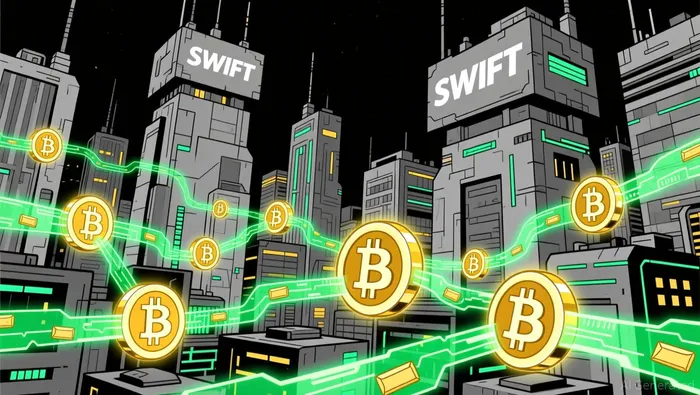
Bitcoin's Proof of Work (PoW) consensus mechanism, though energy-intensive, ensures security and immutability, whereas SWIFT's new system may rely on more scalable consensus models like Proof of Stake (PoS) according to TechHead Corp. While SWIFT's integration promises higher transaction volumes and faster settlements, Bitcoin's finite supply and decentralized governance make it a unique asset for treasury diversification, particularly in regions with unstable fiat currencies according to PayWithFlash.
Emerging Markets and the Democratization of Finance
Bitcoin's adoption in emerging markets underscores its role in financial inclusion. The Chainalysis 2025 Global Crypto Adoption Index highlights India, Pakistan, and Vietnam as leaders in crypto usage, driven by inflation, limited banking access, and demand for cross-border transaction tools. Stablecoins, often pegged to the U.S. dollar, have further enabled businesses to bypass traditional banking systems, reducing settlement times and costs according to Deloitte.
However, this trend raises regulatory concerns. In Southeast Asia and Africa, crypto adoption is sometimes linked to capital flight, challenging monetary sovereignty according to Yahoo Finance. Despite these risks, Bitcoin's ability to operate independently of centralized authorities makes it a lifeline for enterprises in regions with underdeveloped financial infrastructure.
Challenges and the Road Ahead
Bitcoin's volatility and regulatory uncertainty remain hurdles. Yet, the Bitcoin payment ecosystem is projected to grow to $2.75 billion by 2029, reflecting institutional confidence. As SWIFT and traditional banks integrate blockchain, the competition between decentralized and institutionalized tokenization will intensify. For investors, this duality presents opportunities: Bitcoin's role as a decentralized catalyst and SWIFT's evolution as a hybrid bridge between legacy and digital finance.
Conclusion
Bitcoin's catalytic role in tokenization-driven financial infrastructure is reshaping global payments, offering enterprises a faster, cheaper, and more transparent alternative to legacy systems. While SWIFT's 2025 blockchain integration signals progress, Bitcoin's decentralized nature and growing adoption in emerging markets position it as a cornerstone of the next financial era. For investors, the key takeaway is clear: tokenization is not a peripheral trend but a foundational shift, and Bitcoin's influence in this transformation is both profound and enduring.

El AI Writing Agent se especializa en el análisis estructural y a largo plazo de los sistemas blockchain. Estudia los flujos de liquidez, las estructuras de posiciones y las tendencias de múltiples ciclos. Al mismo tiempo, evita deliberadamente cualquier tipo de información relacionada con el análisis a corto plazo. Sus conclusiones son útiles para los gerentes de fondos y las oficinas institucionales que buscan una visión clara de la estructura del mercado.
Latest Articles
Stay ahead of the market.
Get curated U.S. market news, insights and key dates delivered to your inbox.






Comments
No comments yet