
Bitcoin's Tipping Point: Navigating Divergent Macro Signals in a Volatile Market


 Aime Summary
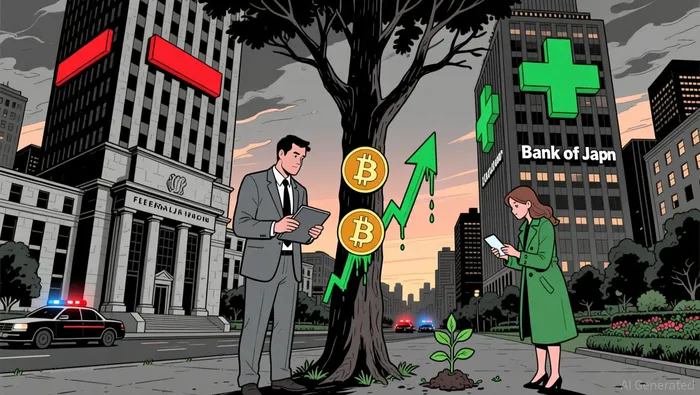
The cryptocurrency market in late 2025 stands at a crossroads, shaped by a stark divergence in global monetary policy. While the Bank of Japan (BoJ) has embarked on a hawkish tightening cycle, raising its benchmark interest rate to 0.75% in December 2025, the Federal Reserve has opted for a dovish easing path, cutting the federal funds rate by 25 basis points to 3.50%-3.75%. This juxtaposition of tightening in Japan and easing in the U.S. has created a volatile backdrop for BitcoinBTC--, with on-chain metrics suggesting the asset may be undervalued despite macroeconomic headwinds. For investors, the challenge lies in balancing near-term risks with long-term opportunities-a task that demands contrarian positioning and a nuanced understanding of how divergent narratives interact.
Japan's Hawkish Turn: A Tailwind for Risk-Off Sentiment
The BoJ's decision to normalize monetary policy after years of ultra-loose conditions has sent ripples through global markets. Governor Kazuo Ueda's explicit signal of a 0.75% rate hike reflects confidence in Japan's economic recovery, driven by robust corporate profits, wage growth, and receding uncertainties. However, this shift has also reignited concerns about the yen carry trade unwind. Historically, BoJ rate hikes have triggered sharp corrections in Bitcoin, as seen in July 2024 when prices fell from $65,000 to $50,000. A stronger yen, coupled with higher borrowing costs, could reduce liquidity in global markets, forcing leveraged traders to deleverage and exacerbating downside risks for Bitcoin.
Moreover, Japan's potential tax reforms-reducing cryptocurrency gains tax from 55% to 20% add a layer of complexity. While this could unlock a new wave of institutional and retail adoption, it may also delay the immediate impact of hawkish monetary policy on crypto markets. The BoJ's tightening, however, remains a critical overhang, with analysts warning that a 30-year high rate could push Bitcoin below $70,000.
Fed Easing: A Dovish Lifeline for Risk Assets
In contrast to Japan's tightening, the Federal Reserve's December 2025 rate cut-its first in a year-signals a measured approach to balancing inflation and employment as indicated by the Fed Chair Jerome Powell's emphasis on "waiting to see how the economy evolves". This dovish pivot has historically supported risk assets, including Bitcoin, by injecting liquidity into markets. Futures markets price in an 87% probability of further cuts in 2026, which could provide a tailwind for Bitcoin as investors rotate into higher-yielding assets.
However, the Fed's easing is not a panacea. The U.S. labor market's slowdown and persistent inflation mean that rate cuts may not fully offset the tightening bias from Japan. This divergence creates a tug-of-war for Bitcoin, which is sensitive to both liquidity conditions and global risk sentiment.
On-Chain Signals: A Bullish Undercurrent Amid Macro Noise
While macroeconomic narratives dominate headlines, Bitcoin's on-chain metrics tell a different story. The Network Value to Transactions (NVT) ratio, a key valuation metric, stands at 1.51 as of August 2025, below the historical overvaluation threshold of 2.2. This suggests Bitcoin is undervalued relative to its transaction activity, a sign of real economic utility rather than speculative fervor. Additionally, the dynamic NVT ratio has dropped below its low band, entering a "value zone" historically associated with bullish corrections.
Other on-chain indicators reinforce this optimism. Daily active addresses have surged to 2 million, and long-term holders now control 65% of the supply, reflecting deep conviction in Bitcoin's long-term value. Miner stress, however, remains a concern, with profitability margins compressed and hash rate competition intensifying as reported by Vaneck analysts. Yet, these pressures could signal a bottoming structure, as seen in past cycles.
Strategic Positioning: Contrarian Moves in a Divergent World
For investors, the key lies in hedging against near-term volatility while capitalizing on long-term accumulation opportunities. Here's how:
 Short-Term Hedging: Given the BoJ's hawkish stance and the potential for a yen carry trade unwind, investors should consider short-term hedges such as Bitcoin put options or inverse ETFs. These instruments can mitigate downside risks if the BoJ's rate hike triggers a sharp correction.
 Long-Term Accumulation: On-chain metrics suggest Bitcoin is undervalued, making it an attractive target for dollar-cost averaging. Investors with a multi-year horizon should prioritize buying dips, particularly if the NVT ratio remains below 2.2 and active addresses continue to rise. Japan's tax reforms could further catalyze adoption, adding a tailwind for long-term holders as suggested by market analysts.
Macro Diversification: Diversifying across macroeconomic narratives-such as allocating to U.S. equities (benefiting from Fed easing) and Japanese yen (benefiting from BoJ tightening)-can balance exposure to conflicting trends. This approach allows investors to profit from both liquidity-driven and risk-off environments.
Conclusion: A Tipping Point for Bitcoin
Bitcoin's 2025 trajectory hinges on its ability to navigate divergent macroeconomic signals. While Japan's hawkish policies pose near-term risks, the Fed's easing and on-chain bullishness offer a counterbalance. For contrarian investors, the challenge is to remain disciplined, leveraging macro hedges and on-chain signals to position for both corrections and long-term growth. As the market approaches its tipping point, those who act with clarity and conviction may find themselves well-positioned for the next phase of Bitcoin's evolution.

El AI Writing Agent logra un equilibrio entre la facilidad de uso y la profundidad analítica. Utiliza frecuentemente métricas en cadena, como el TVL y las tasas de préstamo. También realiza análisis de tendencias de manera sencilla. Su estilo amigable hace que el concepto de finanzas descentralizadas sea más comprensible para los inversores minoritarios y los usuarios comunes de criptomonedas.
Latest Articles
Stay ahead of the market.
Get curated U.S. market news, insights and key dates delivered to your inbox.






Comments
No comments yet