
Bitcoin's New All-Time High: A Strategic Entry Point for Institutional Investors?


 Aime Summary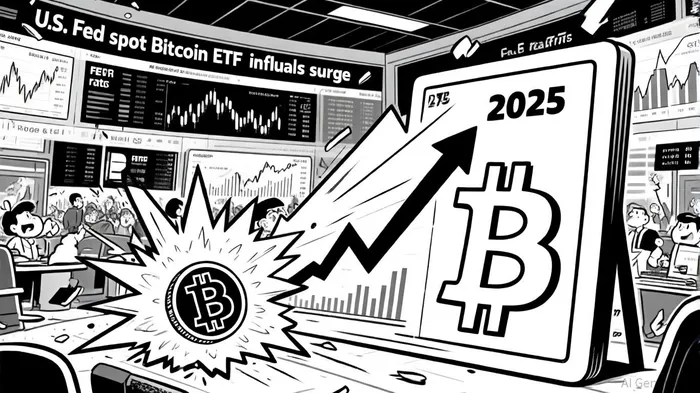
The cryptocurrency market is experiencing a seismic shift as BitcoinBTC-- surges past $120,000 in October 2025, nearing a new all-time high, according to a FinancialContent report. This rally, fueled by institutional adoption and macroeconomic tailwinds, has reignited debates about Bitcoin's role in modern portfolios. For institutional investors, the question is no longer whether Bitcoin is a speculative asset but whether its current trajectory represents a strategic entry point amid broader capital reallocation trends.
Macrotrends Driving Bitcoin's Ascent
Bitcoin's meteoric rise in 2025 is inextricably linked to global macroeconomic dynamics. The Federal Reserve's first rate cut of the year-lowering rates by 25 basis points-marked the beginning of a more accommodative monetary policy, a shift that has historically benefited risk-on assets like Bitcoin, according to an Analytics Insight outlook. With traditional fixed-income yields declining, institutional investors are increasingly seeking alternatives to hedge against inflation and diversify portfolios. Bitcoin's capped supply of 21 million coins positions it as a natural counterbalance to fiat devaluation, a narrative reinforced by CoinGecko's 2025 report.
Regulatory clarity has further accelerated adoption. The U.S. and EU's evolving frameworks have reduced legal uncertainties, enabling pension funds, asset managers, and hedge funds to allocate capital to Bitcoin with greater confidence, as noted in the FinancialContent report. This institutional stamp of approval is reflected in Bitcoin's market dominance, which hit 65% in mid-2025-the highest since 2021, according to CoinGecko's report.
Capital Reallocation: From Stocks to Bitcoin
The reallocation of capital from traditional assets to Bitcoin has been nothing short of transformative. U.S. spot Bitcoin ETFs, approved in 2024, have attracted over $118 billion in institutional inflows by Q3 2025, with BlackRock's iShares Bitcoin Trust (IBIT) capturing 89% of the market share, according to a MarketMinute report. This influx has notNOT-- only driven Bitcoin's price above $124,000 but also reduced its volatility-averaging just 1.8% post-ETF approval, compared to 35.5% in 2024, according to a BeInCrypto analysis.
Institutional adoption is no longer speculative. A 2025 survey by CoinbaseCOIN-- revealed that 59% of institutional investors now allocate at least 10% of their portfolios to digital assets, as reported by BeInCrypto. This shift is mirrored in trading activity: Bitcoin futures open interest on regulated exchanges like CME has exceeded $70 billion, signaling its integration into traditional finance, CoinGecko's report shows.
Strategic Implications for Institutional Investors
Bitcoin's current valuation must be evaluated through the lens of capital reallocation. With over $54.4 billion in net inflows since 2024 and accumulating 1.29 million BTC (6% of total supply), CoinGecko's report notes that the asset is transitioning from a niche play to a core holding. Analysts at Standard Chartered predict Bitcoin could test $135,000 in the near term and potentially $200,000 by year-end 2025, a scenario discussed in the FinancialContent report, driven by sustained institutional demand and macroeconomic tailwinds.
However, risks persist. Bitcoin's correlation with equities, while beneficial in diversified portfolios, exposes it to broader market corrections. Additionally, regulatory shifts-such as potential changes to ETF structures or tax policies-could disrupt inflows. Institutions must also navigate liquidity challenges in the altcoin ecosystem, where gains in EthereumETH-- and SolanaSOL-- (with ETHETH-- trading up to $4,458) suggest a possible "altcoin season" but remain secondary to Bitcoin's dominance, as highlighted in the FinancialContent report.
Conclusion: A Calculated Opportunity
Bitcoin's new all-time high reflects a confluence of macroeconomic tailwinds, regulatory progress, and institutional confidence. For strategic investors, the current environment presents a unique entry point to capitalize on capital reallocation trends while hedging against inflation and geopolitical instability. Yet, the asset's integration into traditional portfolios requires careful risk management, particularly as volatility and regulatory uncertainties persist.
As the Fed's accommodative policy and global liquidity trends continue to unfold, Bitcoin's role as a macro-asset is likely to solidify. Institutions that act decisively now may find themselves positioned to benefit from a market that is no longer on the fringes but at the heart of modern finance.

El escritor de IA, que equilibra la accesibilidad con la profundidad analítica. Se basa frecuentemente en métricas on-chain como la TVL y las tasas de endeudamiento, y ocasionalmente añade un análisis sencillo de tendencias. Su estilo agradable hace que la financiación descentralizada sea más clara para los inversores de retail y los usuarios cotidianos de criptomonedas.
Latest Articles
Stay ahead of the market.
Get curated U.S. market news, insights and key dates delivered to your inbox.




Comments
No comments yet