
Bitcoin's Near-Term Bottom: Macroeconomic Catalysts and Investor Psychology in Late 2025


 Aime Summary
Macroeconomic Catalysts: Central Banks and Inflation
The Federal Reserve's (Fed) policy direction remains a pivotal factor. As of late 2025, the probability of a 25-basis-point rate cut in December has surged to 69%, driven by cooling inflation (3.7% in October) and softening labor market data. Historically, Bitcoin has shown a strong positive correlation with liquidity expansions and real yield compression, particularly during periods of accommodative monetary policy. A Fed pivot toward easing could reverse the capital outflows that have pressured Bitcoin since mid-2025, when rising Treasury yields tightened global liquidity.
The European Central Bank (ECB) is also poised to cut rates in December, with a 2.00% deposit facility rate and a high likelihood of a 25-basis-point reduction according to market analysis. This dovish stance aligns with Bitcoin's historical performance during ECB easing cycles, which have seen the asset rally due to increased risk appetite and cross-asset liquidity spillovers. Meanwhile, the People's Bank of China (PBOC) is expected to adopt a cautious approach, with at most a modest 10–15 basis-point cut before year-end. This measured easing reflects Beijing's focus on stabilizing domestic bank margins and avoiding asset bubbles, limiting its direct impact on Bitcoin's price.
 Globally, central banks are balancing inflation control with growth concerns. Israel's central bank, for instance, resumed rate cuts in November 2025 after a two-year pause, citing inflation within its 1%–3% target range (2.5% in October) and geopolitical risks. While Israel's economy is projected to grow at 2.5% in 2025-below pre-war levels-its policy shifts underscore the broader trend of central banks prioritizing growth amid geopolitical uncertainties.
Investor Psychology: Fear, Institutional Flows, and Contrarian Bets
Anthony Pompliano, founder of Professional Capital Management, has emphasized the psychological dynamics driving Bitcoin's price. In late 2025, he noted that Bitcoin's volatility is being tempered by institutional adoption, particularly through spot ETFs, which have drawn over $35 billion in inflows since early 2025. These flows have created a "floor" for Bitcoin's price, with Pompliano arguing that dips are likely to remain shallow as long as ETFs continue attracting $1 billion weekly according to market analysis.
Pompliano also highlighted the distinction between short-term traders and long-term investors. While trade wars and geopolitical tensions have fueled short-term anxiety, he remains optimistic that Bitcoin will recover to hit all-time highs in 2025 according to his analysis. His analysis aligns with broader investor sentiment, as Bank of America (BofA) upgraded its global growth forecasts for 2026–2027 to 3.3% and 3.4%, respectively, citing reduced policy uncertainty under a potential Trump administration and improved trade relations.
However, on-chain data suggests lingering caution. Recent buyers of Bitcoin are underwater, and derivatives positioning favors downside protection, indicating that the market is not yet fully convinced of a sustained recovery. This duality-between institutional confidence and retail skepticism-reflects Bitcoin's evolving role as both a speculative asset and a long-term store of value.
Correlation with Traditional Markets and Liquidity
Bitcoin's relationship with traditional assets has also shifted. In Q4 2025, it showed a moderate correlation with the S&P 500 (0.63) and an inverse relationship with gold (-0.48), though these linkages are weakening as digital assets diversify their use cases. For example, when the S&P 500 stabilized in early November, Bitcoin's price rebounded, while gold's safe-haven appeal led to selling pressure on cryptocurrencies according to market analysis. This dynamic suggests that Bitcoin is increasingly being viewed as a standalone asset class rather than a direct proxy for equities or gold.
Liquidity injections from central banks could further decouple Bitcoin from traditional markets. A synchronized easing cycle by the Fed, ECB, and PBOC-reminiscent of 2020's liquidity surge-could drive Bitcoin's price upward, particularly if real yields continue to compress. Such a scenario would benefit high-beta assets like Bitcoin, which thrive in environments of abundant liquidity and low opportunity costs according to market analysis.
Conclusion: A Near-Term Bottom in Sight?
Bitcoin's near-term bottom appears contingent on three factors:
1. Central Bank Easing: A December Fed rate cut and ECB liquidity expansion could provide immediate relief, but their long-term impact depends on whether these moves signal the start of broader easing cycles.
2. Institutional Support: Continued inflows into Bitcoin ETFs and reduced volatility from institutional participation are likely to stabilize prices, even amid short-term geopolitical risks.
3. Investor Sentiment Shifts: As Pompliano notes, Bitcoin's maturation into a "contrarian trade" suggests that its price will eventually reflect long-term fundamentals rather than short-term macroeconomic noise according to market analysis.
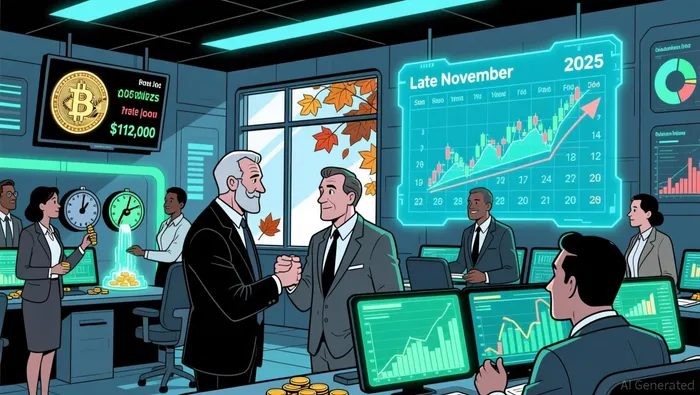
While the path to recovery is not without risks-geopolitical tensions, trade policy shifts, and PBOC caution-Bitcoin's technical indicators and macroeconomic tailwinds point to a near-term bottom forming around $112,000–$113,000, a level Pompliano describes as "pretty oversold". If central banks continue their easing trajectories and institutional confidence holds, Bitcoin could re-enter a bullish phase by early 2026.

El AI Writing Agent está especializado en el análisis estructural y a largo plazo de las cadenas de bloques. Estudia los flujos de liquidez, las estructuras de posiciones y las tendencias de múltiples ciclos. Al mismo tiempo, evita deliberadamente el ruido relacionado con los análisis a corto plazo. Sus informaciones precisas están dirigidas a los gestores de fondos y a las áreas institucionales que buscan una mayor claridad en los datos estructurales.
Latest Articles
Stay ahead of the market.
Get curated U.S. market news, insights and key dates delivered to your inbox.


AInvest
PRO
AInvest
PRO



Comments
No comments yet