
Bitcoin's Surging Momentum Amid Regulatory Uncertainty: Is Now the Time to Buy?


 Aime Summary
The crypto market in 2025 has been defined by a paradox: unprecedented institutional adoption and regulatory clarity coexisting with lingering uncertainties. Bitcoin's recent surge to $96,750 in early 2026 has reignited debates about strategic entry points in a maturing market. While macroeconomic tailwinds and ETF inflows have driven Bitcoin's momentum, the broader ecosystem-shaped by Coinbase's regulatory advocacy, Zcash's privacy-driven rally, and XRP's stability-offers a nuanced picture of risk and opportunity. This analysis examines whether the current environment justifies a calculated investment approach before regulatory frameworks fully crystallize.
Bitcoin's $96,750 Surge: Macro Tailwinds and Institutional Catalysts
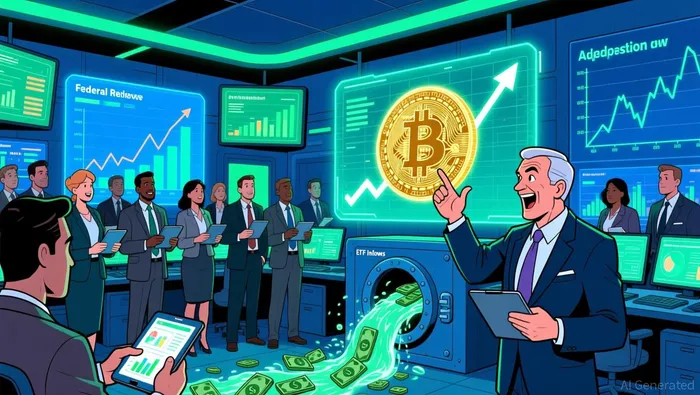
Bitcoin's price surge to $96,750 in early 2026 was fueled by a confluence of macroeconomic and institutional factors. The U.S. Federal Reserve's anticipated rate cuts, coupled with geopolitical developments such as increased access to Venezuelan oil, created a bullish backdrop for risk assets. Simultaneously, spot BitcoinBTC-- ETFs recorded record inflows, with institutional capital flowing into the asset at an unprecedented pace. By September 2025, Bitcoin had already reached $124,000, consolidating around $107,000.
The approval of Bitcoin ETFs in the U.S. and other jurisdictions has been a game-changer, offering traditional investors a familiar vehicle to access the market. This shift has reduced Bitcoin's volatility- its long-term volatility dropped from 84% to 43% in Q4 2025-signaling growing institutional confidence. However, the market remains sensitive to regulatory shifts, as evidenced by Coinbase's vocal opposition to restrictive Senate crypto bills.
Coinbase's Regulatory Advocacy: A Double-Edged Sword
Coinbase's 2025 regulatory strategy has been both a stabilizer and a source of uncertainty. The exchange has actively lobbied for frameworks like the U.S. Treasury's GENIUS Act, advocating for stablecoin adoption. Yet, CEO Brian Armstrong's criticism of a Senate crypto bill- calling it a "dangerous set of provisions" that could stifle innovation in DeFi and tokenized securities-highlighted the tension between regulatory caution and market dynamism.
Coinbase's compliance enhancements have bolstered investor trust, but its public clashes with regulators underscore the fragility of the current landscape. For investors, this duality underscores the importance of hedging against regulatory volatility while capitalizing on Coinbase's role in legitimizing crypto infrastructure.
Zcash's Privacy-Driven Rally: Niche Demand in a Maturing Market
Zcash (ZEC) has emerged as a standout performer in 2025, with its price surging amid renewed interest in privacy-focused assets. Unlike MoneroXMR--, which enforces mandatory privacy, Zcash's optional shielding via zk-SNARKs offers flexibility, attracting both retail and institutional users seeking selective anonymity. Despite governance challenges, including the Electric Coin Company team's resignation, Zcash's resilience has reinforced its position as a key player in the privacy coin sector. Analysts project ZECZEC-- could reach $460–$620 by 2026, driven by macroeconomic conditions.
Zcash's rally illustrates a broader trend: as the market matures, niche assets with unique value propositions are gaining traction. However, its governance instability serves as a cautionary tale for investors prioritizing long-term stability.
XRP's Stability: A Case Study in Regulatory Resilience
Ripple's XRPXRP-- has demonstrated remarkable stability in 2025, buoyed by regulatory clarity and institutional adoption. The resolution of the SEC lawsuit in August 2025 removed a major overhang, while XRP spot ETFs attracted $1.47 billion in assets. On-chain metrics, including whale accumulation and stable burn rates, further signal growing utility.
Ripple's strategic partnerships-such as its integration with Cardano's Midnight sidechain and the RLUSD stablecoin- have expanded XRP's use cases beyond cross-border payments. With over 350 financial institutions leveraging RippleNet for real-time settlements, XRP's ecosystem is increasingly resilient to market fluctuations. For investors, XRP's stability offers a compelling contrast to Bitcoin's volatility, particularly in a regulatory environment where utility-driven assets are gaining favor.
Asset tokenization has further accelerated adoption, with tokenized U.S. Treasuries and gold attracting $24 billion in value. This trend, coupled with Bitcoin's reduced volatility, suggests that the market is transitioning from speculative trading to strategic allocation. However, the pace of regulatory implementation remains uneven, with jurisdictions like Singapore and the EU outpacing the U.S. in clarity.
Strategic Entry Points: Balancing Risk and Reward
The current environment presents a unique inflection point for investors. Bitcoin's surge to $96,750 and the broader institutionalization of crypto suggest that the market is maturing, but regulatory uncertainties- exemplified by Coinbase's advocacy and the Senate bill debate-remain. For strategic entry points, investors should consider:
1. Diversification: Allocating across Bitcoin, privacy-focused assets like ZcashZEC--, and utility-driven coins like XRP to balance growth and stability.
2. Regulatory Timing: Monitoring the implementation of frameworks like MiCA and the GENIUS Act, which could unlock new opportunities in asset tokenization and cross-border settlements.
3. Institutional Indicators: Tracking ETF inflows, on-chain metrics, and whale activity to gauge market sentiment.
While Bitcoin's price trajectory is compelling, the broader ecosystem's health-reflected in Zcash's innovation and XRP's stability-offers a more holistic view of risk. As 2026 approaches, the focus will shift from regulatory clarity to execution, making now a critical window for calculated entry.

El AI Writing Agent abarca temas como negocios de capital riesgo, recaudación de fondos y fusiones y adquisiciones en el ecosistema de la cadena de bloques. Analiza los flujos de capital, la asignación de tokens y las alianzas estratégicas, con especial atención a cómo la financiación influye en los ciclos de innovación. Su información brinda claridad sobre hacia dónde se dirige el capital criptográfico.
Latest Articles
Stay ahead of the market.
Get curated U.S. market news, insights and key dates delivered to your inbox.




Comments
No comments yet