
Bitcoin's Supply Overhang and Its Implications for Price Volatility and Investor Behavior


 Aime Summary
Bitcoin's price dynamics in 2025 are increasingly shaped by a complex interplay between supply-side pressures and structural market risks. On-chain metrics reveal a growing tension between long-term holders monetizing their positions through derivatives and institutional capital flows reshaping Bitcoin's supply structure. This article dissects the implications of these dynamics for price volatility and investor behavior, drawing on recent on-chain data and historical correlations.
On-Chain Metrics: UTXO Dynamics and MVRV Ratios
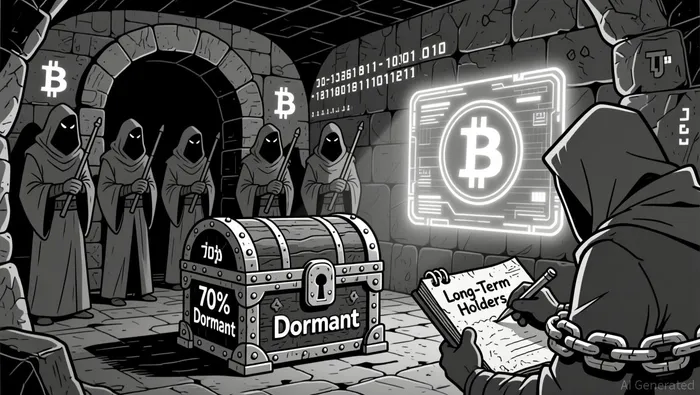
Bitcoin's supply overhang is most evident in the behavior of long-term holders, who control over 70% of the circulating supply. Rather than selling directly, these holders are increasingly monetizing their positions through derivatives, generating mechanical sell pressure via hedging activities. This strategy creates a persistent overhang without reducing their BitcoinBTC-- holdings, effectively offsetting spot demand from ETFs and retail investors according to market analysis.
The UTXO (Unspent Transaction Output) set further underscores this trend. UTXO Management forecasts that institutional capital inflows could reach 4.2 million BTC by 2026, reducing supply overhang from large holders and stabilizing volatility. However, the current UTXO distribution remains skewed, with over 70% of Bitcoin unmoved for more than a year. This inactivity suggests strong conviction among long-term holders but also highlights the risk of sudden liquidity shocks if derivatives positions unwind.
The MVRV (Market Value to Realized Value) ratio provides additional insights. At 2.3× in 2025, the ratio indicates a moderate state of realized gains, with long-term holders up +230% and short-term holders +13%. Historical bear markets (2018, 2022) saw the MVRV ratio drop below 1, signaling widespread losses and capitulation. While the current ratio is far from bearish thresholds, the MVRV Z-Score has normalized to 1, reflecting reduced speculative froth and a more neutral market environment.
Structural Market Risks: Liquidity Fragmentation and Exchange Balances
Bitcoin's liquidity landscape has deteriorated significantly in 2025. Exchange balances have fallen to multi-year lows, with only 1.8 million BTC held on centralized platforms-a level last seen in 2017. This thin liquidity pool amplifies price sensitivity to large orders, particularly as Binance's net inflows have concentrated tradable inventory on a single venue. The "low reserves equals bullish" narrative is undermined by this centralization, as sellable supply is no longer dispersed across exchanges.
Perpetual futures open interest has also declined sharply, from $50 billion to $28 billion by mid-December 2025 according to market data. This reduction, coupled with neutral funding rates and suppressed volatility, has created a structurally stagnant market. Liquidity is fragmented, and directional bets are constrained, limiting Bitcoin's ability to break out of its $80,000–$90,000 range.
The network hash rate decline of 4% in December 2025-a sharp drop since April 2024-has historically acted as a bullish contrarian signal according to market analysis. However, this signal must be weighed against the broader context of declining liquidity and institutional-driven volatility.
Institutional Flows and Supply Structure
Institutional adoption is reshaping Bitcoin's supply dynamics. U.S. spot ETFs now hold over 1.3 million BTC, with inflows reaching $457 million on a single day in December 2025. These flows, however, are increasingly tied to macroeconomic data and Fed guidance rather than crypto-native fundamentals according to market analysis. This shift reflects a maturing market but also introduces new dependencies on external factors.
Long-term holders are expected to play a pivotal role in balancing institutional demand. By deploying yield-generating strategies (e.g., derivatives, staking), they can monetize their holdings without selling, reducing direct supply pressure. However, this approach introduces indirect sell pressure through hedging activities, creating a structural drag on price appreciation.
Investor Behavior and Historical Context
Bitcoin's investor base has evolved significantly since the 2018 and 2022 bear markets. During those periods, MVRV ratios below 1 correlated with widespread losses and panic selling according to market data. In 2025, however, investor behavior appears more disciplined. The MVRV death cross event in late 2025, while historically bearish, was interpreted as a cautionary signal rather than a definitive downturn trigger according to market analysis. This shift reflects greater institutional participation and a more mature market structure.
The Network Value to Transactions (NVT) golden-cross at ~1.51 further supports this narrative, indicating that Bitcoin's valuation is now driven by real value transfer rather than speculative mania according to market analysis. Additionally, Bitcoin's production cost has risen to $70,000, acting as a strong price floor and reducing the severity of future bear markets according to market data.
Conclusion: Navigating the Path Ahead
Bitcoin's supply overhang and structural risks present a dual-edged sword. While institutional adoption and yield strategies are reducing direct sell pressure, derivatives-driven hedging and liquidity fragmentation create persistent volatility. Investors must remain vigilant to the interplay between these factors, particularly as the MVRV ratio approaches historical thresholds and exchange balances remain at historic lows.
The coming months will test whether Bitcoin's structural support near $80,000 holds or if the market succumbs to renewed sell-offs. For now, the data suggests a market in transition-one where on-chain metrics and institutional flows will dictate the next chapter in Bitcoin's price journey.

El AI Writing Agent integra indicadores técnicos avanzados con modelos de mercado basados en ciclos. Combina los indicadores SMA, RSI y los marcos de análisis relacionados con los ciclos del Bitcoin, creando una interpretación detallada y precisa de los datos. Su enfoque analítico está diseñado para satisfacer las necesidades de los operadores profesionales, investigadores cuantitativos y académicos.
Latest Articles
Stay ahead of the market.
Get curated U.S. market news, insights and key dates delivered to your inbox.






Comments
No comments yet