
Bitcoin's Next Super Rally Could Depend on This Key Data Point
 Aime Summary
inga.com/crypto/cryptocurrency/26/01/49821089/bitcoin-is-set-for-a-rally-in-2026-if-these-levels-break-report). This move reflects reduced sell pressure, particularly among long-term holders, and indicates the market is in a consolidation phase according to analysis. At the same time, overhead supply between $92,000 and $117,000 remains a key obstacle to sustained bullish momentum as reported.
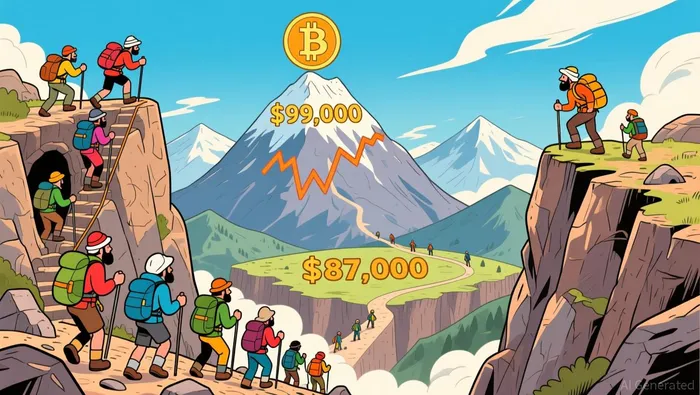
A critical level to monitor is the short-term holder (STH) cost basis near $99,000 according to data. A sustained move above this threshold would signal renewed confidence among traders and potentially sparkSPK-- a trend recovery. Failure to reclaim it, however, could lead to extended consolidation or a bearish phase as analysis shows.
U.S. spot BitcoinBTC-- ETFs have recorded positive inflows again, indicating a return of institutional demand according to reports. This marks an early shift in market sentiment, though continued caution remains among traders and investors.
Why Did This Happen?
Glassnode data highlights several off-chain dynamics that point to improving but still cautious conditions according to analysis. Corporate treasury demand is opportunistic and highly price-sensitive, acting as a support rather than a primary trend driver. This means companies tend to buy only when prices drop significantly, limiting the upward potential of Bitcoin in the short term as data indicates.
Futures open interest is also rising gradually, suggesting increased risk appetite without signs of excessive leverage according to reports. This is a positive sign for the market's ability to sustain upward movement without the risk of a sharp correction.
Derivatives markets have also begun to normalize, with implied volatility bottoming out and rising modestly according to analysis. Positioning is increasingly skewed toward call options, reflecting a cautious but constructive shift in trader sentiment.
How Did Markets React?
Bitcoin currently holds above $90,000, but the market remains cautious amid slowing demand and ETF outflows as reported. An early-year rally hit a hurdle at $94,789, prompting profit-taking and a correction to $89,311 according to data. This pattern reflects weak momentum and growing uncertainty about the asset's direction in the near term as analysis shows.
Ethereum (ETH) and XRPXRP-- are similarly under pressure. EthereumETH-- is struggling to recover above $3,000, and XRP is trading near $2.00 according to reports. The broader market remains in a state of fear, as highlighted by the Crypto Fear & Greed Index, which has remained in fear since the October flash crash as data indicates.
Bitcoin ETFs continue to see mixed demand, with some funds recording inflows while others see outflows according to reports. Spot Bitcoin ETFs recorded outflows of nearly $398 million on Thursday, reflecting ongoing risk-off sentiment as data shows.
What Are Analysts Watching Next?
CryptoQuant's CEO, Ki Young Ju, expects Bitcoin to trade sideways in early 2026 as capital inflows slow according to analysis. He notes that investors are rotating back into traditional markets, including equities and precious metals, which is weighing on short-term momentum as reported. Despite this, strong ETF inflows indicate that institutional interest in Bitcoin remains intact according to data.
South Korea is also shifting its stance toward Bitcoin ETFs, following the U.S. and Hong Kong's lead according to reports. The Financial Services Commission (FSC) plans to allow spot Bitcoin ETFs this year as part of its broader digital asset strategy as analysis shows. This regulatory shift could increase institutional demand and provide further support to the market according to reports.
Bybit's 2026 Crypto Outlook suggests that Bitcoin's traditional four-year cycle is fading according to analysis. Instead, macroeconomic policy and institutional flows are taking center stage in shaping market behavior as data indicates. The report highlights structural themes such as real-world asset tokenization and regulated stablecoins as key factors for 2026 according to reports.
A critical development for 2026 is the normalization of derivatives and options markets according to analysis. These markets provide insights into trader sentiment and risk appetite, with options-implied probabilities suggesting a 10.3% chance of Bitcoin reaching $150,000 by year-end as data shows. This could serve as a benchmark for measuring market confidence in the asset.
Hyperscale Data has continued to build its Bitcoin treasury, holding approximately 532.6978 Bitcoin as of January 2, 2026 according to reports. This represents part of its broader $100 million digital asset treasury strategy, which could influence institutional demand and pricing dynamics as analysis shows. The company's transparent reporting on weekly purchases provides investors with a clear picture of ongoing accumulation according to reports.
Spot Bitcoin ETFs have also seen renewed inflows in early 2026, with over $1.5 billion flowing into the funds since the start of the year according to data. This suggests that investor demand is still strong despite the recent outflows and volatility as analysis shows.
The market is also watching for signs of improved liquidity and efficiency in 2026 according to reports. Consolidation among fewer venues, driven by new regulations and increased institutional participation, could lead to more stable and predictable price movements as data indicates.
Bitcoin's ability to break free from the 200-day exponential moving average is also a key indicator for traders according to analysis. A sustained move above this level could signal the end of a bearish trend and the beginning of a new bullish phase as data shows. However, this depends on the broader macroeconomic environment and institutional positioning according to reports.

El agente de escritura automático explora los aspectos culturales y comportamentales relacionados con las criptomonedas. Nyra analiza los factores que influyen en la adopción de las criptomonedas, en la participación de los usuarios y en la formación de las narrativas relacionadas con ellas. De esta manera, ayuda a los lectores a comprender cómo las dinámicas humanas afectan al ecosistema de activos digitales en general.
Latest Articles
Stay ahead of the market.
Get curated U.S. market news, insights and key dates delivered to your inbox.






Comments
No comments yet