
Bitcoin's Sudden Downturn in Early November 2025: Macroeconomic Policy Spillovers and Institutional Exit Triggers


 Aime Summary
Macroeconomic Policy Spillovers: Central Banks and Geopolitical Uncertainty
The Federal Reserve's continued hawkish stance in October 2025 played a pivotal role in Bitcoin's decline. As the Fed maintained restrictive monetary policy to combat inflation, Bitcoin's price dropped by 13%, reflecting its sensitivity to interest rate expectations and risk-off sentiment, according to a Morningstar report. This was exacerbated by geopolitical tensions, including the Trump administration's threats of a 100% tariff on Chinese rare earths, which triggered a liquidity crunch and forced risk-averse investors to offload volatile assets, according to the Morningstar report.
Cooling inflation data (3.7%) in late October briefly signaled a potential policy pivot, prompting an 86.7% surge in Bitcoin over a 7-day period, according to a Gate article. This inverse correlation between inflation and Bitcoin prices underscores the asset's role as a hedge against macroeconomic uncertainty. However, the Fed's cautious approach to easing-coupled with ongoing geopolitical frictions-left the market in a state of flux, with Bitcoin trading in a narrow range between $103,800 and $114,400 in November, according to a Yahoo Finance report.
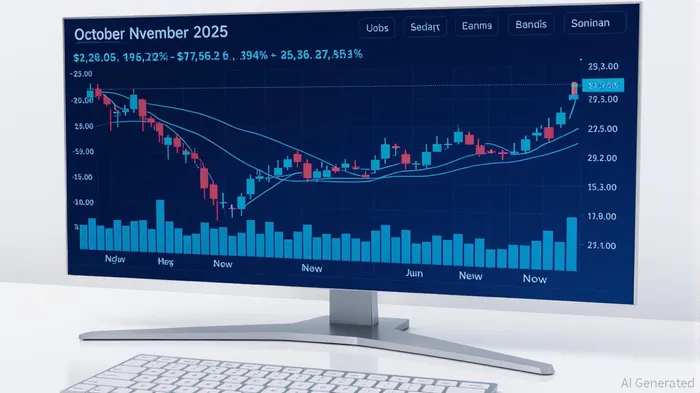
Institutional Exit Triggers: Liquidations and Portfolio Rebalancing
The November downturn was further amplified by institutional exit triggers. Over $379.9 million in crypto liquidations were reported in a single 24-hour period, with Bitcoin accounting for $81.43 million-nearly half of which stemmed from long positions, according to a Coinotag report. Altcoins like ZCashZEC-- and FARTCOIN also faced significant losses, with $31.24 million and $7.87 million in liquidations, respectively, according to the Coinotag report. These cascading liquidations reflected heightened leverage in the market and a lack of downside liquidity during the range-bound phase.
While direct data on institutional crypto portfolio rebalancing is sparse, broader trends in institutional finance offer insights. For instance, Kayne Anderson BDC rotated $113 million out of lower-yielding assets in Q3 2025, redeploying capital into higher-growth opportunities, according to a Seeking Alpha article. This mirrors potential crypto strategies, where institutions may have shifted allocations from Bitcoin to alternative assets or private credit during the price consolidation. Additionally, the adoption of privacy tokens like ZCash and zero-knowledge proofs suggests a growing emphasis on confidentiality and regulatory compliance in institutional crypto strategies, according to a Coinotag article.
The Path Forward: Stability and Institutional Confidence
Despite the volatility, signs of stabilization emerged in early November. The Fed's signals of potential easing, combined with a bipartisan resolution to end the U.S. government shutdown, boosted market optimism, according to an Economic Times report. Bitcoin's price rebounded to $106,000, supported by ETF inflows and Tether's $98 million Bitcoin purchase, according to a Bitget article. Analysts argue that the current market structure is stronger than in previous cycles, with institutional participation and regulatory clarity acting as tailwinds, according to the Morningstar report.
The integration of crypto trading into traditional banking frameworks-such as SoFi's FDIC-insured platform-also signals growing institutional acceptance. While short-term volatility remains, the November correction appears to be a cyclical reset rather than a harbinger of a crypto winter.
Conclusion
Bitcoin's downturn in early November 2025 was driven by a combination of macroeconomic policy spillovers and institutional exit triggers. Central bank hawkishness, geopolitical tensions, and leveraged liquidations created a volatile environment. However, the subsequent stabilization and institutional confidence in crypto's long-term potential suggest that the market is adapting to these challenges. As regulatory clarity and technological innovations like zero-knowledge proofs gain traction, Bitcoin's role as a macroeconomic hedge may become even more pronounced.

Blending traditional trading wisdom with cutting-edge cryptocurrency insights.
Latest Articles
Stay ahead of the market.
Get curated U.S. market news, insights and key dates delivered to your inbox.


AInvest
PRO
AInvest
PRO



Comments
No comments yet