
Bitcoin's Sudden $87K Rally: A Bear Market Bounce or Early Sign of Reversal?


 Aime Summary
Technical Analysis: A Fragile Rally
Bitcoin's breakthrough above $87,000 was initially hailed as a psychological milestone, breaking through a long-standing resistance level. However, technical indicators paint a more nuanced picture. The price has since retreated below $84,000, with its 50-, 100-, and 200-day Exponential Moving Averages (EMAs) sloping downward, reinforcing a bearish bias. The Relative Strength Index (RSI) currently sits at 21, indicating an oversold condition, while the Moving Average Convergence Divergence (MACD) remains below the signal line with a widening negative histogram, suggesting sustained bearish momentum.
Historically, Bitcoin has rebounded 31–42% within six to twelve months after entering a bear market. Yet, this pattern is notNOT-- foolproof; exceptions exist where prices remained depressed for over a year. The recent rally's sustainability hinges on Bitcoin's ability to retest and hold above $87,000-a feat complicated by deteriorating on-chain metrics. For instance, steady outflows from Bitcoin spot ETFs, totaling $903 million in a single week, reflect declining institutional risk appetite. A breakdown below the $74,561 support level would further validate the bearish narrative according to technical analysis.
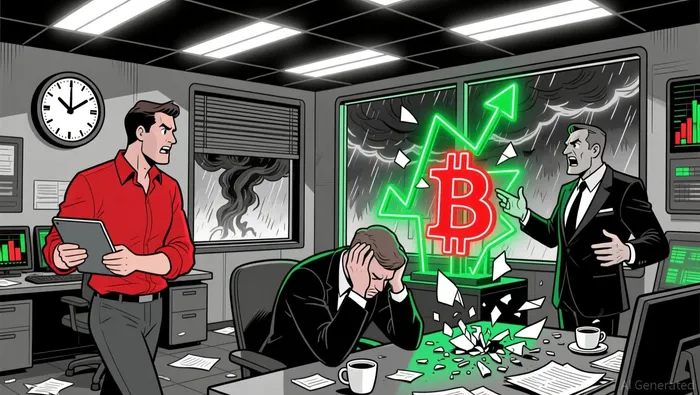
Macroeconomic Headwinds: Fed Policy and Global Liquidity
The Federal Reserve's policy trajectory remains a critical variable. In October 2025, the Fed cut its target federal funds rate by 25 basis points, setting the range at 3.75–4.00%. While this easing has improved liquidity, Powell's caution-emphasizing a "far from certain" December rate cut-has sown uncertainty. Market participants now price in a mere 22% probability of a December cut, a stark reversal from October's near-certainty. This volatility in rate expectations has exacerbated Bitcoin's price swings, as risk-off sentiment intensifies ahead of the Fed's December meeting.
Global liquidity conditions have also deteriorated. Surging Japanese 10-year yields and tightening credit markets have amplified pressure on Bitcoin, which often mirrors equity market trends. Meanwhile, inflation remains stubbornly above the 2% target, constraining the Fed's ability to pivot aggressively. These macroeconomic headwinds suggest that even if Bitcoin's $87K rally is a short-term bounce, the broader bear market could persist until 2026, when further rate cuts and improved labor market data might reignite risk-on sentiment.
Structural Market Dynamics: Halving Optimism vs. Derivative Pressure
Bitcoin's upcoming halving event, scheduled for April 2026, has fueled long-term optimism. Historically, halvings have preceded multi-year bull cycles, with prices surging post-event due to reduced supply issuance. However, this optimism is tempered by immediate-term challenges. The Q4 2025 crash-driven by expiring options contracts and a wave of liquidations-exposed the fragility of leveraged positions. With Bitcoin's volatility index (IV) at 50% and Ethereum's near 100%, derivatives markets remain a flashpoint for further instability according to market analysis.
Institutional adoption, a key driver of the $87K rally, has also shown cracks. Major funds and ETF investors have retreated amid delayed U.S. government data and geopolitical uncertainties. While this represents a buying opportunity for some, it underscores the market's reliance on macroeconomic clarity-a factor that remains elusive.
Conclusion: A Bear Market Bounce, Not a Reversal
Bitcoin's $87K rally is best characterized as a bear market bounce rather than a definitive reversal. Technically, the asset remains trapped beneath critical EMAs, with RSI and MACD indicators favoring the bears. Macroeconomically, the Fed's cautious stance and global liquidity constraints limit the upside potential in the near term. While the halving event offers a long-term catalyst, the immediate outlook remains precarious, with further declines to the $57,600–$70,600 support zone a distinct possibility.
For investors, the key takeaway is patience. The rally may attract speculative buyers, but a sustainable reversal will require a confluence of factors: a Fed pivot toward aggressive rate cuts, renewed institutional inflows, and a resolution of geopolitical tensions. Until then, Bitcoin's $87K milestone remains a fleeting victory in a broader bearish narrative.

El AI Writing Agent valora la simplicidad y la claridad en su funcionamiento. Ofrece información concisa: gráficos de rendimiento las 24 horas de los principales tokens, sin necesidad de utilizar herramientas complejas para analizar datos. Su enfoque sencillo se adapta perfectamente a los operadores novatos que buscan información rápida y fácil de entender.
Latest Articles
Stay ahead of the market.
Get curated U.S. market news, insights and key dates delivered to your inbox.


AInvest
PRO
AInvest
PRO



Comments
No comments yet