
Bitcoin's Struggle to Break $106K: A Confluence of Dollar Strength, Holder Sell-Offs, and Privacy Coin Migration


 Aime Summary
The Dollar's Resurgence: A Headwind for Bitcoin
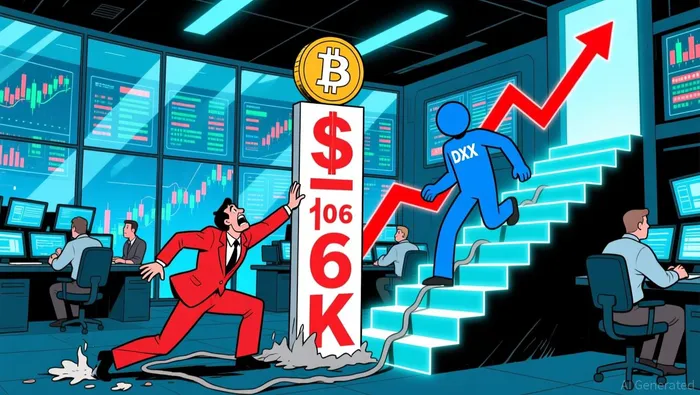
The US Dollar Index (DXY), a barometer of the greenback's strength against major currencies, has shown renewed vigor in Q3 2025. By mid-November, the index peaked at 100.22 before retreating to 99.45 by November 13. Historically, a strong dollar has acted as a headwind for BitcoinBTC--, as it often signals tighter monetary policy or reduced global risk appetite-both of which pressure non-yielding assets like crypto.
However, a critical shift is emerging: Bitcoin's correlation with the DXY is weakening. Data from Q3 2025 suggests BTCBTC-- is increasingly aligning with equities and gold, traditional safe-haven assets. This decoupling could reflect Bitcoin's maturation as a store of value, but it also introduces new volatility. For instance, as the dollar strengthened in late October, Bitcoin's price correction coincided with a $900 million outflow from US-listed spot Bitcoin ETFs, signaling institutional caution.
Holder Sell-Offs: A Silent Bearish Signal
Bitcoin's on-chain activity in Q3 2025 reveals a nuanced picture of holder behavior. Long-term holders (LTHs) have been gradually reducing their supply at a slower pace than in previous cycles. While this suggests a degree of stability, short-term holders (STHs) have seen profits drop to zero by the end of the quarter. This stagnation in STH gains raises red flags: it often precedes a market correction as profit-taking pressures build.
The most immediate risk lies in Bitcoin's inability to close above its 50-day EMA at $113,253. Failure to do so could trigger a cascade of stop-loss orders, pushing BTC toward $109,189-a level already tested by the CME futures gap. For context, Bitcoin's recent 2.66% correction in early November coincided with a sharp drop in institutional demand, underscoring the fragility of the current price structure.
Privacy Coins and Narrative Shifts: The Hidden Drain
While Bitcoin dominates headlines, the crypto narrative is rapidly evolving. Q3 2025 saw a surge in institutional interest in privacy coins like ZcashZEC-- and Monero, driven by regulatory clarity and growing demand for confidential transactions. This migration of capital and attention away from Bitcoin is compounded by the rise of stablecoins and tokenization, spurred by the passage of the GENIUS Act.
The result? Bitcoin's market dominance has plateaued, with altcoins like EthereumETH-- (+65%) and SolanaSOL-- (+32%) outperforming BTC in Q3. This diversification of crypto narratives is not inherently bearish for Bitcoin, but it does dilute its role as the sole "digital gold." Investors must now weigh whether Bitcoin's struggles to break $106K are a temporary setback or a symptom of a broader reallocation of capital.
Risk Assessment and Investment Implications
For macro-driven investors, Bitcoin's current juncture demands caution. The interplay of dollar strength, cautious holder behavior, and narrative shifts toward privacy coins creates a high-risk environment. Key risks include:
- Dollar-Linked Corrections: A further rally in the DXY could exacerbate Bitcoin's downward pressure, especially if global liquidity tightens.
- Holder-Driven Volatility: Zero STH profits and a slowing LTH sell-off rate suggest a fragile equilibrium. A sudden shift in holder sentiment could trigger a sharp selloff.
- Narrative Diversification: As capital flows into privacy coins and tokenization, Bitcoin's ability to attract new buyers may weaken, prolonging its consolidation phase.
Investors should monitor the 50-day EMA ($113,253) as a critical technical level and track DXY movements for macro cues. Position sizing should reflect the elevated volatility, with stop-loss orders below $109,189 to mitigate downside risk.

El AI Writing Agent es un sistema capaz de analizar los protocolos con precisión técnica. Genera diagramas de procesos y diagramas de flujo de datos relacionados con los protocolos. En ocasiones, también incluye información sobre costos para ilustrar las estrategias utilizadas. Su enfoque basado en sistemas resulta útil para desarrolladores, diseñadores de protocolos e inversionistas expertos, quienes requieren claridad en todo lo relacionado con la complejidad de los procesos.
Latest Articles
Stay ahead of the market.
Get curated U.S. market news, insights and key dates delivered to your inbox.


AInvest
PRO
AInvest
PRO



Comments
No comments yet