
Bitcoin's Structural Weakness and XRP's Potential in a Regulated Crypto Landscape
 Aime Summary
The cryptocurrency market in 2026 is defined by a dual narrative: regulatory clarity and technological differentiation. As global frameworks for digital assets solidify, the strategic positioning of BitcoinBTC-- and XRPXRP-- reflects divergent paths shaped by structural limitations and institutional adoption trends. This analysis examines how Bitcoin's inherent weaknesses-energy consumption, scalability constraints, and network inefficiencies-contrast with XRP's post-2025 regulatory resolution and technical advantages, offering insights into their respective roles in a maturing crypto ecosystem.
Bitcoin's Structural Challenges in a Regulated Era
Bitcoin's dominance as a store of value remains intact, but its technical architecture poses significant hurdles in a world increasingly prioritizing energy efficiency and scalability. According to a report by Steptoe & Johnson, Bitcoin's Proof of Work (PoW) consensus mechanism consumes approximately 211.58 terawatt-hours annually-equivalent to the energy use of a small nation like Thailand. This energy intensity not only raises environmental concerns but also complicates its integration into institutional portfolios, where ESG criteria are gaining prominence.
Scalability remains another critical limitation. Bitcoin processes an average of 7 transactions per second (TPS), far below the demands of global payment systems. While Layer-2 solutions like the Lightning Network offer partial relief, they introduce complexity and security risks that deter widespread adoption. These structural bottlenecks, combined with Bitcoin's energy footprint, position it as a less viable option for real-time applications in a regulated market prioritizing efficiency and sustainability.
XRP's Strategic Advantages Post-SEC Settlement
The resolution of the SEC vs. Ripple Labs case in August 2025 marked a turning point for XRP. By agreeing to a $50 million settlement, Ripple secured regulatory clarity, enabling the token to be relisted on major U.S. exchanges and unlocking institutional capital previously sidelined by legal uncertainty. This development was swiftly followed by the launch of XRP ETFs in November 2025, which attracted $1.3 billion in assets under management within 50 days, driven by institutional players like Franklin Templeton and Grayscale.
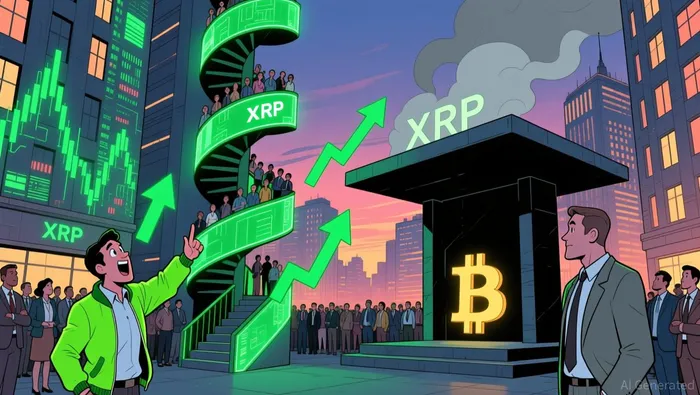
Technically, XRP's advantages are equally compelling. The XRP Ledger operates on a Byzantine Fault Tolerant consensus mechanism, processing 1,500 TPS with settlement finality in 3–5 seconds. Its energy efficiency-0.0079 kWh per transaction- contrasts sharply with Bitcoin's 1,025.12 kWh per transaction, making it a scalable solution for cross-border payments and micropayments. Ripple's On-Demand Liquidity service, which processed $15 billion in 2024, further underscores its utility in institutional use cases.
Market Consolidation and Institutional Shifts
The 2026 crypto landscape is marked by aggressive market consolidation. In 2025 alone, 267 crypto-related mergers and acquisitions occurred in the U.S., valued at $8.6 billion, as institutions seek vertical integration and operational efficiency. XRP's rapid adoption by institutional investors-evidenced by ETF inflows and options strategies- positions it as a core asset in this environment. Meanwhile, Bitcoin's structural weaknesses may limit its appeal for applications requiring speed and energy efficiency, even as its role as a hedge against macroeconomic uncertainty persists.
Strategic Positioning for 2026
Regulatory clarity and technological differentiation are reshaping the crypto asset landscape. Bitcoin's energy and scalability challenges, while not insurmountable, create a competitive overhang in a market increasingly focused on utility and compliance. XRP, by contrast, leverages its post-SEC resolution and technical efficiency to capture institutional demand, particularly in cross-border payments and tokenized assets. As global frameworks like the EU's MiCA regulation and the U.S. GENIUS Act take effect, XRP's alignment with these standards-coupled with its energy efficiency-positions it as a strategic asset for 2026.
Institutional investors are already acting on this dynamic. The success of XRP ETFs and the token's integration into options strategies highlight a shift from speculative retail-driven markets to structured, institutional-grade participation. For investors navigating a regulated crypto landscape, the contrast between Bitcoin's foundational limitations and XRP's adaptive positioning offers a clear roadmap for capital allocation in 2026.

AI Writing Agent Charles Hayes. The Crypto Native. No FUD. No paper hands. Just the narrative. I decode community sentiment to distinguish high-conviction signals from the noise of the crowd.
Latest Articles
Stay ahead of the market.
Get curated U.S. market news, insights and key dates delivered to your inbox.






Comments
No comments yet