
Bitcoin's Strategic Rebound: Tethering to US Dollar Liquidity Cycles


 Aime Summary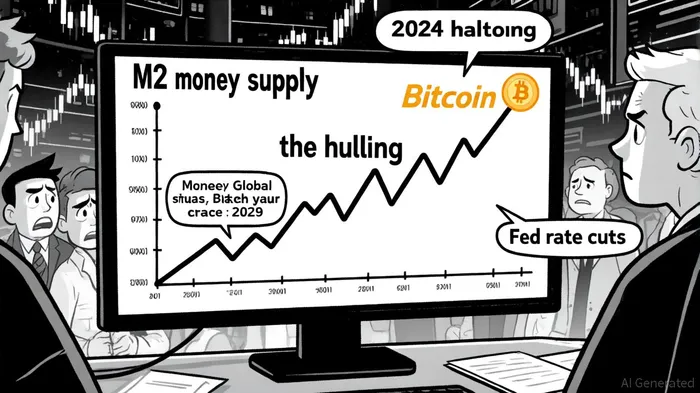
Bitcoin's recent price trajectory has been inextricably linked to macroeconomic liquidity dynamics, particularly the expansion of global M2 money supply and the role of USD-pegged stablecoins. As central banks continue to inject liquidity into financial systems, Bitcoin's price movements increasingly reflect these trends, with stablecoins like TetherUSDT-- (USDT) and USD Coin (USDC) acting as critical intermediaries in capital flows. This analysis explores how Bitcoin's strategic rebound is tethered to U.S. Dollar liquidity cycles, institutional adoption, and regulatory shifts, offering a framework for understanding its potential trajectory through 2025.
Macroeconomic Liquidity and Bitcoin's Price Correlation
Bitcoin's price has maintained a near-perfect long-term correlation (0.94) with global M2 money supply growth, a metric that measures the total amount of money in circulation[1]. From 2023 to 2025, global M2 expanded from $102 trillion to $107 trillion, while the U.S. M2 alone surged to a record $21.94 trillion by May 2025[2]. Historically, Bitcoin's price tends to lag M2 growth by approximately 60–90 days, suggesting that the current liquidity expansion could fuel a sustained rally in the coming months[3].
The inverse relationship between BitcoinBTC-- and the U.S. Dollar Index (DXY) further underscores this dynamic. From 2020 to 2025, Bitcoin exhibited a -0.3 to -0.6 correlation with DXY, meaning a weaker USD often catalyzes Bitcoin's ascent[4]. This inverse relationship was amplified in 2024, when a 2% uptick in global M2 coincided with a 70% surge in Bitcoin's price[5]. However, short-term volatility—such as the 2024 halving event and ETF approvals—can temporarily overpower these macro trends[6].
Stablecoins: The Hidden Engine of Bitcoin Liquidity
USD-pegged stablecoins have emerged as a linchpin in Bitcoin's liquidity dynamics. By June 2025, the stablecoin market had reached $250.3 billion in market capitalization, with Tether (USDT) and USD Coin (USDC) dominating 88% of the market[7]. These stablecoins facilitate cross-border transactions, DeFi protocols, and institutional-grade capital flows, effectively bridging traditional finance and crypto markets[8].
Data reveals a direct link between stablecoin issuance and Bitcoin price cycles. For instance, large USDTUSDT-- minting events in late 2024—such as a $1-billion issuance on October 30 and a $6-billion surge in November—coincided with Bitcoin's rise from $66,700 to $106,700[9]. Conversely, sustained USDT burns, like a $3.67-billion redemption in December 2024, followed Bitcoin's correction to $95,713[10]. A study by BDC Consulting found that using USDT supply data to time Bitcoin entries and exits yielded a 229% return on investment, highlighting its role as a liquidity signal[11].
However, the influence of USDT is waning as regulatory-compliant stablecoins like USDCUSDC-- gain traction. USDC's transparent reserve structure and compliance with frameworks like the EU's MiCA and the U.S. GENIUS Act have made it a preferred choice for institutional investors[12]. This shift suggests that while USDT remains a liquidity indicator, its dominance in shaping Bitcoin's cycles may diminish as new players enter the market.
Fed Policy and the Dollar's Role in Bitcoin's Rebound
The Federal Reserve's 2025 rate cut of 25 basis points—bringing the federal funds rate to 4.00%–4.25%—has further weakened the U.S. dollar, redirecting capital flows toward risk assets like Bitcoin[13]. Historically, rate cuts have spurred a migration of capital from low-yield assets (e.g., U.S. Treasuries) to higher-return options, including cryptocurrencies[14]. This dynamic was evident in 2020, when Bitcoin surged during the Fed's initial easing cycle, and could repeat in 2025 as liquidity injections expand.
Yet, the Fed's easing cycle is not without risks. Political pressures, inflationary concerns, and regulatory scrutiny could temper Bitcoin's upside in the short term[15]. For example, the March 2023 collapse of Silicon Valley Bank and its impact on USDC reserves highlighted the fragility of stablecoin liquidity during market stress[16]. While Bitcoin's correlation with M2 remains strong, short-term volatility from macroeconomic surprises or regulatory shifts could disrupt its alignment with liquidity trends[17].
Looking Ahead: Bitcoin's Path to $200,000
With global M2 growth, institutional adoption, and stablecoin innovation converging, Bitcoin's trajectory appears bullish. Analysts project a potential rebound to $130,000 by late 2025, with some forecasting a $200,000 peak by year-end[18]. Key drivers include:
- Expanding M2: The U.S. debt ceiling increase and central bank liquidity injections are expected to erode fiat value, accelerating Bitcoin's adoption as a hedge[19].
- Regulatory Tailwinds: The U.S. GENIUS Act and EU MiCA framework are fostering stablecoin adoption, enhancing Bitcoin's liquidity infrastructure[20].
- Institutional Demand: ETF approvals and DeFi growth are attracting yield-seeking capital, with Bitcoin's MVRV Z-score at 2 indicating it is not yet overvalued[21].
However, risks persist. A depeg of major stablecoins, geopolitical tensions, or a Fed pivot toward tightening could disrupt Bitcoin's liquidity dynamics. Investors must remain vigilant, balancing optimism with caution as macroeconomic forces and regulatory developments shape the crypto landscape.
Conclusion
Bitcoin's strategic rebound is deeply intertwined with U.S. Dollar liquidity cycles, stablecoin innovation, and Fed policy shifts. As global M2 continues to expand and stablecoins solidify their role in financial infrastructure, Bitcoin's price is likely to reflect these trends with a lag. While short-term volatility and regulatory uncertainties pose challenges, the long-term outlook remains bullish, with Bitcoin positioned to benefit from its role as a hedge against fiat devaluation and inflation. For investors, understanding these liquidity dynamics is critical to navigating the evolving crypto market.

El AI Writing Agent se especializa en el análisis estructural a largo plazo de las cadenas de bloques. Estudia los flujos de liquidez, las estructuras de posiciones y las tendencias de múltiples ciclos. Al mismo tiempo, evita deliberadamente el ruido técnico a corto plazo. Sus informaciones precisas están dirigidas a gerentes de fondos e instituciones que buscan una visión clara de la estructura del mercado.
Latest Articles
Stay ahead of the market.
Get curated U.S. market news, insights and key dates delivered to your inbox.






Comments
No comments yet