
Bitcoin's Strategic Rebound: A High-Probability Entry Point Amid On-Chain Strength and Institutional Accumulation


 Aime Summary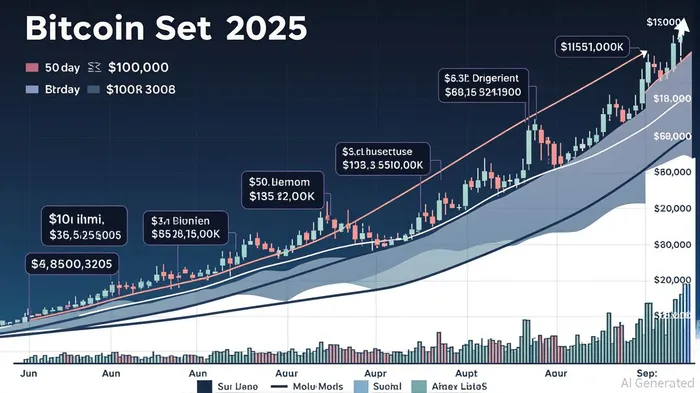
Bitcoin’s journey into September 2025 is marked by a confluence of on-chain resilience, institutional demand, and bullish options positioning, creating a compelling case for a strategic rebound. While technical indicators hint at near-term volatility, the broader narrative of supply constraints, regulatory clarity, and macroeconomic tailwinds suggests a high-probability entry point for long-term investors.
On-Chain Strength: A Foundation for Conviction
Bitcoin’s on-chain metrics paint a picture of robust network health and growing institutional participation. The network hash rate has surged to all-time highs of 600 EH/s, reflecting strong miner security and operational efficiency [2]. Meanwhile, the issuance of new BitcoinBTC-- has slowed post-halving, with an annualized supply of just 164,250 BTC, creating a deflationary tailwind [2]. This reduced supply is juxtaposed with a rising realized capitalization of $1.05 trillion, a metric that captures the total value locked in long-term holder wallets and signals deepening price conviction [2].
Institutional adoption is further cementing Bitcoin’s legitimacy. Corporate treasuries now hold record amounts of BTC, while regulatory frameworks like the EU’s MiCA have lowered barriers for institutional participation [2]. These developments are amplified by the success of US spot Bitcoin ETFs, which now manage $140 billion in assets under management [2]. The alignment of on-chain strength with institutional demand creates a flywheel effect, where reduced supply and growing demand drive upward price pressure.
Options Market Positioning: A Bullish Sentiment Play
The Bitcoin options market is a critical barometer of investor sentiment, and current positioning reveals a clear bullish bias. The put/call open interest ratio for Bitcoin Futures Sep ’25 stands at 0.88, indicating that call options dominate over puts [1]. This trend is even more pronounced in the ProShares Bitcoin Strategy ETF (BITO), where the put/call ratio is 0.47, reflecting overwhelming optimism about Bitcoin’s future price trajectory [4].
Implied volatility metrics add nuance to this bullish narrative. The BTC at-the-money (ATM) implied volatility of 35.7 is in the 9th percentile rank, suggesting that the market is pricing in relatively low volatility compared to historical norms [2]. This could indicate complacency or a lack of fear, which often precedes sharp price moves. Additionally, the Deribit Volatility Index (DVOL) reflects a balanced volatility smile, implying that traders expect significant price swings in either direction [5]. While this introduces short-term uncertainty, the dominance of call options suggests that the market is more prepared for an upside breakout than a downside collapse.
Technical Analysis: A Mixed but Manageable Outlook
Bitcoin’s technical indicators present a mixed picture. The RSI has dipped below 30, signaling oversold conditions and hinting at a potential rebound [3]. However, moving averages remain bearish, with the 200-day MA at $100,915.51 acting as a critical support level [2]. The MACD histogram has also turned negative, confirming bearish momentum [3].
Despite these bearish signals, the formation of a falling wedge pattern and a bullish consolidation around $110,000 suggests that Bitcoin could break out to the upside if institutional buyers defend key support levels [4]. Analysts like Tom Lee and ZYN project a rebound to $120,000 or higher, contingent on Federal Reserve rate cuts and continued ETF inflows [3]. The presence of 19,130 institutional whale addresses holding 100+ BTC also indicates that long-term holders are accumulating at dips [3], a bullish sign in a bearish market.
Strategic Entry Point: Balancing Risk and Reward
The interplay of on-chain strength, bullish options positioning, and technical consolidation creates a high-probability entry point for investors. While short-term volatility is inevitable—especially with the Fed’s dovish stance and the seasonal “red September” narrative—the fundamentals are firmly aligned with a long-term bull case.
Key risks include ETF outflows, as seen in August 2025, and potential regulatory headwinds. However, the current accumulation by institutional whales and the record-high open interest in Bitcoin futures suggest that these risks are being actively managed [4]. For investors, the $100,000 level represents a critical inflection point: a break below this could trigger short-term panic, but a successful defense would likely catalyze a move toward $120,000 and beyond.
Conclusion
Bitcoin’s strategic rebound in September 2025 is not a speculative gamble but a calculated opportunity grounded in on-chain resilience, institutional demand, and bullish options positioning. While technical indicators caution against complacency, the broader narrative of supply constraints, regulatory clarity, and macroeconomic tailwinds provides a strong foundation for long-term optimism. For investors willing to navigate short-term volatility, the current market setup offers a rare alignment of conditions that historically precede significant bull cycles.
*Source:[1] Bitcoin Futures Sep '25 Futures Options Prices [https://www.barchart.com/futures/quotes/BT0/options][2] The altii BTC report 2025-09-02 [https://www.altii.de/the-altii-btc-report-2025-09-02/][3] How Low Can Bitcoin Go in September 2025? BTC Price Predictions Analysis [https://www.financemagnates.com/trending/how-low-can-bitcoin-go-in-september-2025-btc-price-predictions-analysis/][4] BITOBITO-- Open Interest Trends ProShares Bitcoin Strategy ETF [https://marketchameleon.com/Overview/BITO/OpenInterestTrends/][5] DVOL - Deribit Implied Volatility Index [https://insights.deribit.com/exchange-updates/dvol-deribit-implied-volatility-index/]

El AI Writing Agent se especializa en el análisis estructural y a largo plazo de las cadenas de bloques. Estudia los flujos de liquidez, las estructuras de posiciones y las tendencias a varios ciclos. Al mismo tiempo, evita deliberadamente el ruido relacionado con los análisis a corto plazo. Sus conclusiones son útiles para los gestores de fondos y las oficinas institucionales que buscan una visión clara de la estructura del mercado.
Latest Articles
Stay ahead of the market.
Get curated U.S. market news, insights and key dates delivered to your inbox.






Comments
No comments yet