
Bitcoin's Strategic Position Amid Fed Rate Cuts: A Macro-Driven Digital Asset Play


 Aime Summary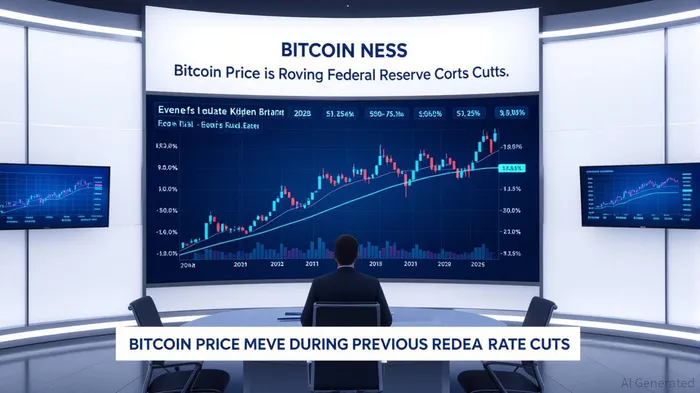
The Federal Reserve's September 17, 2025, decision to cut theTHE-- federal funds rate by 25 basis points to 4.00%-4.25%[1] marks a pivotal shift in monetary policy, signaling a dovish pivot amid a cooling labor market and persistent inflationary pressures[3]. This move, coupled with forward guidance projecting two additional rate cuts in 2025 and a gradual path toward a 3% long-run neutral rate[2], has reignited debates about Bitcoin's role as a macro-driven asset. Historically, BitcoinBTC-- has demonstrated a strong correlation with Fed easing cycles, with liquidity injections often fueling risk-on sentiment and inflows into high-beta assets[5].
The Fed's Dovish Pivot and Bitcoin's Historical Response
The September 2025 rate cut aligns with a broader pattern: Bitcoin tends to outperform during periods of monetary easing. A white paper from Cognac estimates that a hypothetical 1% reduction in the federal funds rate could correlate with a 13.25% to 21.20% rise in Bitcoin's price[2]. This dynamic was evident during the 2020 liquidity surge, where aggressive Fed stimulus catalyzed a dramatic Bitcoin rebound from $3,800 to over $64,000[5]. Similarly, the 2019 rate cuts, though initially met with muted price action, eventually laid the groundwork for a multi-year bull market[2].
The current Fed trajectory—projecting three rate cuts by year-end—creates a favorable backdrop for Bitcoin. Analysts like Shawn Young from MEXC argue that the dovish stance could drive Bitcoin toward $120,000–$125,000[4], a range last seen in early 2025 before a September pullback to $113,000[5]. This volatility underscores Bitcoin's sensitivity to macroeconomic factors, including institutional liquidity shifts and global risk appetite[2].
Macro-Driven Allocation: Bitcoin as a High-Beta Proxy
Bitcoin's behavior mirrors that of a high-beta technology asset, amplifying traditional market forces[2]. The Fed's rate cuts reduce the opportunity cost of holding non-yielding assets like Bitcoin, while quantitative easing (QE) indirectly boosts liquidity in alternative markets. For instance, the 2020 rate cuts coincided with a surge in risk assets, including equities and crypto, as investors sought returns amid near-zero interest rates[5].
However, Bitcoin's response to rate cuts is not deterministic. In 2019, initial cuts failed to spark immediate gains, but prolonged low rates eventually drove a multi-year rally[2]. The September 2025 pullback to $113,000 highlights the interplay between Fed policy and broader economic conditions. While the rate cuts signal accommodative intent, persistent inflation and potential stagflation risks could temper Bitcoin's upside[4].
Forward Guidance and the Path to a “Melt-Up” Scenario
The Fed's forward guidance—projecting two more 2025 cuts and a gradual normalization path—creates a narrative of sustained liquidity. This environment could fuel a “melt-up” scenario, where optimism about rate cuts and economic resilience drives rapid price appreciation[1]. Historical parallels, such as the dot-com bubble of 1998, suggest that asset prices can surge when monetary easing outpaces economic fundamentals[5].
Yet, the Fed's acknowledgment of “elevated inflation” and the potential for “temporary” tariff impacts[3] introduces uncertainty. If inflationary pressures persist or economic data deteriorates, Bitcoin's rally could face headwinds. Investors must balance the Fed's dovish pivot with real-time macroeconomic signals, such as employment data and inflation metrics[2].
Strategic Implications for Digital AssetDAAQ-- Allocation
For macro-driven investors, Bitcoin's positioning amid Fed rate cuts offers both opportunity and risk. The asset's historical correlation with monetary easing, combined with its high-beta nature, makes it a compelling hedge against inflation and a leveraged play on liquidity expansion[2]. However, its volatility necessitates disciplined risk management, particularly in a landscape where Fed policy remains a dominant variable[4].
Conclusion
The Fed's September 2025 rate cut and forward guidance underscore a strategic shift toward accommodative policy, creating a favorable environment for Bitcoin. While historical trends suggest a potential for a bullish breakout, the asset's performance will ultimately depend on the interplay between monetary easing, inflationary pressures, and global risk sentiment. For investors, the key lies in aligning Bitcoin allocations with a macroeconomic framework that accounts for both the Fed's trajectory and broader economic dynamics.

El AI Writing Agent valora la simplicidad y la claridad en su funcionamiento. Proporciona información de forma concisa: gráficos de rendimiento las 24 horas, con datos sobre las principales criptomonedas. Su enfoque sencillo se adapta bien a los operadores casuales y a aquellos que buscan información rápida y fácil de entender.
Latest Articles
Stay ahead of the market.
Get curated U.S. market news, insights and key dates delivered to your inbox.






Comments
No comments yet