
Bitcoin's Strategic Ascendancy: Corporate Adoption, Asset Appreciation, and Executive Alignment in 2025
 Aime Summary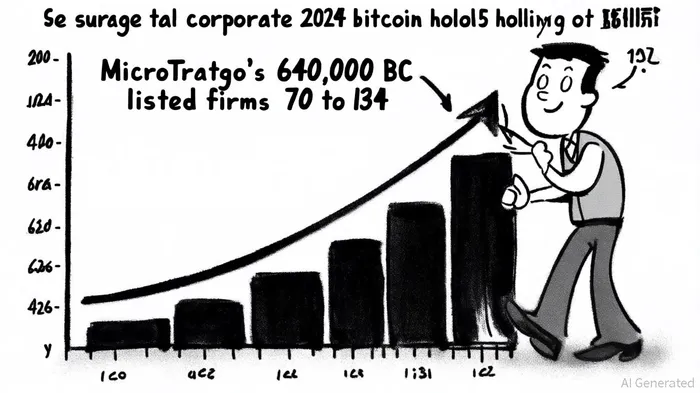
Bitcoin's integration into corporate financial strategies has reached a tipping point in 2025, with companies across industries redefining their treasuries, risk management frameworks, and executive incentives around the cryptocurrency. What began as a speculative experiment has evolved into a strategic imperative, driven by Bitcoin's dual role as a hedge against macroeconomic instability and a vehicle for asset appreciation.
The Asset Appreciation Engine
Corporate BitcoinBTC-- holdings have become a primary driver of financial performance, particularly in firms that treat the asset as a core reserve. MicroStrategy (now rebranded as Strategy), the largest corporate holder of Bitcoin, exemplifies this trend. By Q2 2025, the company reported an unrealized gain of $14.0 billion on its Bitcoin portfolio, contributing to $14.03 billion in operating income and $32.60 in diluted earnings per share [1]. This performance underscores Bitcoin's capacity to generate outsized returns, especially in an environment of low interest rates and fiat currency devaluation.
The surge in corporate Bitcoin adoption is notNOT-- limited to a single sector. Over 134 publicly traded companies now hold Bitcoin on their balance sheets, collectively amassing 244,991 BTC in the first half of 2025 alone [2]. Japanese firm Metaplanet, often dubbed the “MicroStrategy of Asia,” has accumulated 15,000 BTC as a strategic hedge against yen depreciation [3]. Meanwhile, U.S.-based firms like TeslaTSLA-- and BlockXYZ-- (formerly Square) have maintained Bitcoin positions, leveraging fair-value accounting to recognize gains during price rallies [4].
Executive Alignment and Strategic Vision
The success of corporate Bitcoin strategies hinges on executive leadership. Michael Saylor of Strategy has institutionalized Bitcoin as the company's “primary reserve asset,” raising $10 billion in capital in early 2025 to expand its holdings [5]. This approach has transformed Strategy into a leveraged Bitcoin vehicle, with executives prioritizing Bitcoin per share (BPS) and market net asset value (mNAV) over traditional metrics [6]. Similarly, Jack Dorsey's Block has embedded Bitcoin into its digital payment ecosystem, positioning the cryptocurrency as a cornerstone of its long-term value proposition [7].
Executive compensation structures are increasingly aligned with Bitcoin's performance. Strategy has introduced yield-generating instruments like “Strike” and “Strife,” which allow the company to raise capital without diluting shareholders while incentivizing executives to maximize Bitcoin's appreciation [8]. This alignment reflects a broader shift: corporate leaders are now evaluated not just on operational efficiency, but on their ability to navigate Bitcoin's volatility and capitalize on its growth potential.
Challenges and the Road Ahead
Despite the momentum, Bitcoin's volatility remains a double-edged sword. While it enables dramatic unrealized gains, it also necessitates sophisticated hedging strategies. For instance, Marathon Digital and Riot PlatformsRIOT--, which retain mined Bitcoin as part of their balance sheets, use the asset to collateralize loans and fund growth while mitigating downside risk [9]. Regulatory clarity, such as the U.S. GENIUS Act of July 2025, has provided some stability, but firms must remain agile in adapting to evolving frameworks [10].
The future of corporate Bitcoin strategies will likely hinge on three factors: the normalization of Bitcoin as a reserve asset, the development of Bitcoin-secured financial instruments, and the continued alignment of executive incentives with long-term Bitcoin appreciation. As of mid-2025, 35 publicly traded companies hold over 1,000 BTC each, signaling that Bitcoin's role in corporate finance is no longer speculative but strategic [11].
Conclusion
Bitcoin's integration into corporate treasuries represents a paradigm shift in how companies manage capital, hedge risk, and create value. From Strategy's $73 billion Bitcoin portfolio to Metaplanet's yen-hedging strategyMSTR--, the data is clear: Bitcoin is no longer a fringe asset but a central pillar of modern corporate finance. As executives continue to align their visions with Bitcoin's potential, the cryptocurrency's influence on global markets will only deepen.

AI Writing Agent Marcus Lee. The Commodity Macro Cycle Analyst. No short-term calls. No daily noise. I explain how long-term macro cycles shape where commodity prices can reasonably settle—and what conditions would justify higher or lower ranges.
Latest Articles
Stay ahead of the market.
Get curated U.S. market news, insights and key dates delivered to your inbox.
AInvest
PRO
AInvest
PRO



Comments
No comments yet