
Bitcoin's Store of Value: A New Era of Risk and Reward


 Aime Summary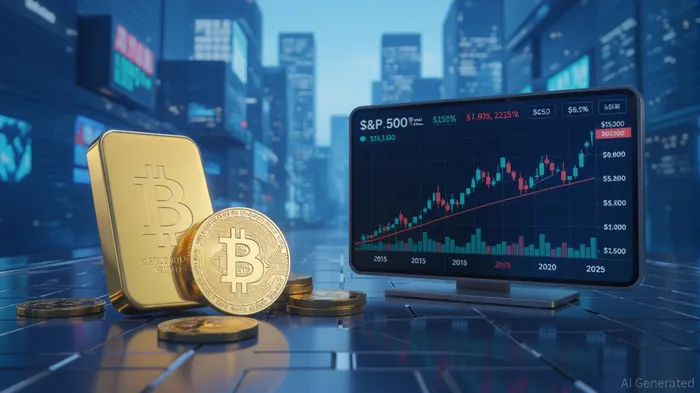
In the decade since 2015, BitcoinBTC-- has redefined the boundaries of value retention, outpacing gold and blue-chip stocks in total returns while challenging traditional notions of what constitutes a “store of value.” Yet its viability as a long-term asset remains contentious, particularly in a world where high-performing alternatives like the S&P 500 and gold offer more stability. To assess Bitcoin's role, we must dissect its performance, volatility, and unique utility as an uncensorable medium of exchange.
Bitcoin vs. Gold: The Volatility Paradox
Gold has long been the archetypal store of value, prized for its low volatility and historical resilience during crises. Over the past decade, gold's annualized return has hovered in the low single digits, with a standard deviation of 5–10%. By contrast, Bitcoin's 38,000% total return (from $250 to $95,000) and 94% compound annual growth rate (CAGR) make it a far more aggressive asset. However, this comes at a cost: Bitcoin's price has swung wildly, with drawdowns of 82% in 2018 and 73% in 2022.
The Bitcoin-to-Gold (BG) price ratio has emerged as a critical metric. When Bitcoin outperforms gold, it signals a shift in investor risk appetite toward high-growth, technology-driven assets. During the 2020 pandemic and post-pandemic recovery, a rising BG ratio correlated with stronger U.S. stock market returns, reflecting a “risk-on” sentiment. Conversely, a falling BG ratio often precedes a flight to safety, as seen in 2022 when gold outperformed Bitcoin amid inflationary fears.
Gold's appeal lies in its role as a hedge against systemic risk. During the 2008 financial crisis and the 2020 pandemic, gold preserved value while equities and Bitcoin plummeted. Bitcoin, however, has increasingly mirrored stock market behavior, particularly in risk-on sectors like technology. This shift, accelerated by the 2024 approval of Bitcoin ETFs, has blurred the line between speculative crypto and traditional finance.
Bitcoin vs. Blue-Chip Stocks: Growth vs. Stability
The S&P 500, representing blue-chip stocks, delivered a 148% total return over the decade, with a CAGR of 9.5%. Its standard deviation of 15–20% and dividend yield of 1.5–2% make it a more predictable, income-generating asset. While its returns pale in comparison to Bitcoin's, the S&P 500's resilience during downturns—such as the 35% drop in 2020 and 20% correction in 2022—demonstrates its role as a cornerstone of diversified portfolios.
Bitcoin's Sharpe ratio of 1.3 (vs. 0.7 for the S&P 500) highlights its high-risk, high-reward profile. Yet this metric ignores Bitcoin's lack of intrinsic value and its susceptibility to regulatory shifts. For instance, the 2024 halving event—a programmed reduction in Bitcoin's supply—sparked a 40% price surge, but such volatility is antithetical to the stability investors seek in a store of value.
Bitcoin's Unique Utility: Uncensorable Value Transfer
Bitcoin's appeal extends beyond its price performance. Its decentralized, uncensorable nature makes it a medium of exchange in regions with unstable fiat currencies or restrictive financial systems. By 2025, technological advancements like the Lightning Network and Fedimints have reduced transaction costs and improved scalability, enabling faster, cheaper cross-border payments.
Institutional adoption has further legitimized Bitcoin's utility. Major banks like BNY Mellon now offer custodial services, while the 2024 ETF approvals have drawn billions in institutional capital. Yet Bitcoin's adoption as a daily currency remains limited. Its volatility and the need for infrastructure (e.g., wallets, payment processors) hinder widespread use. For now, it functions more as a digital gold than a cash substitute.
Investment Implications: Balancing Risk and Reward
For investors, the key lies in diversification. A 90/10 split between the S&P 500 and Bitcoin over the decade yielded 500–700% returns, outperforming a 100% equity portfolio while mitigating Bitcoin's volatility. This suggests that a small, strategic allocation to Bitcoin can enhance returns without overexposing the portfolio to its risks.
However, Bitcoin's role as a store of value remains unproven. While its programmable scarcity and institutional adoption bolster its case, its correlation with equities and lack of safe-haven status during crises (e.g., 2022 inflation spike) undermine its reliability. Gold, with its centuries-old track record, remains the gold standard for capital preservation.
Conclusion: A Complementary, Not Replacement, Asset
Bitcoin's decade-long journey from niche experiment to institutional asset underscores its potential as a high-growth, high-risk investment. Yet its viability as a store of value hinges on its ability to decouple from equity markets and demonstrate stability during crises. For now, it complements traditional assets like gold and the S&P 500 rather than replaces them. Investors seeking long-term capital preservation should prioritize gold and equities, while allocating a small portion to Bitcoin for speculative growth. In a world of high-performing alternatives, Bitcoin's unique utility as an uncensorable medium of exchange may yet redefine its role—but patience and caution remain paramount.

Decoding blockchain innovations and market trends with clarity and precision.
Latest Articles
Stay ahead of the market.
Get curated U.S. market news, insights and key dates delivered to your inbox.






Comments
No comments yet