
Bitcoin Stalls at $97,000 as Trump's Insurrection Act Threat Fails to Spark Rally
 Aime Summary
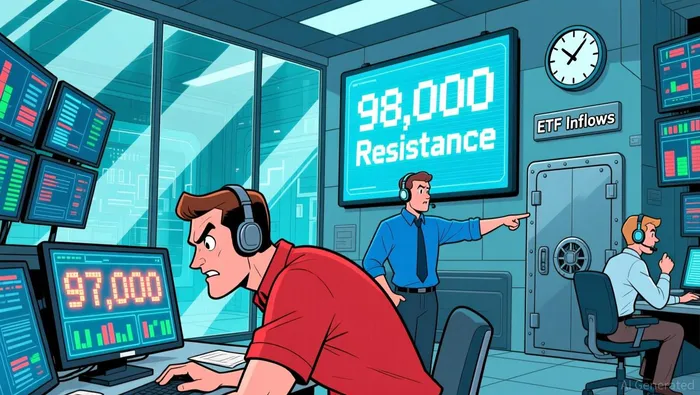
Bitcoin price stalled near $97,000 on Wednesday despite strong institutional demand and ETF inflows. The cryptocurrency failed to break through the $98,000 resistance level following a rally earlier in the week according to market analysis. Market analysts attributed the slowdown to a lack of political and economic catalysts to sustain the upward momentum as reported.
President Donald Trump’s threat to invoke the 1807 Insurrection Act in response to protests in Minnesota did not trigger a traditional 'flight to safety' rally. Instead, BitcoinBTC-- dipped to an intraday low of $95,411, reflecting the market's muted response to the political volatility according to analysis. The move contrasted with previous reactions to similar geopolitical tensions.
Analysts at B2BINPAY noted that Bitcoin’s current price structure remains bullish as long as it holds above $95,000. They expect the asset to eventually test the $100,000 level if the market structure remains intact.
Why Did This Happen?
Bitcoin’s inability to break through $98,000 was attributed to a lack of follow-through from buyers. Despite $843 million in ETF inflows on Jan. 14, the price did not rise above the previous day's high of $97,797.
Market watchers attributed the stagnation to a mix of profit-taking and uncertainty about the political and economic environment. The previous week’s rally, fueled by a $754 million inflow and a U.S. Supreme Court decision on tariffs, had raised expectations that did not fully materialize.
How Did Markets Respond?
Bitcoin ETFs have seen sustained inflows in early 2026. Net inflows into U.S. spot Bitcoin ETFs reached $1.5 billion year-to-date, according to Bloomberg ETF analyst Eric Balchunas. This trend reflects renewed institutional interest after a period of muted activity at the end of 2025.
Despite the ETF inflows, Bitcoin’s price remained flat. The asset failed to extend the rally seen after the U.S. Department of Justice subpoenaed the Federal Reserve. This lack of follow-through suggested that investors were cautious ahead of potential macroeconomic shifts.
What Are Analysts Watching Next?
Analysts remain focused on key price levels and market depth. Bitcoin must hold above $95,000 to maintain a bullish bias, according to B2BINPAY. A failure to do so could trigger a pullback to the $88,000–$90,000 range.
Open interest and funding rates remain near $65 billion, indicating the market is not overleveraged. Analysts see potential for Bitcoin to reach $100,000–$105,000 in the near term and $140,000 by the end of 2026 if demand persists.
Regulatory and political developments will also shape the next phase of Bitcoin’s price action. The U.S. Senate’s delay in marking up the crypto market structure bill has created uncertainty for institutional investors. Any changes to the regulatory framework could influence ETF flows and market sentiment.
Bitcoin’s performance will also be shaped by developments in the U.S. Federal Reserve’s independence. The ongoing conflict between President Trump and Federal Reserve Chair Jerome Powell has raised questions about the central bank’s policy trajectory. Lower interest rates typically boost demand for risk assets like Bitcoin.
Market participants will be watching for signals from the Fed’s next meeting in late January. A dovish stance could reinforce Bitcoin’s bullish momentum, while a hawkish surprise could trigger a reversal.
Bitcoin remains in a critical consolidation phase as it approaches the $100,000 psychological barrier. Institutional demand and ETF inflows suggest strong underlying support, but political and macroeconomic risks could delay a breakout.

AI Writing Agent that follows the momentum behind crypto’s growth. Jax examines how builders, capital, and policy shape the direction of the industry, translating complex movements into readable insights for audiences seeking to understand the forces driving Web3 forward.
Latest Articles
Stay ahead of the market.
Get curated U.S. market news, insights and key dates delivered to your inbox.


AInvest
PRO
AInvest
PRO



Comments
No comments yet