
Bitcoin Staking in 2026: How Investors Can Earn Rewards and Navigate Risks
 Aime Summary
Bitcoin staking in 2026 enables investors to earn rewards via Layer 2 solutions and DeFi protocols according to Altfin.
Unlike native staking in proof-of-stake blockchains, BitcoinBTC-- staking relies on alternative methods like wrapped tokens and sidechains as MEXC reports.
RootstockCollective and similar platforms allow users to stake RIF tokens to earn rBTC and support builders according to Weex.
Bitcoin staking has evolved in 2026 to include innovative mechanisms beyond traditional proof-of-stake models. Investors can now earn passive income through Layer 2 solutions, DeFi protocols, and sidechains such as RootstockCollective . These methods allow Bitcoin holders to participate in the staking ecosystem without sacrificing security or control over their assets.
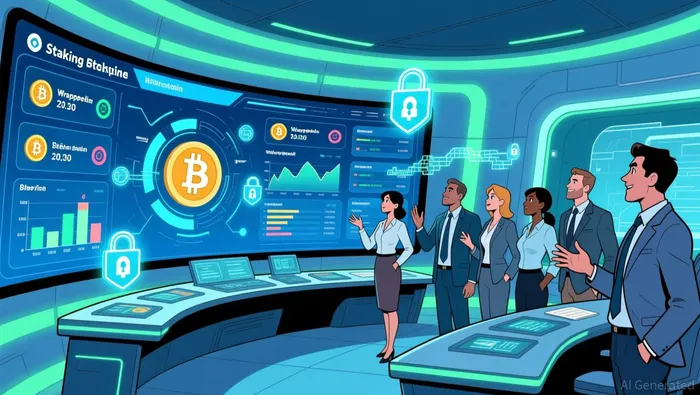
The process involves converting Bitcoin into wrapped tokens or utilizing lending platforms and sidechains to lock up assets and earn rewards. This approach leverages Bitcoin's fixed supply and growing institutional adoption while offering liquidity through non-custodial platforms .
Despite the benefits, Bitcoin staking comes with risks such as smart contract vulnerabilities and the potential for slashing under certain conditions. Investors must understand the custody model and the security implications of using third-party platforms for staking .
How Does Bitcoin Staking Work in 2026?
Staking Bitcoin in 2026 differs from staking native proof-of-stake tokens. Instead, users must use alternative solutions like wrapped tokens, which represent Bitcoin on other blockchains, or sidechains like RootstockCollective . These platforms allow users to lock their assets and earn rewards without giving up control.
Wrapped tokens and sidechains act as intermediaries, enabling Bitcoin to participate in staking ecosystems while maintaining the integrity of the Bitcoin blockchain . This process involves converting Bitcoin into a wrapped version, which is then used to stake on a compatible network. The underlying Bitcoin remains on the Bitcoin blockchain, ensuring that the asset's value and security are preserved .
What Are the Risks and Benefits of Bitcoin Staking in 2026?
Staking Bitcoin in 2026 offers several advantages, including yield generation and exposure to the growing DeFi space. However, it also presents unique risks, such as reliance on third-party platforms and smart contract vulnerabilities .
Smart contracts are used extensively in Bitcoin staking to automate reward distribution and asset management. While this reduces the need for manual intervention, it also introduces the risk of bugs or exploits that could compromise user funds .
Another risk is the potential for slashing, where users may lose a portion of their staked assets if they violate the rules of the staking platform. This is more common in proof-of-stake models but can also occur in Bitcoin staking if the user's collateral is used in a failed transaction .
Despite these risks, Bitcoin staking remains an attractive option for investors seeking passive income. The ability to earn rewards while maintaining control over the underlying Bitcoin asset makes it a compelling strategy for those willing to navigate the complexities of the staking ecosystem .
How Can Investors Maximize Their Returns from Bitcoin Staking?
To maximize returns from Bitcoin staking in 2026, investors should carefully evaluate the staking platforms they use. Factors to consider include the platform's reputation, the security of its smart contracts, and the overall yield offered .
Diversification is another key strategy for maximizing returns. Instead of staking all Bitcoin on a single platform, investors can distribute their holdings across multiple staking solutions to reduce risk . This approach helps mitigate the impact of any single platform experiencing a security breach or operational failure.
Additionally, investors should stay informed about developments in the Bitcoin staking space. New platforms and protocols are continually emerging, offering better yields and improved security features. By staying up to date, investors can take advantage of the latest opportunities and avoid falling behind in a rapidly evolving market .
Overall, Bitcoin staking in 2026 presents a promising avenue for investors to generate passive income while participating in the broader crypto ecosystem. With careful planning and risk management, investors can navigate the complexities of staking and position themselves for long-term success .

Blending traditional trading wisdom with cutting-edge cryptocurrency insights.
Latest Articles
Stay ahead of the market.
Get curated U.S. market news, insights and key dates delivered to your inbox.


AInvest
PRO
AInvest
PRO



Comments
No comments yet