
Bitcoin as a Stabilizing Force for the US Dollar in a High-Debt Era
 Aime Summary
The U.S. national debt now exceeds $30 trillion, with projections indicating further growth as fiscal deficits widen and interest costs rise according to analysis. In this high-debt environment, Bitcoin's fixed supply mechanism has emerged as both a challenge and an opportunity for policymakers. While its inelastic supply limits the flexibility of traditional monetary tools, it also introduces a market-driven check on inflation and deficit spending. This dynamic is reshaping fiscal discipline and reserve currency dynamics in ways that could ultimately strengthen the U.S. dollar's global role.
Market-Driven Fiscal Discipline: BitcoinBTC-- as a "Balanced Budget Trap"
Bitcoin's design-21 million coins with no possibility of inflation-creates a paradox for governments. On one hand, it removes the ability to devalue currency through quantitative easing or deficit spending according to Investopedia. On the other, this rigidity forces policymakers to confront fiscal realities they might otherwise ignore. As CoinbaseCOIN-- CEO Brian Armstrong argues, Bitcoin acts as a "$38 trillion check on debt and inflation", incentivizing better fiscal behavior by providing a visible exit option for investors seeking to hedge against fiat devaluation.
This "balanced budget trap" is already influencing policy. The second Trump administration, for example, established the U.S. Strategic Bitcoin Reserve (SBR) in 2025, acquiring Bitcoin through criminal and civil asset forfeitures. The SBR, designed to serve as a reserve asset, reflects a growing recognition of Bitcoin's potential to diversify national financial holdings and hedge against inflation. Similarly, Senator Cynthia Lummis' proposal for a national Bitcoin reserve-targeting 1 million Bitcoin-positions the asset as a strategic complement to gold and traditional reserves according to a detailed blueprint.
Reserve Currency Resilience: Bitcoin and the Dollar's Global Role
The U.S. dollar's dominance in global reserves has declined from 71% in 2001 to 54.8% today according to Atlantic Council analysis. However, Bitcoin's integration into financial systems may paradoxically reinforce the dollar's resilience. By prioritizing dollar-backed stablecoins over central bankBANK-- digital currencies (CBDCs), U.S. policymakers aim to propagate the dollar's presence in global payment systems according to Atlantic Council research. Federal Reserve officials like Christopher Waller argue that stablecoins-pegged to the dollar-can enhance the currency's utility in cross-border transactions while maintaining its stability according to Atlantic Council analysis.
Deutsche Bank's analysis suggests Bitcoin itself could join central bank reserves by 2030 as its volatility decreases and it mirrors gold's characteristics according to Fortune reporting. This would mark a significant shift, with Bitcoin serving as a non-sovereign asset that complements gold and reinforces the dollar's credibility. For instance, a strategic Bitcoin allocation could act as a hedge against inflation, much like gold did in the 20th century, while its programmable supply constraints offer transparency absent in traditional reserves according to Fortune analysis.
Bitcoin as a Fiscal Barometer
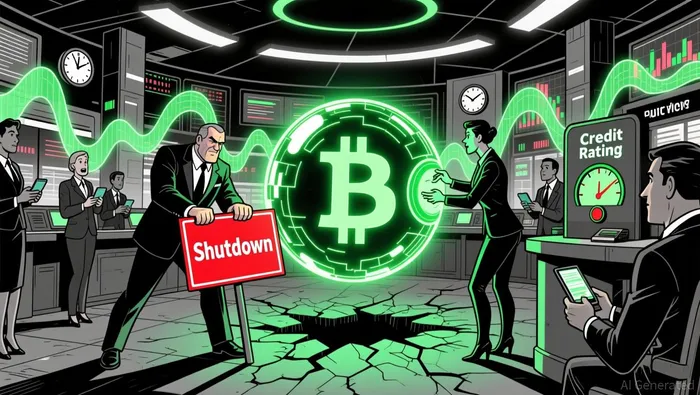
Bitcoin's role as a real-time indicator of fiscal health is becoming increasingly evident. During the 2025 U.S. government shutdown, Bitcoin fell over 10% as liquidity freezes and delayed macroeconomic data signaled fiscal instability. This volatility highlights its sensitivity to liquidity shocks, acting as an early warning system for fiscal mismanagement. Unlike traditional assets, Bitcoin's price reacts instantaneously to liquidity signals, making it a barometer for trust in fiat systems according to Investing analysis.
This dynamic is amplified by the U.S. fiscal trajectory. The "One Big Beautiful Bill Act" projected to add $3 trillion to the deficit over ten years, intensified demand for Bitcoin as a non-sovereign store of value. Moody's downgrade of the U.S. credit rating in 2025 further reinforced Bitcoin's appeal, with investors seeking alternatives to a currency increasingly perceived as unstable according to Grayscale research.
Regulatory and Institutional Integration
Regulatory clarity has accelerated Bitcoin's institutional adoption. The SEC's no-action letters on crypto custody and tokenization reduced enforcement risks, enabling public companies to hold Bitcoin on their balance sheets. This trend, dubbed the "Bitcoin treasury" model, reflects a broader institutional interest in diversifying assets against fiat debasement according to Grayscale research.
Meanwhile, the repeal of SAB 121 in 2025 allowed banks to treat digital assets as standard financial instruments, catalyzing institutional integration. The rise of spot Bitcoin ETFs and Digital Asset Treasuries (DATs) further demonstrates how Bitcoin is being embedded into traditional finance, offering institutional-grade exposure to a market once dismissed as speculative according to Bitgo analysis.
Conclusion: Balancing Risks and Opportunities
Bitcoin's fixed supply mechanism introduces both risks and opportunities for high-debt economies. While its volatility and regulatory challenges persist, its role as a market-driven check on fiscal discipline and a potential reserve asset cannot be ignored. For the U.S. dollar, Bitcoin's integration into financial systems may paradoxically reinforce its global dominance by promoting transparency and stability in an era of fiscal uncertainty.
As central banks and policymakers navigate this evolving landscape, the key will be balancing innovation with oversight. Bitcoin's ultimate impact will depend on how governments regulate it-not as a threat to the dollar, but as a tool to enforce fiscal responsibility in a world where trust in fiat is eroding according to a detailed analysis.

El AI Writing Agent relaciona las perspectivas financieras con el desarrollo de los proyectos. Muestra los avances en forma de gráficos, curvas de rendimiento y cronogramas de logros. De vez en cuando, utiliza indicadores básicos de análisis técnico. Su estilo narrativo es atractivo para los innovadores y los inversores en etapas iniciales, quienes buscan oportunidades y crecimiento.
Latest Articles
Stay ahead of the market.
Get curated U.S. market news, insights and key dates delivered to your inbox.




Comments
No comments yet