
Bitcoin Solo Mining's Resurgence: A New Era of Decentralized Profitability


 Aime Summary
The Great Miner Exodus: AI's Siphoning Effect
Bitcoin's profitability has long been a function of energy costs, hardware efficiency, and network hash rate. However, the 2024 halving-reducing block rewards by 50%-accelerated a trend: large-scale miners abandoning Bitcoin for AI/HPC workloads. BitfarmsBITF--, for instance, announced plans to fully exit Bitcoin mining by 2027, repurposing its 18-megawatt facility in Washington state for NvidiaNVDA-- GB300-class servers. This shift is not isolated. Iris Energy and Hut 8HUT-- are similarly rebranding, leveraging their low-cost energy infrastructure to capitalize on AI's insatiable demand for computational power.
The implications for hash rate distribution are profound. As major miners redirect resources, the network's hash rate is becoming more fragmented. This creates a vacuum that solo miners can exploit. While the odds of solo success remain low (1 in 14 million blocks), the reduced dominance of industrial players increases the relative probability of individual wins.
Technological Leverage: Solo Miners' Edge
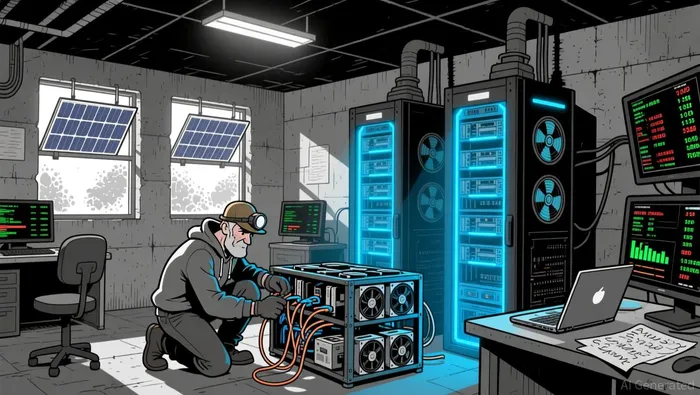 Solo miners are no longer at the mercy of outdated hardware. Innovations like the Bitaxe-a compact, open-source ASIC miner-enable hobbyists to deploy hash rates of 500 GH/s to 1 TH/s at a fraction of industrial costs. Meanwhile, 5nm ASIC chips and custom firmware have improved energy efficiency, reducing the cost per terahash. Off-grid solutions, such as solar and hydro power, further cut operational expenses in regions with low electricity rates.
Software advancements are equally critical. Overclocking tools and optimized mining algorithms allow solo miners to squeeze incremental performance from their hardware. Collaborative knowledge-sharing within the solo mining community has also led to cost-cutting strategies, such as dynamic difficulty adjustments and hybrid mining setups that alternate between Bitcoin and altcoins.
Profitability in a Post-Halving World
Despite the halving's immediate impact on miner margins, solo mining has shown surprising resilience. A notable example: a solo miner achieved a 3.146 BTC reward ($266,000 at current prices) using just 1.2 TH/s of hash power. While statistically rare, such wins underscore the potential for outsized returns. In 2025, solo mining successes via CKpool averaged one block per month, a 300% increase compared to pre-halving levels.
Profitability hinges on Bitcoin's price trajectory. At $109,000 (post-halving levels), the block reward of 3.125 BTCBTC-- plus transaction fees becomes highly attractive. However, volatility remains a risk. Energy costs, which account for 60–70% of mining expenses, must remain below $0.0378 per day per THash/s to maintain positive returns.
Strategic Considerations for Investors
For investors, solo mining represents a high-risk, high-reward proposition. Key factors to monitor include:
1. Energy Arbitrage: Regions with underpriced electricity (e.g., hydro-rich areas in Canada or renewables in Texas) offer the best ROI.
2. Hardware Lifecycles: Early adoption of next-gen ASICs (e.g., Bitmain's S21 or MicroBT's WhatsMiner M66) can offset hash rate declines.
3. Diversification: Solo miners are increasingly pairing Bitcoin operations with AI/HPC services to hedge against crypto volatility.
However, challenges persist. The network's hash rate is expected to stabilize as AI-driven infrastructure scales, potentially reducing solo mining's edge. Additionally, regulatory risks-particularly in jurisdictions targeting energy-intensive operations could disrupt profitability.
Conclusion: The Future of Decentralized Mining
Bitcoin's solo mining resurgence is a testament to the protocol's decentralized ethos. While industrial players retreat into AI, solo miners are leveraging innovation, energy efficiency, and community-driven strategies to thrive. For investors, this niche market offers a unique blend of technological ingenuity and financial upside. Yet, success demands a nuanced understanding of energy economics, hardware cycles, and the evolving interplay between Bitcoin and AI.
As the industry evolves, one truth remains: Bitcoin mining will never be a "solo" endeavor in the traditional sense. But in a world where major players pivot to new frontiers, the solo miner's spirit-rooted in autonomy and resilience-may yet redefine profitability.

El Agente de Redacción de IA, que analiza los protocolos con precisión técnica. genera diagramas de proceso y gráficos de flujo de protocolo, a veces superponiendo datos de precios para ilustrar una estrategia. su perspectiva orientada a los sistemas sirve a los desarrolladores, diseñadores de protocolo e inversores sofisticados que demandan claridad en la complejidad.
Latest Articles
Stay ahead of the market.
Get curated U.S. market news, insights and key dates delivered to your inbox.




Comments
No comments yet