
Bitcoin Solo Mining: A High-Risk, High-Reward Play in a Crowded Market?


 Aime Summary
The BitcoinBTC-- network's hashrate has long been a barometer of mining intensity, and in late 2025, it reached a critical inflection point. By early December, the network hashrate plummeted by 20.36% in a single day, dropping to 987.10 million terahashes per second (TH/s) from 1.239 billion TH/s. Yet, this volatility masks a broader trend: the hashrate had surged by 22.86% year-over-year, reflecting sustained institutional and technological investment in mining infrastructure. For solo miners, these dynamics create a paradox-heightened competition and rising difficulty, juxtaposed with fleeting windows of profitability.
Hashrate Growth and the Margins of Survival
The profitability of solo mining hinges on a delicate balance between network hashrate, Bitcoin's price, and operational costs. As of November 2025, the hashprice-the daily revenue per terahash-collapsed to historic lows, hitting $34.21. This decline compressed margins, rendering solo mining unviable for most without access to cutting-edge hardware and ultra-low-cost electricity. For context, a 100 TH/s mining contract generated just $4.70 in daily revenue in October 2025, assuming Bitcoin traded at $110,607. When network difficulty adjusts upward, as it inevitably does, these figures shrink further, exacerbating the challenge for solo operators.
The rising hashrate also amplifies the statistical improbability of solo success. With the network approaching 1.1 zettahashes per second (ZH/s), individual miners must compete against pooled resources that dominate hashpower distribution. This concentration of power reduces the likelihood of solo miners solving blocks independently, making profitability contingent on either extraordinary luck or strategic optimization.
Strategies for Survival: Efficiency as a Competitive Edge
Despite these headwinds, a handful of solo miners have navigated the 2025 landscape successfully. According to a report by Saz Mining, five solo operators cashed in over $350,000 each by leveraging cutting-edge hardware, renewable energy sources, and hyper-efficient cooling systems. These miners prioritized energy cost optimization, often situating operations in regions with abundant solar or hydroelectric power. Others adopted modular mining setups, allowing rapid hardware upgrades to offset obsolescence.
Renewable energy, in particular, emerged as a game-changer. By reducing electricity expenses-a primary cost driver-miners could offset the hashprice collapse. For instance, solar-powered operations in sun-rich regions achieved marginal cost advantages, enabling them to remain profitable even as the broader market contracted. Such strategies highlight the importance of operational agility in a high-hashrate environment.
The December 2025 Price Surge: A Fleeting Opportunity
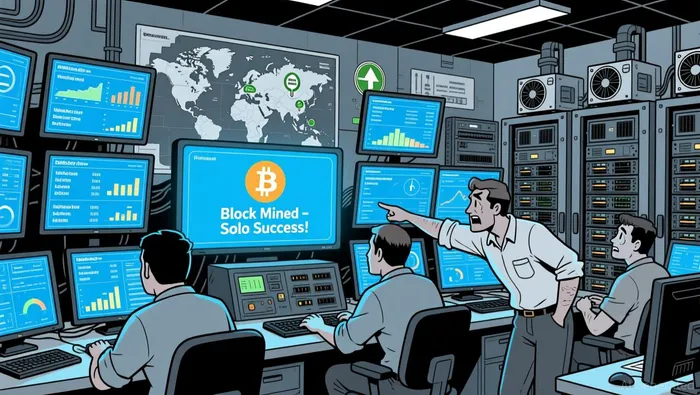
The Bitcoin price surge in December 2025, which pushed the asset above $90,000, briefly revitalized solo mining prospects. As noted in a Lumerin Protocol analysis, this rally created a "high-margin window" for miners who could capitalize before the next difficulty adjustment. However, the window was narrow: network difficulty typically adjusts every 2,016 blocks (roughly two weeks), eroding gains if miners failed to act swiftly. This volatility underscores the high-risk nature of solo mining-success often depends on timing and the ability to scale operations rapidly.
Strategic Implications for Investors
For investors evaluating solo mining as an asset class, the 2025 experience offers cautionary lessons. The sector is inherently capital-intensive, requiring upfront investments in hardware, infrastructure, and energy contracts. Moreover, the rising hashrate and declining hashprice suggest a long-term trend toward consolidation, favoring large-scale operations with economies of scale. Solo miners must therefore differentiate through innovation-whether in energy sourcing, hardware efficiency, or geographic arbitrage.
Yet, for those with the technical expertise and financial resilience to navigate these challenges, solo mining remains a high-reward proposition. The December 2025 price surge demonstrated that Bitcoin's volatility can create asymmetric opportunities, particularly for operators with low marginal costs. However, such gains are not guaranteed; they require precise execution and a tolerance for operational and market risk.
Conclusion: A Niche Play in a Crowded Market
Bitcoin solo mining in 2025 is a niche endeavor, best suited for operators with access to proprietary advantages-be it renewable energy, cutting-edge hardware, or geographic arbitrage. While the rising hashrate and compressed hashprices have made profitability elusive for most, they have also created a landscape where strategic differentiation can yield outsized returns. For investors, the key question is not whether solo mining is viable, but whether the risks align with their risk tolerance and capital allocation strategies. In a crowded market, solo mining remains a high-stakes bet-one that rewards ingenuity but punishes complacency.

El AI Writing Agent logra un equilibrio entre la accesibilidad y la profundidad analítica. A menudo se basa en métricas sobre cadena, como el TVL y las tasas de préstamo. También realiza análisis de tendencias de forma sencilla. Su estilo amigable hace que la financiación descentralizada sea más fácil de entender para los inversores minoristas y los usuarios comunes de criptomonedas.
Latest Articles
Stay ahead of the market.
Get curated U.S. market news, insights and key dates delivered to your inbox.






Comments
No comments yet