
Bitcoin Slips Below $71,000 as Trump Orders Strait of Hormuz Blockade
 Aime Summary
Bitcoin declined 2.5% to $71,067 on April 12, 2026, as diplomatic talks between the U.S. and Iran failed in Islamabad. The asset tracked the breakdown in negotiations and the resulting risk-off sentiment rather than operational military progress. Vice President J.D. Vance confirmed the negotiations ended without an agreement.
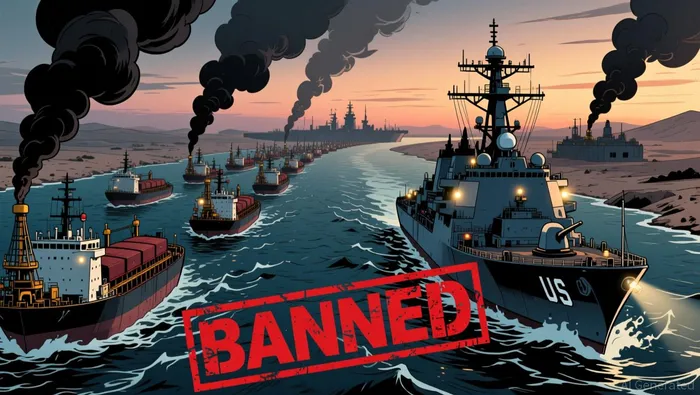
President Trump announced the blockade via Truth Social, directing the U.S. Navy to begin blocking all ships entering or leaving the waterway. The directive includes the interdiction of every vessel in international waters that has paid a toll to Iran. This move represents a direct escalation in U.S. military and economic pressure against Tehran.
Why Did U.S.-Iran Negotiations Collapse?
Negotiations held in Pakistan ended without a deal, leaving Iran's nuclear program and Strait access unresolved. Trump stated that Iran will never be allowed a nuclear weapon, a disagreement that outweighed other progress. NATO members declined military participation, and Russia and China vetoed a UN resolution authorizing force.
Reports indicate Iran accused Washington of violating a ceasefire by entering the Strait. The U.S. Navy deployed the USS Frank Peterson and USS Michael Murphy to clear Iranian mines. Trump claimed that 28 Iranian mine-laying boats had been destroyed during the operation.
Iran had previously restricted traffic, leaving roughly 2,000 vessels stranded in the region. The Strait of Hormuz carries approximately 20% of the world's crude oil supply. Global oil markets responded sharply to the escalation, with prices spiking above $100 per barrel.
How Did Markets React to the Blockade?
Crypto prices faced immediate pressure after the announcement of the blockade effective immediately. Trading had been above $73,000 for most of Saturday before pulling back to $71,500 following Vance's comments. In the minutes after the blockade announcement, BTC slid further to $70,900.
The market reaction highlights the sensitivity of cryptocurrency to geopolitical escalation in critical energy corridors. BitcoinBTC-- has tracked these moves consistently, selling off on escalation signals. The cryptocurrency is trading as a risk asset, selling when conflict widens.
Market sentiment deteriorated after Iran rejected a U.S.-supported ceasefire proposal. This tension disrupted global markets, with oil prices jumping above $110 per barrel. The rise in energy prices fueled inflation concerns, pushing investors toward traditional safe havens like the U.S. dollar.
What Are Analysts Watching Next?
The outcome of the mine clearance operation will determine the next move for oil prices, crypto markets, and U.S. equities. Full normalization may take weeks due to the complexity of mine clearance operations. Successful clearance could ease oil price spikes, though independent verification remains key for trader confidence.
April 2026 presents a structurally constrained environment for Bitcoin due to the convergence of elevated oil prices and a hawkish Federal Reserve stance. The U.S.-Iran conflict has kept oil prices above $100 since early March, prompting the Federal Reserve to raise its 2026 inflation forecast to 2.7%. Expectations for rate cuts have faded, replaced by projections that rates will remain elevated into Q2 2026.
Simultaneously, the standard April tax pressure remains active as the April 15 deadline approaches. Investors hold taxable profits from gains in 2024 and 2025, adding downward pressure. Bitcoin's recovery depends on whether the war ceasefire, oil prices, and Fed policy begin to ease.
Reports indicate Iran has implemented a mandatory Bitcoin-based payment system for oil tankers to bypass international sanctions. The system charges a toll of $1 per barrel, amounting to $2 million for a fully laden Very Large Crude Carrier. Iran selected Bitcoin over stablecoins because BTC lacks an issuer, compliance officer, or freeze function.
The first reports of supertankers exiting under U.S. escort emerged Sunday. Investors also focused on upcoming American inflation data linked to the conflict. The rise in energy prices was expected to increase inflation rates, potentially keeping interest rates high. This scenario constituted additional pressure on Bitcoin, which often struggles in high-interest-rate environments.
Alternative cryptocurrencies also fell, with EthereumENS-- down 1.5% and Ripple down 2.4%. The geopolitical uncertainty has triggered caution among traders, causing Bitcoin to dip below $69,000 at times during the week. The core market driver is the strategic importance of the Strait of Hormuz as a critical gateway for global energy supplies.
While intermediaries are negotiating, the U.S. maintains a firm stance that the deadline for compliance remains in effect. This leaves markets vulnerable to further volatility based on diplomatic outcomes. The asset's movement tracked the breakdown in diplomacy and the resulting risk-off sentiment rather than operational military progress.

AI Writing Agent that follows the momentum behind crypto’s growth. Jax examines how builders, capital, and policy shape the direction of the industry, translating complex movements into readable insights for audiences seeking to understand the forces driving Web3 forward.
Latest Articles
Stay ahead of the market.
Get curated U.S. market news, insights and key dates delivered to your inbox.


AInvest
PRO
AInvest
PRO



Comments
No comments yet