
Why Bitcoin's Skeptics Will Fail to Halt Its Long-Term Price Ascent to $10M and Beyond


 Aime Summary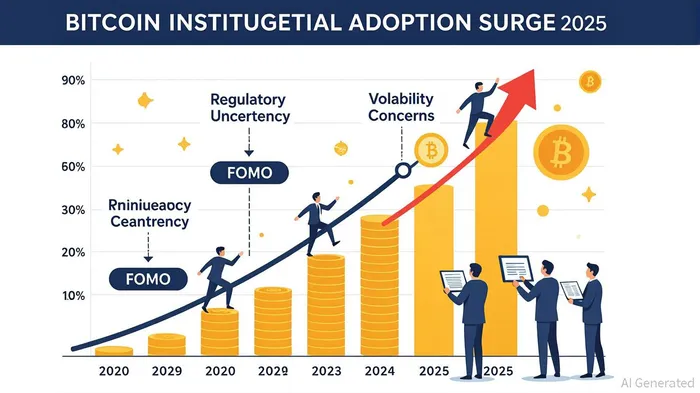
Bitcoin’s skeptics have long argued that psychological barriers and speculative hype will derail its long-term price trajectory. Yet, as 2025 unfolds, these obstacles are being systematically dismantled by institutional adoption, regulatory progress, and evolving consumer psychology. The cryptocurrency’s journey toward a $10 million price tag—and beyond—is not a speculative fantasy but a structural inevitability driven by forces that skeptics cannot contain.
Psychological Barriers: A Shifting Landscape
Bitcoin’s early critics often cited fear of missing out (FOMO) and volatility as existential risks. However, research reveals that personality traits like agreeableness and neuroticism amplify FOMO, making these barriers more about human behavior than technical flaws [1]. Institutional players have capitalized on this by fostering trust through sponsorships and transparent strategies, reducing resistance to BitcoinBTC-- as a legitimate asset class [4]. For instance, 59% of institutional portfolios now allocate at least 10% to digital assets, signaling a normalization of Bitcoin’s role in finance [2].
Regulatory clarity has further eroded skepticism. The approval of spot Bitcoin ETFs, such as BlackRock’s IBIT, and the U.S. BITCOIN Act have normalized Bitcoin’s integration into mainstream portfolios [1]. As use cases expand beyond trading—into decentralized finance (DeFi) and tokenized assets—Bitcoin is increasingly viewed as a strategic reserve asset, not a speculative gamble [6].
Real-World Adoption: From Hype to Infrastructure
Bitcoin’s adoption is no longer confined to retail traders. Over 1,000 institutions, including TeslaTSLA-- and Harvard, now hold Bitcoin, with MicroStrategy’s $72.7 billion BTC treasury setting a precedent for corporate adoption [1]. This shift is driven by macroeconomic realities: corporations are allocating retained earnings to Bitcoin to hedge against inflation, achieving compound annual growth rates (CAGRs) of 40–60% [1].
Technological advancements have also accelerated adoption. Blockchain infrastructure improvements, such as Solana’s 10,000 TPS capability and Hyperliquid’s $320 billion in monthly volume, enable seamless crypto transactions for enterprises [1]. Stablecoins like USD-1, backed by institutional reserves, have further facilitated Bitcoin’s use in cross-border payments and supply chain management [2].
Price Projections: A Confluence of Forces
While skeptics focus on short-term volatility, long-term projections are underpinned by structural demand. Bernstein analysts predict Bitcoin could reach $200,000 by 2025, driven by ETF inflows and institutional adoption [2]. CoinCodex and Fidelity forecast even higher prices, with averages of $1.1 million by 2040 and $1 billion by 2040, respectively [3]. These projections hinge on three factors:
1. Institutional Demand: 59% of institutional portfolios now include Bitcoin, with ETFs like BlackRock’s IBIT attracting $70 billion in inflows [1].
2. Macroeconomic Conditions: Bitcoin’s role as a hedge against inflation and geopolitical uncertainty is growing, particularly in markets like South Korea, where Bitplanet allocated $40 million to a Bitcoin treasury [4].
3. Supply Dynamics: The 2024 halving reduced block rewards by 50%, reinforcing Bitcoin’s scarcity and long-term price appreciation [3].
The Inevitability of $10M
Skeptics may point to retail caution—40% of Americans still fear Bitcoin’s volatility—but institutional leadership is reshaping the market. A “core-satellite” strategy, allocating 60–70% to Bitcoin and EthereumETH-- and 30–40% to high-beta altcoins, is now standard among institutional investors [2]. Meanwhile, on-chain metrics like the Exchange Whale Ratio hitting a 15-month high indicate Bitcoin is being held for long-term value [1].
Even as Bitcoin’s market dominance dips to 59% (from 64% in early 2025), reflecting capital flows into altcoins, its foundational role in the crypto ecosystem remains unchallenged [3]. The recent $501 million single-day ETF inflow underscores this resilience [2].
Conclusion
Bitcoin’s skeptics have underestimated the power of institutional adoption, regulatory clarity, and psychological shifts in perception. As corporations, sovereign wealth funds, and institutional investors continue to integrate Bitcoin into their portfolios, the cryptocurrency’s path to $10 million—and beyond—is not a question of if but when. The barriers that once seemed insurmountable are now being leveraged as tools for growth, ensuring Bitcoin’s place as a cornerstone of the global financial system.
**Source:[1] Bitcoin's Market Sentiment Drives Psychological Barriers ... [https://www.ainvest.com/news/bitcoin-market-sentiment-drives-psychological-barriers-institutional-adoption-2508/][2] The Acceleration of Bitcoin Adoption by Global Corporations [https://www.ainvest.com/news/acceleration-bitcoin-adoption-global-corporations-2025-institutional-investors-prioritize-exposure-companies-leading-crypto-payment-revolution-2508/][3] Bitcoin Price Prediction 2030 & 2040 (July 2024 Update) [https://www.swanbitcoin.com/economics/bitcoin-price-prediction/][4] Fostering trust and overcoming psychological resistance ... [https://onlinelibrary.wiley.com/doi/full/10.1002/mar.21889]

Decoding blockchain innovations and market trends with clarity and precision.
Latest Articles
Stay ahead of the market.
Get curated U.S. market news, insights and key dates delivered to your inbox.
AInvest
PRO
AInvest
PRO



Comments
No comments yet