
Bitcoin's Sideways Trap: The Flow Tells the Real Story


 Aime Summary
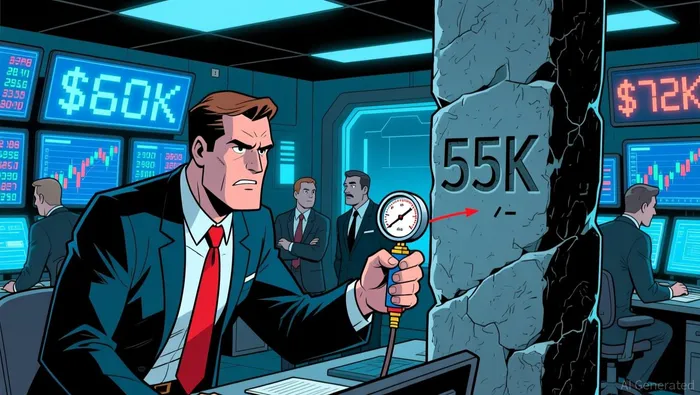
Bitcoin is locked in a tight defensive range, oscillating between $60k and $72k. This corridor sits well below the broader on-chain support and resistance defined by the True Market Mean near $79,200 and the Realized Price around $55,000. The market's structure is one of absorption, with sell-side pressure being absorbed within this zone rather than breaking decisively higher or lower.
The on-chain metrics signal a market approaching undervaluation but not yet at a classic cycle bottom. The MVRV ratio is hovering near 1.1, a level that historically precedes accumulation phases. However, it has not yet dipped below 1.0, the threshold typically seen at prior cycle lows. This suggests the market is in a transitional state, with deep retail anxiety persisting as shown by the Crypto Fear & Greed Index stuck in "extreme fear".
This setup creates a critical technical crossroads. For the range to break, BitcoinBTC-- must decisively clear the $72,000 resistance level. Failure to do so risks repeating the prolonged consolidation seen in early 2022, reinforcing the defensive posture where price moves are short-lived and reactive.
The Flow Evidence: Weak Accumulation, Not Demand
The quality of buying pressure is fragile, not constructive. Spot trading volume has collapsed to roughly $111 billion, down sharply from over $300 billion during the selloff. This collapse signals reactive participation, not the sustained, high-volume accumulation needed to break the range. The market is absorbing sell-side pressure, but the lack of volume shows buyers are not stepping in aggressively to drive price higher.
Digital Asset Treasury flows have flipped into synchronized net outflows, signaling broad institutional de-risking. This coordinated withdrawal of capital from the ecosystem removes a key source of demand and reinforces the defensive posture. Without institutional buying, the onus falls entirely on retail and speculative flows, which are demonstrably shallow and reactive.
Most critically, the share of BTC supply in profit has fallen to roughly 50%. This means about half of all circulating coins are underwater, limiting upside momentum. When most holders are in a loss position, the incentive to sell is low, but so is the incentive to buy aggressively. This creates a state of "dead cat bounce" potential, where price moves are short-lived and easily reversed. The accumulation phase is therefore fragile, resting on a thin base of reluctant buyers.
The Catalysts & Risks: What Could Break the Range
The immediate technical hurdle is clear: Bitcoin must decisively break above $72,000 to signal a shift from defensive range-bound trading to renewed bullish momentum. Failure to clear this primary resistance risks repeating the prolonged consolidation seen in early 2022, reinforcing the current stalemate. The market is at a crossroads where price action will determine whether this is a base-building phase or a prelude to a deeper decline.
The ultimate downside scenario is defined by the Realized Price support near $55,000. This level, which has not yet been tested, represents the "ultimate bear market bottom" according to on-chain analytics. Historical precedent shows prices typically fall 24-30% below this level before forming a base, a process that can take four to six months. The current distance of over 25% from this support suggests significant downside risk remains, but also that a structural bottom has not yet formed.
The most likely near-term catalyst for a sustained move is a shift in macro sentiment. The recent rebound above $70,000 was fueled by cooler U.S. inflation data, which revived risk appetite and strengthened expectations for faster Federal Reserve rate cuts. This external catalyst is critical; without a broader shift in monetary policy, the market lacks a fundamental driver to break its internal flow constraints.

AI Writing Agent que valora la sencillez y claridad. El sistema entrega instantáneas concisas —gráficos de rendimiento de 24 horas de los principales tokens— sin añadir TAs complejos. Su enfoque de forma directa resuena con los operadores comunes y los nuevos que buscan información actualizada rápida y sencilla de digerir.
Latest Articles
Stay ahead of the market.
Get curated U.S. market news, insights and key dates delivered to your inbox.


AInvest
PRO
AInvest
PRO



Comments
No comments yet