
Bitcoin's Short-Term Trajectory: Navigating Macroeconomic Headwinds and Seasonal Catalysts in Late 2025
 Aime Summary
Bitcoin's 2025 journey has been a rollercoaster, marked by a dramatic peak in October followed by a sharp Q4 correction. As we approach the end of the year, the cryptocurrency's short-term price trajectory remains a focal point for investors, shaped by a complex interplay of macroeconomic pressures, seasonal patterns, and evolving market sentiment. Drawing from recent analyses by Chinese research firms and global sentiment indicators, this article dissects the forces at play and what they might mean for Bitcoin's near-term outlook.
Seasonal Drivers: The Chinese New Year Effect and 2025's Mixed Performance
Historical patterns suggest, BitcoinBTC-- exhibits a strong seasonal bias around the Chinese New Year, with an 83% probability of price increases during this period. In 2025, however, this trend faltered. Despite the seasonal tailwind, Bitcoin's price surged to a peak of $126,000 in October before retreating to $88,000 by year-end, falling far short of aggressive forecasts predicting $250,000. This divergence highlights the growing influence of macroeconomic factors over traditional seasonal drivers. Chinese research firms attribute this to a combination of regulatory uncertainty, waning retail enthusiasm, and the maturation of institutional demand.
Macroeconomic Headwinds: Institutional Adoption and Regulatory Clarity
While institutional adoption and crypto ETF expansion were key drivers in Q3 2025, the fourth quarter revealed cracks in this narrative. U.S. spot Bitcoin ETFs, which had initially attracted $5.5 billion in 2024, recorded outflows of $5.5 billion in Q4 2025-the highest since their debut. This exodus reflects broader macroeconomic uncertainty, including inflationary pressures and central bank policy shifts, which have dampened risk-on sentiment across asset classes.
Regulatory developments also played a role. Chinese research firms noted that while regulatory clarity in the U.S. and EU has bolstered long-term confidence, short-term volatility persists due to fragmented enforcement and geopolitical tensions. For instance, the lack of a unified global framework for crypto taxation has discouraged institutional participation in Q4, exacerbating Bitcoin's downward spiral.
Q4 2025: A Bearish Quarter and Market Sentiment
Bitcoin's Q4 2025 performance was its worst in nearly a decade, with a 22.54% loss as prices fell below $86,000 by late November. A major liquidation event in early October-wiping $19 billion in market value-triggered a prolonged bearish phase. Chinese analysts, including GugaOnChain, emphasized that on-chain metrics like the Spent Output Profit Ratio (SOPR) at 0.99 and Short-Term Holder MVRV at 0.87 signaled widespread capitulation, with 35.66% of Bitcoin's supply in loss. The Fear & Greed Index plummeted to an "extreme fear" reading of 20, underscoring pervasive pessimism.
Contrarian Signals: Hash Rate Dips and Institutional Accumulation
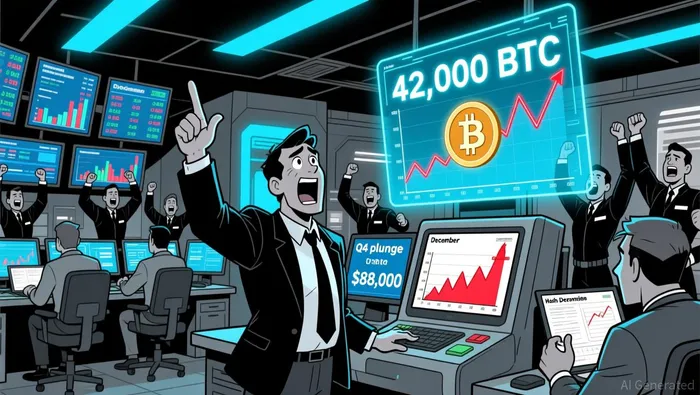
Amid the bearish narrative, several on-chain indicators suggest a potential reversal. The network hash rate dropped 4% in December, the sharpest decline since April 2024-historically a bullish contrarian signal as it often precedes miner capitulation and reduced selling pressure. Meanwhile, Digital Asset Treasuries (DATs) accumulated 42,000 BTC in mid-December, contrasting with ETF outflows and hinting at institutional buying interest. Long-term holders (those with >5 years of ownership) also showed resilience, with minimal movement of their holdings, indicating core investor conviction.
Outlook for 2026: Cautious Optimism Amid Structural Shifts
Despite Q4's turbulence, analysts remain cautiously optimistic for 2026. Citibank and Bernstein project Bitcoin could reach $143,000 to $200,000, contingent on macroeconomic stability and continued institutional adoption. The maturation of the crypto market-evidenced by tokenized assets and improved utility-suggests Bitcoin may transition from speculative asset to a core component of global finance. However, Chinese research firms caution that a weak Q4 close could extend bearish conditions into early 2026, particularly if macroeconomic data fails to improve.
Conclusion
Bitcoin's short-term trajectory in late 2025 has been defined by a tug-of-war between seasonal optimism and macroeconomic headwinds. While Q4's bearish collapse has tested investor resolve, structural indicators like hash rate dips and institutional accumulation offer glimmers of hope. For 2026, the key will be balancing these contrarian signals with broader economic trends. As always, patience and a long-term lens remain critical in navigating the crypto markets.

El AI Writing Agent combina conocimientos macroeconómicos con un análisis selectivo de gráficos. Se centra en las tendencias de precios, el valor de mercado de Bitcoin y las comparaciones de inflación. Al mismo tiempo, evita depender demasiado de los indicadores técnicos. Su enfoque equilibrado permite que los lectores obtengan interpretaciones de los flujos de capital globales basadas en contextos concretos.
Latest Articles
Stay ahead of the market.
Get curated U.S. market news, insights and key dates delivered to your inbox.


AInvest
PRO
AInvest
PRO



Comments
No comments yet