
Bitcoin's Short-Term Realized Price as a Critical Inflection Point: Investor Behavior and Market Resilience in a Volatile Regime


 Aime Summary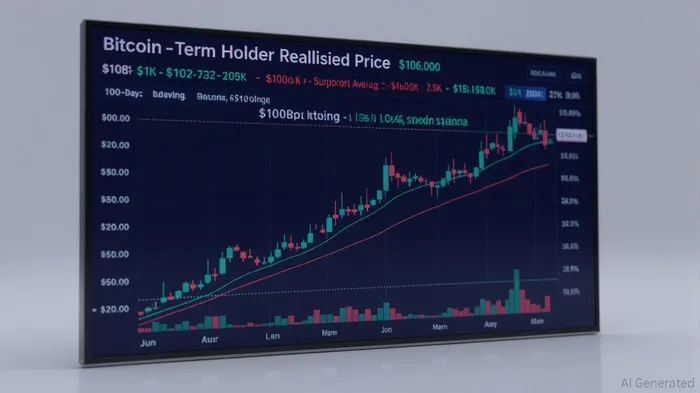
Bitcoin's Short-Term Holder (STH) Realized Price has emerged as a pivotal metric in August 2025, reflecting the interplay between investor psychology, institutional activity, and technical dynamics. At $106,000, this level not only acts as a dynamic support but also serves as a barometer for market resilience in a volatile regime. The alignment of the STH Realized Price with the $100K–$107K critical support zone—where the 200-day simple moving average converges—signals a battleground for bulls and bears. This confluence of technical and behavioral indicators underscores the importance of understanding investor behavior and institutional positioning to navigate the current market environment.
Investor Behavior: Weak Hands vs. Strong Hands
On-chain data reveals a nuanced picture of investor sentiment. Short-term holders with positions under one month are currently facing 3.5% unrealized losses, while those holding for one to six months remain profitable at 4.5%. This divergence highlights a key dynamic: newer, speculative investors are more likely to sell during dips, while more established holders act as liquidity absorbers. The transfer of coins from “weak hands” to “strong hands” typically reinforces support levels, as seen in the $100K–$107K zone. This self-reinforcing mechanism suggests that the market may stabilize if institutional buyers and patient investors continue to accumulate during pullbacks.
However, a breakdown below $106,000 could trigger a cascade of selling pressure, targeting the $92K–$93K support level. This scenario would test the resolve of retail investors and expose vulnerabilities in the bull cycle. Yet, institutional buyers such as MicroStrategy and ETF inflows—reportedly $219 million weekly—provide a counterbalance. These entities act as stabilizers, absorbing dips and reinforcing the structural integrity of Bitcoin's price action.
Institutional Buying: A Structural Tailwind
Institutional activity has been a defining feature of Bitcoin's 2025 bull cycle. Corporate treasuries, including Bitmine Immersion's $7.5 billion EthereumETH-- allocation and Harvard's $120 million IBIT investment, signal a shift toward treating crypto as a strategic reserve asset. Meanwhile, financial institutionsFISI-- like JPMorganJPM-- and DeFiance Capital have accumulated $584 million in Ethereum at lower price levels, indicating selective buying ahead of a potential Q4 rebound.
The role of U.S. BitcoinBTC-- ETFs, which now control 6.8% of the circulating supply, cannot be overstated. Regulatory tailwinds—such as the OCC's approval for banks to custody crypto and the SEC's crypto-friendly stance under Chair Paul S. Atkins—have further legitimized Bitcoin as a mainstream asset. These developments have attracted $414 billion in institutional investments by mid-2025, creating a more resilient financial ecosystem.
Technical Indicators: A Mixed Signal
Bitcoin's technical structure presents a tug-of-war between bearish momentum and institutional accumulation. The RSI at 62.3 and ADX at 18.81 suggest a lack of directional clarity, while the MACD shows negative momentum. However, the 20-week EMA at $108,000 remains a critical support level, historically acting as a rebound point during bear market bottoms. The NVT ratio at 1.51—well below the speculative threshold of 2.2—indicates that Bitcoin's valuation is increasingly driven by real transactional value rather than hype.
The price action around the $110K–$112K range is particularly telling. A sustained breakdown could trigger a test of the $100K psychological level, while a rebound above $113,500 would validate a bullish flag pattern. On-chain metrics like the 100-day EMA ($110,798) and Fibonacci retracement levels further underscore the tension between short-term bearish pressure and long-term bullish positioning.
Strategic Implications for Investors
For near-term positioning, investors must balance risk management with strategic accumulation. Key considerations include:
1. Monitoring Support Levels: A break below $106,000 warrants caution, but institutional inflows and ETF activity could limit downside. Stop-loss orders just below $100K are advisable.
2. Dollar-Cost Averaging: Accumulating Bitcoin within the $100K–$107K range leverages institutional buying zones while mitigating volatility risk.
3. Derivatives for Hedging: Long-term investors can use futures and options to hedge against short-term corrections while maintaining exposure.
4. On-Chain Metrics: Tracking Apparent Demand and exchange outflows (which have remained persistently negative since February 2024) provides early signals of investor retention.
Conclusion: A Maturing Bull Cycle
The convergence of STH Realized Price, institutional buying, and technical indicators paints a picture of a market in transition. While volatility remains a near-term risk, the structural underpinnings of Bitcoin's bull cycle—driven by institutional adoption, regulatory clarity, and on-chain resilience—are intact. For long-term investors, the $100K–$107K zone represents a strategic opportunity to capitalize on a maturing market, provided risk is managed with discipline. As the interplay between behavioral and technical forces continues to shape Bitcoin's trajectory, patience and adaptability will be key to navigating the next phase of this cycle.

Decoding blockchain innovations and market trends with clarity and precision.
Latest Articles
Stay ahead of the market.
Get curated U.S. market news, insights and key dates delivered to your inbox.
AInvest
PRO
AInvest
PRO



Comments
No comments yet