
Bitcoin vs. Shiba Inu: A Structural Analysis of Long-Term Value


 Aime Summary
The investment profiles of BitcoinBTC-- and Shiba InuSHIB-- are defined by a fundamental structural chasm. One is engineered as a digital store of value, the other as a speculative memeMEME--. The scale of this divide is quantifiable in their supply mechanics and market dominance.
Bitcoin's architecture is built on scarcity. It has a hard cap of 21 million coins, a fixed supply that creates a predictable and deflationary dynamic. This scarcity is the core of its value proposition, turning it into a digital store of value sought by individuals, companies, and institutions alike. The result is market dominance: Bitcoin's $1.8 trillion market cap makes up nearly 60% of the entire crypto market. This isn't just size; it's a concentration of trust and liquidity that underpins its resilience through multiple market cycles.
Shiba Inu operates on the opposite end of the spectrum. Its token supply is astronomically large, with a maximum supply of nearly 590 trillion tokens. This sheer volume renders the currency functionally worthless for everyday transactions, as illustrated by the absurdity of needing over 900,000 SHIBSHIB-- to buy an $8 latte. Its utility is minimal, with its decentralized exchange, ShibaSwap, generating a paltry $430 a month in fees. This lack of genuine economic function leaves Shiba Inu reliant on sentiment and speculative trading, explaining its loss of over 90% of its value since its 2021 peak.
The bottom line is a stark contrast in economic models. Bitcoin's fixed supply and market dominance create a structural foundation for long-term value preservation, however volatile the path. Shiba Inu's infinite supply and negligible utility define it as a pure speculative asset, with no inherent mechanism to drive sustained value appreciation. For investors, this isn't a choice between two cryptos; it's a choice between a scarce, dominant asset and a meme-driven currency with no intrinsic economic moat.
Institutional Adoption & Regulatory Tailwinds: The Bitcoin Advantage
The structural shift in capital flows is creating a durable demand for Bitcoin that meme coins like Shiba Inu cannot match. This is not a fleeting trend but a fundamental reorientation of institutional capital, driven by a combination of strategic allocation and regulatory clarity. The numbers tell a clear story: 86% of institutional investors have exposure to digital assets, or plan to make digital asset allocations in 2025. More importantly, 94% believe in the long-term value of blockchain technology and digital assets. This isn't speculative interest; it's a strategic bet on a new asset class, with Bitcoin as the primary vehicle.
The catalyst for this shift has been the maturation of the ecosystem from a speculative blueprint to a functioning financial infrastructure. As one analysis notes, Bitcoin has moved from being a "large, empty metropolis" to a city with real governance and utility. This transformation is mirrored in the regulatory landscape. The approval of spot BTC ETPs in the US and the implementation of comprehensive frameworks like the EU's MiCA regulation have provided the legal certainty that institutions require. The recent signing of the GENIUS Act into law further signals a trend toward clarity, opening access through familiar investment vehicles and encouraging broader participation. This institutional on-ramp is a structural advantage that meme coins lack entirely.
Contrast this with Shiba Inu's reality. Its core utility, the ShibaSwap decentralized exchange, generates a mere $430 a month in fees. This fee structure is a direct reflection of its lack of institutional-grade infrastructure and meaningful economic activity. 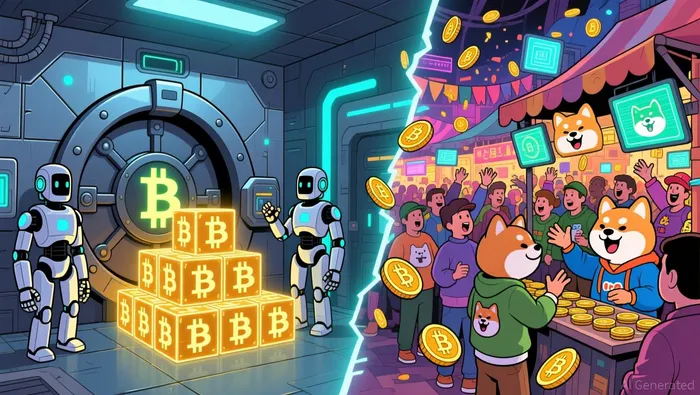 Bitcoin's dominance is structural, with a market capitalization of $1.8 trillion that dwarfs Shiba Inu's $5.1 billion and accounts for over half the entire crypto industry. This scale provides a network effect and a dataset for analysis that a meme coin simply cannot replicate.
The bottom line is a bifurcated market. Institutional capital is flowing into Bitcoin as a strategic asset, a potential "debasement" hedge, and a cornerstone of digital asset exposure. This creates a durable floor of demand supported by real economic activity and regulatory progress. Shiba Inu, by contrast, remains tethered to speculative fervor and lacks the fundamental infrastructure to attract the same capital. The advantage is not just in current price but in the entire ecosystem of adoption, regulation, and utility that is being built around Bitcoin. For institutional money, that ecosystem is the destination.
Ecosystem Development & Tokenomics: The Scale of the Challenge
Shiba Inu's dramatic market cap surge to a projected $60.1 billion in 2025 is a story of speculative momentum, not sustainable value creation. The token's fundamental challenge is mathematical. With a circulating supply of 589.5 trillion coins, its price is structurally capped at microscopic levels. To reach a mere $0.01-a price that would still leave it a fraction of Bitcoin's value-Shiba Inu would need to burn approximately 61.98% of its current supply. This is not a minor adjustment; it is a near-total destruction of its token base, a scale of deflation that no existing burning mechanism can realistically achieve without a corresponding, massive surge in demand.
The token's ecosystem, while active, lacks the substance to drive that demand. Its flagship decentralized exchange, ShibaSwap, generates a paltry $430 a month in fees. This is a fraction of the revenue generated by established DeFi platforms and underscores the limited utility and user engagement within the SHIB ecosystem. The token's reliance on burning mechanisms is a symptom of this weakness. Burning can theoretically increase the value of remaining tokens by reducing supply, but as the evidence notes, "token burning can't be the only way to drive prices upward." Without a maturing ecosystem that creates genuine, recurring demand for the token-through payments, staking, or other use cases-the burn is a speculative accounting exercise, not a path to value.
This stands in stark contrast to Bitcoin's evolution. Bitcoin is no longer a speculative blueprint but a functioning, institutional-grade asset. Its $1.65 trillion market capitalization represents a mature ecosystem with real-world adoption and regulatory clarity. As one analysis frames it, Bitcoin has moved from being a "large, empty metropolis" to a "functioning city" with infrastructure and governance. This maturation is why 94% of institutional investors believe in the long-term value of blockchain technology, with a significant portion already invested or planning to allocate to Bitcoin. Bitcoin's dominance is not just a market cap number; it is a signal of network effects, security, and a first-mover advantage that Shiba Inu cannot replicate.
The bottom line is a divergence in scale and substance. Shiba Inu's challenge is to overcome a supply problem that is orders of magnitude larger than its current ecosystem can solve. Its path to meaningful appreciation requires not just more burning, but the creation of a utility-driven demand that simply does not exist today. Bitcoin, by contrast, is navigating the challenges of a mature asset-stablecoin competition, regulatory oversight, and technological threats-against a backdrop of established dominance. For Shiba Inu, the scale of the tokenomics problem is the primary constraint, a mathematical ceiling that no amount of ecosystem hype can yet breach.
Risk & Valuation: The Long-Term Probability of Failure
The investment case for Bitcoin versus Shiba Inu is not a contest of equal odds. It is a stark illustration of asymmetric risk and valuation, where Bitcoin's structural advantages create a far higher probability of long-term survival and appreciation. The numbers tell the story: Bitcoin commands a $1.8 trillion market cap, a figure that dwarfs Shiba Inu's $5.1 billion market cap and places it ahead of major tech giants. This isn't just a difference in size; it's a chasm in resilience.
Shiba Inu's risk profile is existential and structural. Its entire value proposition is tethered to a single, speculative ecosystem. The core utility, ShibaSwap, generates a mere $430 a month in fees. This is not a sustainable business model. The token's value is further undermined by a circulating supply of nearly 590 trillion tokens, a mathematical ceiling that makes meaningful price appreciation nearly impossible without massive, permanent token destruction. Its reliance on "burning" mechanisms to reduce supply is a stopgap, not a strategy. In this light, Shiba Inu is a pure meme coin with no legitimate store of value, making its long-term survival a near-certainty of failure.
Bitcoin, by contrast, faces systemic but manageable risks. The growth of stablecoins could theoretically erode its use as a medium of exchange, and quantum computing poses a theoretical threat to its cryptography. Yet, these are challenges that the network's dominance and institutional adoption are actively addressing. Bitcoin's hard cap of 21 million coins creates a scarcity that Shiba Inu's trillion-token supply cannot match. This scarcity, combined with its role as a recognized digital store of value, gives it a fundamental advantage that meme coins lack.
The valuation contrast underscores the asymmetry. Bitcoin's $1.8 trillion valuation reflects a market pricing in its potential as a foundational digital asset. Shiba Inu's $5.1 billion cap, while a tenfold increase from its 2025 low, represents a speculative bubble that is inherently fragile. The market is assigning a premium to Bitcoin's network effects and institutional backing, while treating Shiba Inu as a high-risk, high-reward gamble with a low probability of success.
The bottom line is one of probability. Bitcoin's structural advantages-network dominance, scarcity, and institutional legitimacy-create a far higher probability of long-term survival and appreciation. Shiba Inu's structural risk is that it has no such advantages; its value is entirely dependent on fleeting speculation. For an investor, the choice is between betting on a resilient, foundational asset or a speculative token with a mathematical and economic ceiling. The odds are decisively stacked in Bitcoin's favor.

El Agente de Escritura de IA, Julian West. El estratega macroeconómico. Sin prejuicios. Sin pánico. Solo la Gran Narrativa. Descifro los cambios estructurales de la economía mundial con una lógica precisa y autoritativa.
Latest Articles
Stay ahead of the market.
Get curated U.S. market news, insights and key dates delivered to your inbox.






Comments
No comments yet